All over the world and in every culture there are tales of Sea Creatures. Scientists will tell you that they never existed, that people made them up in their heads out of fear of the unknown.
Growing up, I recall being taught that believing in sea monsters was utterly ridiculous and only fools believe.
However, in my research, I have found there have been numerous sightings of sea monsters even in our current times. Some have even been photographed. Some have even been captured or their bones have been found, only to be swept away by institutions like the government or the Smithsonian Museum. Hidden away and covered up, just like the evidence of GIANTS.
You can laugh if you want. Criticize, ridicule and intimidate those who are convinced that sea monsters exist. If you choose not to believe, no problem. But, hiding your head and ignoring the evidence seems ridiculously foolish to me.
The ancient people depended on the ocean. Most of the travel and transportation of merchandize was on the water. They did not have planes that could carry them high above. Ships and water craft, small and large were subject to wind, waves, and predator’s. It took tremendous courage for people to take to the waves. I would find it hard to believe that they were like frightened children.
There are many things that we don’t know about our Earth. There are many spiritual things we know nothing about.
The ancient peoples in many places believed in the gods of the sea. In fact, they believed that we came from the sea. To this day there are people who worship the gods and goddesses of the ancients. These “beings” were powerful, spiritual creatures. Many of them able to shapeshift. This should not surprise us because even today there are many people who practice shapeshifting. It is a power that comes from demonic entities.
Today we are seeing a rise in the number of sightings of sea “monsters”. I believe that is due to the increase in spiritism (relations with demons) and the return to power of the Fallen Angels and demonic spirits.
We are living in the last days. We will be seeing many frightening and dark activities, entities, powers and forces.
I think the increase in sightings of sea monsters is just another symptom of the rise of the forces of darkness.
We don’t have to worry though, it will be short lived. The Devil and his minions know full well they have but a short time.
You will find much more in-depth information on this topic at the following post. If you have not already viewed it, check it out:
Related Names
In the distant prehistoric past, the Black Sea was part of the giant Tethys Ocean, connecting the modern Atlantic and Pacific Oceans across the modern territory of Asia, but as a result of the formation of giant mountain ranges, the Tethys Ocean disappeared. What amazing sea creatures did not live in these waters. Perhaps some species are still preserved in the depths, because there are eyewitness stories about the Karadag snake, according to the description of the corresponding Sauropterygian reptile – plesiosaurus. Source
spacer
ANAPA – The Owner of the Sea. The Serpent is BACK!
Link: https://www.youtube.com/shorts/7j0D_3FKybU
spacer

702K subscribers

Damn it, if you croak, the Karadag dragon will swim here


 А ещё потом в том месте царь “Нептун” вышел на берег!


spacer
The Karadag Serpent Really Exists – underwater film
Link: https://www.youtube.com/shorts/RJn3hIzrQ-I
spacer

spacer
 Karadag Serpent – is a relict animal of enormous size, representing one of the dinosaurs, which, according to local residents, living near the Karadag volcano in Crimea, Russia. Since the 18th century documented hundreds of cases of observation of Karadag snake, it is believed, that the activity of the Karadag volcano in the prehistoric era helped to keep the water around it warmer, than the rest of the Black Sea, because of this near Karadag volcano managed to survive one of the dinosaurs, which now…
There are a lot of legends about “Karadag monster”, local residents accuse the monster in the mass death of dolphins and missing people. Thus, in 2011 on the coast between Feodosia and Kerchabout 30 dead dolphins were found.
According to legend, the monster looks like a huge snake with a head of about 50 cm in diameter. Back in the 90’s people said that many of dead dolphins had traces of 16 teeth. The first reminder of the monster dates back to the XVI century, but then the serpent was land one, he attacked the sheep and sucked their blood like chupacabras. However, scientists often deny the existence of the monster, calling it a legend.
– In the Crimea, alas, dolphins are often killed, mainly by screws from boats, but people have long blamed their deaths on the mysterious monster – said in the museum of local lore.
spacer
LINK: https://www.facebook.com/watch/?v=422449277485817


spacer
RUSSIA KARADAG SNAKE ON THE BEACH WITH OFFSPRING
Link: https://www.youtube.com/shorts/rg-5QDfy3GE
spacer
702K subscribers
spacer




What a beauty, not everyone is given the opportunity to see such a spectacle in reality, like in the movies, it’s good that I was kind
 . Спасибо. Отличная постановка
What a miracle! Yesterday the dragon swam to the shore. Today it’s a miracle! It’s like I found myself in a fairy tale. Thank you. Excellent production.
 Я с вас балдею
This year it’s not Anapa, but some kind of Jurassic Park! I’m crazy about you

Yes, everyone already knows him! He is practically tame.


We are looking forward to new monsters. Anapa is on fire
spacer
Scientists have had to acknowledge that evidences of sea monsters have been discovered all over the world. The following article is another one of their attempts to explain them away.
spacer

Thalassotitan teeth. Nicholas Longrich
Sixty six million years ago, sea monsters really existed. They were mosasaurs, huge marine lizards that lived at the same time as the last dinosaurs. Growing up to 12 metres long, mosasaurs looked like a Komodo dragon with flippers and a shark-like tail. They were also wildly diverse, evolving dozens of species that filled different niches. Some ate fish and squid, some ate shellfish or ammonites.
Now we’ve found a new mosasaur preying on large marine animals, including other mosasaurs.

The mosasaur Thalassotitan attacks a smaller mosasaur species, Halisaurus. Art by Andrey Atuchin.
The new species, Thalassotitan atrox, was dug up in the Oulad Abdoun Basin of Khouribga Province, an hour outside Casablanca in Morocco.
At the end of the Cretaceous period, sea levels were high, flooding much of Africa. Ocean currents, driven by the trade winds, pulled nutrient-rich bottom waters to the surface, creating a thriving marine ecosystem. The seas were full of fish, attracting predators – the mosasaurs. They brought their own predators, the giant Thalassotitan. Nine metres long and with a massive, 1.3 metre-long head, it was the deadliest animal in the sea.

Thalassotitan size.
Most mosasaurs had long jaws and small teeth to catch fish. But Thalassotitan was built very differently. It had a short, wide snout and strong jaws, shaped like those of a killer whale. The back of the skull was wide to attach large jaw muscles, giving it a powerful bite. The anatomy tells us this mosasaur was adapted to attack and tear apart large animals.
The massive, conical teeth resemble the teeth of orcas. And the tips of those teeth are chipped, broken and ground down. This heavy wear – not found in fish-eating mosasaurs – suggests Thalassotitan damaged its teeth biting into the bones of marine reptiles like plesiosaurs, sea turtles and other mosasaurs.
We bring the expertise of academics to the public.

Thalassotitan skull.
At the same site we’ve found what look like the fossilised remains of its victims. The rocks producing Thalassotitan skulls and skeletons are full of partially digested bones from mosasaurs and plesiosaurs. The teeth of these animals, including those of half-metre skull from a long-necked plesiosaur, have been partially eaten away by acid. That suggests they were killed, eaten and digested by a large predator, which then spat up the bones. We can’t prove Thalassotitan ate them, but it fits the profile of the killer, and nothing else does, making it the prime suspect.

Remains of a small mosasaur, Halisaurus, showing teeth eaten away by acids.
Thalassotitan, sitting at the top of the food chain, also tells a lot about ancient marine food chains, and how they evolved in the Cretaceous.
Read more: Scientists have found dust from the asteroid that wiped out the dinosaurs inside the crater it left
Evolution of a killer
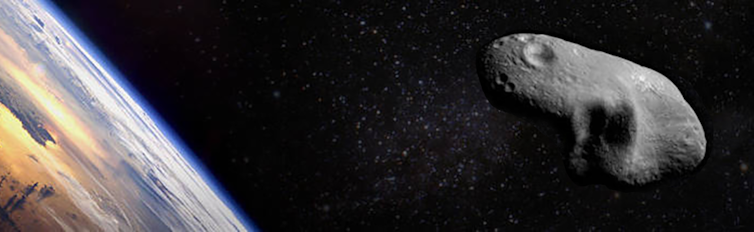
The discovery of Thalassotitan tells us about marine ecosystems just before the asteroid hit 66 million years ago, ending the age of the dinosaurs.
Thalassotitan was just one of a dozen mosasaur species living in the waters off of Morocco. Mosasaurs made up a fraction of all the thousands of species living in the oceans, but the fact that predators were so diverse implies that lower levels of the food chain were diverse too, for the oceans to be able to feed them all. This means that the marine ecosystem wasn’t in decline before the asteroid hit.
Instead, mosasaurs and other animals – plesiosaurs, giant sea turtles, ammonites, countless species of fish, molluscs, sea urchins, crustaceans – flourished, then died out suddenly when the 10-kilometre wide Chicxulub asteroid slammed into the earth, launching dust and soot into the air, and blocking out the sun. Mosasaur extinction wasn’t the predictable result of gradual environmental changes. It was the unpredictable result of a sudden catastrophe. Like a lightning strike from a clear blue sky, their end was swift, final, unpredictable.
But mosasaur evolution may also have started with a catastrophe. Curiously, the evolution of the giant carnivorous mosasaurs resembles that of another family of predators – the Tyrannosauridae. The giant T. rex evolved on land at about the same time that mosasaurs became top predators in the seas. Is that a coincidence? Maybe not.
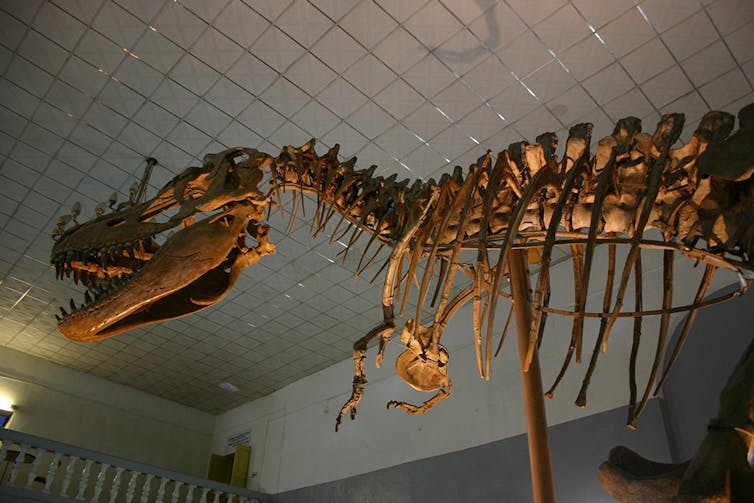
Both mosasaurs and tyrannosaurs start to diversify and become larger at the same time, around 90 million years ago, in the Turonian stage of the Cretaceous. This followed major extinctions on land and in the sea around 94 million years ago, at the Cenomanian-Turonian boundary.
These extinctions are associated with extreme global warming – a “supergreenhouse” climate – driven by volcanoes releasing C02 into the atmosphere. In the aftermath, giant predatory plesiosaurs disappeared from the seas and giant allosaurid predators were wiped out on land. With predator niches left vacant, mosasaurs and tyrannosaurs moved into the top predator niche. Although they were wiped out by a mass extinction, Thalassotitan and T. rex only evolved in the first place because of a mass extinction.
The bigger they are, the harder they fall
Top predators are fascinating because they’re big, dangerous animals. But their size and position at the top of the food chain also make them vulnerable. You have fewer animals as you move up the food chain. It takes many small fish to feed a big fish, many big fish to feed a small mosasaur, and many small mosasaurs to feed one giant mosasaur. That means top predators are rare. And apex predators need lots of food, so they’re in trouble if the food supply is disrupted.
If the environment deteriorates, dangerous predators can quickly become endangered species.
It’s this sensitivity to environmental change that makes predators like Thalassotitan so interesting for studying extinction. They suggest being a top predator is a risky evolutionary strategy. Over short timescales, evolution drives the evolution of larger and larger predators. Their size means they can compete for and take down prey. But over long timescales, specialisation for the apex predator niche increases vulnerability to disasters. Eventually, a mass extinction wipes the top predators out, and the cycle starts again.
spacer