There has been a lot of commotion lately about nuclear war and the threat of it. Everyone is thinking about the costs of nuclear war. Certainly, everyone is holding fast to HOPE.
There was a story in the news today about the folks who were living downwind of the test area of the first atomic bomb. Apparently, they are getting some response to their cries for justice. It only took 80 years!! Why now?
This post is about the bell that was delivered to the people of Nagasaki who were the target of the “FAT BOMB” dropped on Japan in 1945.
There are a lot of aspects to this story. A lot of players. A lot of agendas. A lot of mystery. A lot of propaganda. As usual, I will leave it to the reader to come to their own conclusions. My job is to search out the truth and pass it on.
I hope you find the information enlightening and that it inspires you to NEVER take the news at face value. Always dig for the deeper truths. We are living in the age of deception.
spacer


spacer
Nagasaki etymology
Etymology, Meaning, and Origin of “Nagasaki”:
Etymology:
The name “Nagasaki” comes from a Japanese phrase meaning “long promontory”.
promontory(n.) |
Meaning and Origin:
The name was first used in the 16th century to refer to a small fishing village located on a long, narrow peninsula. The peninsula was home to a natural harbor, which made it a strategic location for trade and commerce.
History:
-
- 1571: Portuguese traders arrived in Nagasaki and established a trading post.
- 16th-17th centuries: Nagasaki became a major center for trade with China, Korea, and other Asian countries.
- 1639: The Portuguese were expelled from Japan, and Nagasaki became the only port in the country open to foreign trade.
- 19th century: Nagasaki played a significant role in the modernization of Japan. Shipyards, factories, and shipbuilding facilities were established in the city.
- 1945: Nagasaki was the second city to be targeted by an atomic bomb during World War II, resulting in the deaths of hundreds of thousands of people.
Current Usage:
Today, Nagasaki is a major city on the island of Kyushu, Japan. It is known for its historical significance, beautiful scenery, and vibrant culture.
spacer

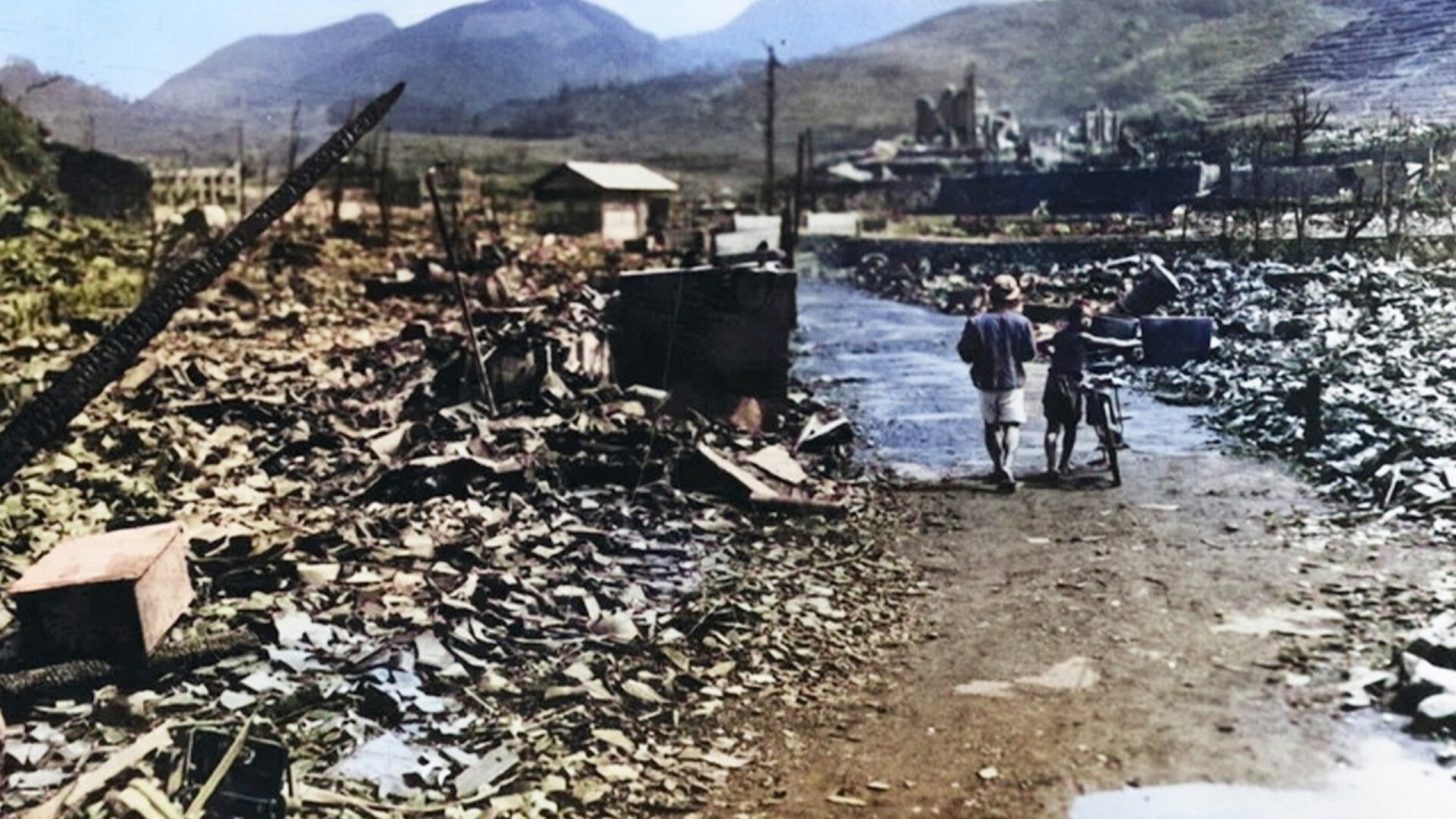
NAGASKI GROUND ZERO BEFORE AND AFTER THE BOMBING – Source: United States Army
spacer
Urakami in Japanese Kanji(Hiragana) :
浦上 (うらかみ)
Meaning :
浦 meaning bay, creek, inlet, gulf, beach, seacoast./ 上 meaning above, up.
spacer
Immaculate Conception Cathedral, Nagasaki Church in Nagasaki, Japan
The Immaculate Conception Cathedral[1] (無原罪の聖母司教座聖堂), also St. Mary’s Cathedral,[2][3] and often known as Urakami Cathedral (浦上天主堂, Urakami Tenshudō; Japanese pronunciation: [ɯ.ɾa.ka.mʲi | teɰ̃.ɕɯ.doː][4]) after its location Urakami, is a Roman Catholic cathedral located in Motoomachi, Nagasaki, Japan.
History
 |
The name Agnes
Gender: Feminine
Usage: English, German, Dutch, Swedish, Norwegian, Danish, Icelandic, Estonian, Late Greek (Latinized)
Scripts: Ἅγνη(Ancient Greek)
Meaning & HistoryLatinized form of the Greek name Ἅγνη(Hagne), derived from Greek ἁγνός(hagnos) meaning “chaste”. Saint Agnes was a virgin martyred during the persecutions of the Roman emperor Diocletian. The name became associated with Latin agnus“lamb”, resulting in the saint’s frequent depiction with a lamb by her side. Due to her renown, the name became common in Christian Europe.
As an English name it was highly popular from the Middle Ages until the 17th century. It was revived in the 19th century and was common into the 20th, but it fell into decline after the 1930s. It last appeared on the American top 1000 rankings in 1972. source St. AgnesSt. Agnes (flourished 4th century, Rome [Italy]; feast day January 21) was a virgin andpatron saintof girls, who is one of the most-celebrated Roman martyrs. According to tradition, Agnes was a beautiful girl, about 12 or 13 years old, who refused marriage, stating that she could have no spouse but Jesus Christ. Her suitors revealed her Christianity, which was then condemned as a cult, and in punishment she was exposed in a brothel. Awed by her purity and presence, all but one of the Roman youths left her untouched; in his attempt to violate her, the sole attacker was miraculously struck blind, whereupon Agnes healed him with prayer. Later, after refusing to renounce her faith, she was murdered during the persecution of the Christians by the Roman emperor Diocletian and was buried beside the Via Nomentana. source QUOTE: She famously said, “He is my spouse whom the angels serve, whose beauty the sun and moon admire, and by whose gifts virgins are crowned.” Traditions and HonorsSt. Agnes’s feast day is celebrated on January 21. A unique tradition associated with her involves the blessing of two lambs at the Church of St. Agnes in Rome. These lambs’ wool is woven into pallia, which are ceremonial stoles symbolizing the authority and pastoral mission of archbishops. The pallia are placed on the main altar of St. Peter’s Basilica on the feast of Sts. Peter and Paul and later bestowed upon the archbishops by the pope. Patronage and LegacySt. Agnes is the patron saint of young girls, chastity, and victims of sexual assault. Her story has inspired countless works of art, including paintings by Domenichino and sculptures by Giovanni Lorenzo Bernini. She is often depicted with a lamb, symbolizing her name and her pure devotion to Christ, as well as a palm branch, signifying her martyrdom. source. |
spacer
Atomic bombed Agnes of Urakami, displayed at United Nations Headquarters

Pic from – https://commons.wikimedia.org/wiki/File:Statue_of_St._Agnes,_UN_headquarters,_New_York.jpg
|
About the Nagasaki bombing The atomic bomb that fell on Nagasaki on August 9, 1945,detonated in Urakami only 500 m (1640 ft) from the cathedral, completely destroying it. As the Feast of the Assumption of Mary (August 15) was near, Mass was held on the day and was well attended. The resultant collapse and heat-wave cindered and buried all those present in the cathedral. The destruction of the cathedral hit the religious community of Nagasaki the hardest, as they viewed it as a loss of spirituality.
|
spacer

In 1865, the French priest Bernard Petitjean discovered that almost all the Urakami villagers were Christian. Even then Christianity was forbidden still for the locals, those rediscovered Kakure Kirishitan (Hidden Christians) were persecuted by the then central governments respectively. Between 1869 and 1873, over 3,600 villagers were banished to exile by the newly installed government. During their exile, 650 died. The persecuted came back to their home village after 7 years exile in 1873, and decided to construct their own church.
Construction of the original Urakami Cathedral, a brick Neo-Romanesque building, began in 1895, after a long-standing ban on Christianity was lifted. They purchased the land of the village chief where the humiliating interrogations had taken place for two centuries. The annual “fumi-e” interrogations required those present to tread upon an icon of the Virgin Mary or Jesus. They thought the place was appropriate considering their memory of the long persecution. Construction of the building was started by Father Francine and was completed under the direction of Father Regani. The frontal twin spires stood 64 meters high were constructed in 1875. When completed in 1925 (Taishō 14), until its destruction in 1945, it was the largest Christian structure in the Asia-Pacific region.[5]
The atomic bomb that fell on Nagasaki on August 9, 1945, detonated in Urakami only 500 m (1640 ft) from the cathedral, completely destroying it. As the Feast of the Assumption of Mary (August 15) was near, Mass was held on the day and was well attended. The resultant collapse and heat-wave cindered and buried all those present in the cathedral.[6] The destruction of the cathedral hit the religious community of Nagasaki the hardest, as they viewed it as a loss of spirituality. It had such an impact, that noted playwright Tanaka Chikao wrote his most successful play, Head of Mary, about the efforts of Christians in Nagasaki to reconstitute their faith by rebuilding the Virgin Mary.[citation needed]
The plans to replace the cathedral led to a prolonged debate between the city government and the congregation. The city government had suggested preserving the destroyed cathedral as a heritage site, and offered an alternate site for a new church. However, Christians in Nagasaki strongly wanted to rebuild their cathedral on the original site, as a symbol of their persecution and suffering. In January 1958 the Catholic community announced their intent to build a new, larger cathedral of reinforced concrete on the original site and following the plan of the original cathedral. After further debate the city government accepted this proposal and the new cathedral was finished by October 1959.[7] In 1980 the cathedral was remodeled using brick tiles to more closely resemble the original French style.[8]
Statues and artifacts damaged in the bombing, including a French Angelus bell and the Atom-bombed Mary, are now displayed on the grounds. The nearby Peace Park contains remnants of the original cathedral’s walls. What remained of the cathedral is now on display in the Nagasaki Atomic Bomb Museum.
SPACER
Angelus
 The Angelus (/ˈændʒələs/; Latin for “angel”) is a Catholic devotion commemorating the Incarnation of Christ. As with many Catholic prayers, the name Angelus is derived from its incipit—the first few words of the text: Angelus Domini nuntiavit Mariæ (“The Angel of the Lord declared unto Mary“). The devotion is practised by reciting as versicle and response three Biblical verses narrating the mystery, alternating with the prayer “Hail Mary“. The Angelus exemplifies a species of prayers called the “prayer of the devotee”.[1]
The devotion is traditionally recited in Roman Catholic churches, convents, monasteries and by the faithful three times a day:[2] in the morning, at noon and in the evening (usually just before or after Vespers). The devotion is also observed by some Western Rite Orthodox, Lutheran, and Anglican churches.[3]
The Angelus is usually accompanied by the ringing of the Angelus church bells, which is a call to prayer and to spread goodwill to everyone. The angel referred to in the prayer is Gabriel, a messenger of God who revealed to the Virgin Mary that she would conceive a child to be born the Son of God (Luke 1:26–38).[4] In Eastertide, the Angelus is replaced by the Regina Coeli.
According to Herbert Thurston, the Angelus originated with the 11th-century monastic custom of reciting three Hail Marys at the evening, or Compline, bell.[5]
The first written documentation stems from the Italian Franciscan friar Sinigardi di Arezzo (died 1282).[6] Franciscan friaries in Italy document the use in 1263 and 1295. The current form of the Angelus prayer is included in a Venetian Catechism from 1560. The older usages seem to have commemorated the resurrection of Christ in the morning, his suffering at noon, and the annunciation in the evening.[6] In 1269, St Bonaventure urged the faithful to adopt the custom of the Franciscans of saying three Hail Marys as the Compline bell was rung.[7]
The custom of reciting it in the morning apparently grew from the monastic custom of saying three Hail Marys while a bell rang at Prime. The noon time custom apparently arose from the noon time commemoration of the Passion on Fridays. The institution of the Angelus is by some ascribed to Pope Urban II, by some to Pope John XXII in the year 1317.[7] The triple recitation is ascribed to Louis XI of France, who in 1472 ordered it to be recited three times daily.[8] The form of the prayer was standardised by the 17th century.[7]
The manner of ringing the Angelus—the triple stroke repeated three times, with a pause between each set of three (a total of nine strokes), sometimes followed by a longer peal as at curfew—seems to have been long established. The 15th-century constitutions of Syon monastery dictate that the lay brother “shall toll the Ave bell nine strokes at three times, keeping the space of one Pater and Ave between each three tollings”.[9] The pattern of ringing on Irish RTÉ Radio One and television, RTÉ One, consists of three groups of three peals, each group separated by a pause, followed by a group of nine peals, for a total of eighteen rings.[10][11]
In his Apostolic Letter Marialis Cultus (1974), Pope Paul VI encouraged the praying of the Angelus considering it important and a reminder to faithful Catholics of the Paschal Mystery.
During Paschaltide, the Marian antiphon Regina Cœli with versicle and prayer, is said in place of the Angelus.[5]
In some Catholic schools, the Angelus is recited periodically. In most Franciscan and contemplative monasteries, the Angelus is prayed three times a day.
In Germany, the Netherlands, and in some parts of France, the Angelus bell was regularly known as the Peace bell, and pro pace schlagen (to toll for peace) was a phrase popularly used for ringing the Angelus.
spacer
Atom-bombed Mary
 Atom-bombed Mary (Hibaku no Maria), also known as Our Lady of Nagasaki or the Virgin of Nagasaki, is the head from a wooden statue of Mary, mother of Jesus from a cathedral in Nagasaki, Japan. The statue survived the atomic bombing of Nagasaki in August 1945, but was severely damaged as a result of the explosion.
After the persecution of Christians in Japan ended in 1873, Japanese Catholics purchased land in the Urakami Valley district of Nagasaki, where fumi-e interrogations had taken place.[1] On that land, the Urakami Cathedral was built; construction was completed in 1895, and it was consecrated in 1925. Three years later, a wooden altarpiece depicting Mary was constructed, inspired by a painting by the Spanish artist Bartolomé Murillo.[2][3] The statue was constructed in Italy.[4]
On August 9, 1945, three days after the city of Hiroshima had been obliterated by an atomic bomb, an American B-29 bomber dropped the plutonium–powered “Fat Man” bomb on Nagasaki, destroying the Urakami cathedral. Later, the Trappist monk Kaemon Noguchi entered the ruins of the chapel to pray, and found the remains of the statue of Mary, burned and damaged. It had missing eyes and a crack across its face. Noguchi took the statue with him to his monastery in Hokkaido. In 1975, he returned it when he learned that the church was looking for relics that survived the bombing. The statue was held in the Nagasaki Atomic Bomb Museum until 2005, when it was moved back to the Urakami Cathedral, which had been rebuilt.[2][5][6]

In 2005, Kofi Annan, Secretary-General of the United Nations, visited the statue in Japan, and said that seeing it “strengthened [his] determination to see the end of all nuclear weapons”. In 2010, Archbishop Joseph Mitsuaki Takami brought the statue with him to the United Nations headquarters in New York City, where he pleaded for the global elimination of nuclear weapons.[1] In 2019, Pope Francis held Papal Mass in a trip to Nagasaki with the statue near the altar.[7]
spacer
Nagasaki Peace Park
Established in 1955, and near to the hypocenter of the explosion, remnants of a concrete wall of Urakami Cathedral can still be seen. Urakami Cathedral was the grandest church in east Asia at the time. At the park’s north end is the 10-meter-tall Peace Statue created by sculptor Seibo Kitamura of Nagasaki Prefecture. The statue’s right hand points to the threat of nuclear weapons while the extended left hand symbolizes eternal peace. The mild face symbolizes divine grace and the gently closed eyes offer a prayer for the repose of the bomb victims’ souls. The folded right leg and extended left leg signify both meditation and the initiative to stand up and rescue the people of the world. The statue represents a mixture of western and eastern art, religion, and ideology. Installed in front of the statue is a black marble vault containing the names of the atomic bomb victims and survivors who died in subsequent years.
spacer
 |
 |
| NAGASAKI PEACE PARK | Woman with Doves |
spacer
 |
A plaque by the Peace Statue is titled Words from the Sculptor and reads:
|
Plaque
|
Fountain of Peace in Nagasaki Peace Park
|
 |
spacer
Peace Memorial Ceremony
Every year, on 9 August, the anniversary of the atomic bombing, a Peace Memorial Ceremony is held in front of the statue and the Mayor of Nagasaki delivers a Peace Declaration to the World.[1]
At the south end of the park is a “Fountain of Peace”. This was constructed in August, 1969, as a prayer for the repose of the souls of the many atomic bomb victims who died searching for water, and as a dedication to world peace. Lines from a poem by a girl named Sachiko Yamaguchi, who was nine at the time of the bombing, are carved on a black stone plaque in front of the fountain. It reads:
“I was thirsty beyond endurance. There was something oily on the surface of the water, but I wanted water so badly that I drank it just as it was.”
In 2024, on the eve of the 79th anniversary of the bombing, ambassadors from all members of the G7 as well as the European Union announced that they will be skipping the ceremony due to Israel’s exclusion, instead sending representatives, citing fears of politicization of the ceremony in light of the ongoing Gaza war.[2][3] The Mayor of Nagasaki City, Shiro Suzuki, justified his decision to exclude Israel (as well as Russia and Belarus, who are involved in the invasion of Ukraine) in an interview with the Mainichi Shimbun stating that “something might happen if we invite participants of a conflict where the ceremony cannot proceed peacefully and solemnly”.[4] This was in contrast to Hiroshima City which had invited the Israeli Ambassador to its ceremony held three days prior.[5][6]
Of the G7 members’ ambassadors that skipped the 2024 ceremony, the British and American ambassadors, together with the Israeli Ambassador, attended a memorial service on that day held at Zojoji in Tokyo.[7]
spacer
Unearthed footage shows cathedral in Nagasaki before atomic bombーNHK WORLD-JAPAN NEWS #shorts

3.28M subscribers

spacer

A Reminder of the Destruction to People, Communities, and Places
spacer

 |
 |
Urakami Church before the atomic bombing

The Cathedral has since been rebuilt and every August is the centre of religious commemoration ceremonies.
SPACER

The cathedral and atomic bomb-charred statues at its side
Urakami Cathedral (浦上天主堂, Urakami Tenshudō) is a Catholic church in Nagasaki with a tragic yet interesting history. Today a working church housed in a large, European-style, red brick building, the cathedral is home to various relics that survived the atomic bombing.
The atomic bomb was dropped on Nagasaki on August 9, 1945 and almost completely destroyed the church which stood only 500 meters from the hypocenter. A group of charred stone saints were left in place and still stand before a decimated wall in front of the cathedral. There are also other relics inside, including the surviving head of a Saint Mary statue recovered after the blast, and one of the church’s original bells. The modern incarnation of the cathedral was completed in 1959.
Another intriguing facet of the cathedral’s history dates back to its origins. Construction began on the complex in 1895 on the very ground where picture trampling ceremonies had previously been carried out in an attempt to root out Christianity when the religion was prohibited in Japan. In those ceremonies, people were coerced into trampling on biblical images in order to expose secret Christians. The church was then erected here as a message of resilience.

Urakami Cathedral is located a ten minute walk from the Nagasaki Peace Park and the Peace Park (Heiwa Koen) tram stop on the lines 1 and 3 (10 minutes from Nagasaki Station).

spacer

spacer
Japan, new bell for Nagasaki Cathedral
13 hours ago

Milan, 18 July (LaPresse/AP) – The restoration of Nagasaki Cathedral, destroyed by an atomic bomb dropped by the United States during World War II 80 years ago, has been completed in Japan. The last piece to be restored by a group of Americans was the bell, which was blessed during a ceremony held in the religious building yesterday in the presence of over 100 worshippers and other participants. The bell will be hung inside the cathedral in August, the anniversary of the bombing, filling the empty bell tower for the first time.
spacer
American Catholic leading project to replace bell at cathedral in Nagasaki

James Nolan Jr. details story of grandfather’s role in Manhattan Project, suffering of Japanese Catholics
A Catholic professor whose grandfather had an important role in the Manhattan Project has spearheaded an effort to replace a bell in the Urakami Cathedral, destroyed by the atomic bombing in Nagasaki, Japan, nearly 80 years ago.
Through discovering his grandfather’s history, James L. Nolan Jr., a sociology professor at Williams College in Williamstown, Massachusetts, said he also learned about the resilience of a Catholic community and the voices of some who viewed the tragedy as an opportunity to share in Christ’s sufferings as they rebuilt their cathedral.
Nolan spoke about the bell project in October at several parishes in the Archdiocese of St. Louis. The project is being funded completely through donations, and the Archdiocese of Nagasaki plans to install the donated bell next year in time for the 80th anniversary of the atomic bombings.

Remnants of one of the bells of Urakami Cathedral that was destroyed by the 1945 atomic bombing in Nagasaki, Japan. American Catholics are raising funds to replace the bell at Urakami Cathedral before the 80th anniversary of the bombing.
It’s an “expression of our American Catholics’ admiration, respect and gratitude for the incredible example of the Urakami Catholics who throughout history endured unimaginable suffering and yet have remained steadfast in their faith,” Nolan said at a talk Oct. 12 at St. Gianna Parish in Wentzville. “It would be a great honor for us to show our solidarity with the Nagasaki Catholics through this gift.”
The atomic bombings of Hiroshima and Nagasaki in August 1945 killed as many as 250,000 people. In Nagasaki, the Urakami Cathedral was heavily damaged. It was completed in 1925 and was the largest Catholic cathedral in east Asia. It’s estimated that 8,500 of the city’s 12,000 Catholics perished.
Only the cathedral’s walls remained. The twin bell towers were destroyed, but the south tower’s bell was found nearly intact in the ruins; it eventually was restored and placed in the reconstructed bell tower. The bell from the north tower, though, was severely damaged by the bomb, and its remnants are displayed in a nearby museum. The cathedral was rebuilt in 1959, nearly 15 years after the bombing.
After Nolan’s father died about 10 years ago, he received a box of materials from his family containing a treasure trove of information about the role of his grandfather, Dr. James Nolan, in the Manhattan Project. His grandson wrote a book, “Atomic Doctors: Conscience and Complicity at the Dawn of the Nuclear Age,” in 2020 that examined the moral and professional dilemmas faced by doctors and others who participated in the Manhattan Project.
Dr. Nolan, an OB/GYN and radiologist who was trained at Washington University in St. Louis, served as the post surgeon at the Los Alamos, New Mexico, facility where the atomic bomb was developed. He helped coordinate the safety procedures for the Trinity Test (the first test detonation of an atomic bomb), accompanied the “Little Boy” bomb to the Pacific Islands and was one of the first Americans to visit Hiroshima and Nagasaki to assess the damage.
Trinity was the first detonation of a nuclear weapon, conducted by the United States Army at 5:29 a.m. Mountain War Time[a] (11:29:21 GMT) on July 16, 1945, as part of the Manhattan Project. The test was of an implosion-design plutonium bomb, or “gadget” – the same design as the Fat Man bomb later detonated over Nagasaki, Japan, on August 9, 1945. Concerns about whether the complex Fat Man design would work led to a decision to conduct the first nuclear test. The code name “Trinity” was assigned by J. Robert Oppenheimer, the director of the Los Alamos Laboratory; the name was possibly inspired by the poetry of John Donne.
Code nameThe origin of the code name “Trinity” for the test is unknown, but it is often attributed to Oppenheimer as a reference to the poetry of John Donne, which in turn references the Christian belief of the Trinity. In 1962, Groves wrote to Oppenheimer about the origin of the name, asking if he had chosen it because it was a name common to rivers and peaks in the West and would not attract attention, and elicited this reply:
|
spacer
The idea of the Trinity has never been exclusive to Christianity. It has been taught in nearly all pagan religions throughout history. Satan and his demons know the plan of GOD. They are the source of all pagan relgions. They cannot CREATE, they can ONLY IMITATE. Satan wants to be LIKE GOD. So naturally, he would have all his worshippers serve him in the manner that he interprets Gods plan. Also, he wanted to though doubt and confusion into the mix before God’s plan fully manifested, in order to cause people to reject TRUTH.
The gentleman who named the nuclear test TRINITY, says he didn’t not even know the reason himself. Though I think he was purposely being evasive. He many not have known completely. But the demons who were directing him knew. I would not even pretend to know myself. I am sure there are multiple reasons and purposes in the spirit realm of which we are unaware.
SPACER
Hinduism
| Trimurti/Trinity The Trimurti (Trinity) is the triple deity of supreme divinity in Hinduism,[2][3][4][5] in which the cosmic functions of creation, preservation, and destruction are personified as a triad of deities. Typically, the designations are that of Brahma the creator, Vishnu the preserver, and Shiva the destroyer.[6][b]The Om symbol of Hinduism is considered to have an allusion to Trimurti, where the A, U, and M phonemes of the word are considered to indicate creation, preservation and destruction, adding up to represent Brahman.[7] The Tridevi is the trinity of goddess consorts for the Trimurti.[8] |
ShaktismThe female-centric Shaktidharma denomination assigns the eminent roles of the three forms (Trimurti) of Supreme Divinity not to masculine gods but instead to feminine goddesses: Mahasarasvati (Creatrix), Mahalaxmi (Preservatrix), and Mahakali (Destructrix). This feminine version of the Trimurti is called Tridevi (“three goddesses”). The masculine gods (Brahma, Vishnu, Shiva) are then relegated as auxiliary agents of the supreme feminine Tridevi. |
SmartismSmartism is a denomination of Hinduism that places emphasis on a group of five deities rather than just a single deity.[21] The “worship of the five forms” (pañcāyatana pūjā) system, which was popularized by the ninth-century philosopher Śankarācārya among orthodox Brahmins of the Smārta tradition, invokes the five deities Shiva, Vishnu, Brahma, Shakti and Surya.[22] Śankarācārya later added Kartikeya to these five, making six total. This reformed system was promoted by Śankarācārya primarily to unite the principal deities of the six major sects on an equal status.[23] The monistic philosophy preached by Śankarācārya made it possible to choose one of these as a preferred principal deity and at the same time worship the other four deities as different forms of the same all-pervading Brahman. |
spacer
Buddhism
The Three JewelsAll forms of Buddhism revere and take spiritual refuge in the “three jewels” (triratna) /Trinity: Buddha, Dharma and Sangha.[172] In Buddhism, refuge or taking refuge refers to a religious practice which often includes a prayer or recitation performed at the beginning of the day or of a practice session. Its object is typically the Three Jewels (also known as the Triple Gem, Three Treasures, or Three Refuges, Pali: ti-ratana or ratana-ttaya; Sanskrit: tri-ratna or ratna-traya), which are the Buddha, the Dharma, and the Sangha.[1][2] Taking refuge is a form of aspiration to lead a life with the Triple Gem at its core. In early Buddhist scriptures, taking refuge is an expression of determination to follow the Buddha’s path, but not a relinquishing of responsibility.[3] Refuge is common to all major schools of Buddhism. Since the period of Early Buddhism, all Theravada and mainstream Mahayana schools only take refuge in the Triple Gem. However, the Vajrayana school includes an expanded refuge formula known as the Three Jewels and Three Roots.[4] Since the period of Early Buddhism, devotees expressed their faith through the act of taking refuge, which is threefold. These are the three supports or jewels in which a Sutrayana Buddhist takes refuge:
Trimurti succeeds in the Vedas to another trinity formed by Agni, Vayu and Surya which symbolized the sacrificial fire and which was represented by a body of three Heads. From the point of view of iconography, the trimurti is represented in the form of the three deities, possibly accompanied by their consort, or in the form of a single body surmounted by the heads of the three deities. |

spacer
| Religion in Japan is manifested primarily in Shinto and in Buddhism, the two main faiths, which Japanese people often practice simultaneously
Shinto (神道, Shintō), also kami-no-michi,[a] is the indigenous religion of Japan and of most of the people of Japan.[10] George Williams classifies Shinto as an action-centered religion;[11] it focuses on ritual practices to be carried out diligently in order to establish a connection between present-day Japan and its ancient roots. The Japanese adopted the word Shinto (“way of the gods”), originally as Shindo,[15] from the written Chinese Shendao (Chinese: 神道; pinyin: shén dào),[16][b] combining two kanji: shin (神), meaning “spirit” or kami; and tō (道), meaning a philosophical path or study (from the Chinese word dào).[13][16] Kami are defined in English as “spirits”, “essences” or “gods”, referring to the energy generating the phenomena.[17] Since the Japanese language does not distinguish between singular and plural, kami refers to the divinity, or sacred essence, that manifests in multiple forms: rocks, trees, rivers, animals, places, and even people can be said to possess the nature of kami.[17] Kami and people are not separate; they exist within the same world and share its interrelated complexity.[13] |
spacer
 |
 |
Nolan Jr. has visited Nagasaki several times to interview Japanese Catholics,including descendants of the bombing victims, for a new book he’s writing. During one visit, he met a Urakami Cathedral parishioner who asked what Americans thought about the bomb.
The question caught Nolan off guard. After some conversation, the man suggested: “Wouldn’t it be wonderful if some American Catholics would give as a gift a replacement bell for the left tower?”
Maryland Heights-based McShane Bell Company is overseeing the casting of the bronze bell, which will be 31.5” in diameter and weigh about 750 pounds.
| Another set of dimensions: 66 centimeters in height, 80.7 centimeters in diameter and weighs 224 kilograms. Source | |||
|


spacer
still another different set of dimensions:
The restored bell is of the same type as the broken bell, and according to a bell manufacturer in St. Louis, Missouri, it is made of bronze with a diameter of 80 cm, a height of 81 cm, and a weight of 224 kg. Source
It will look much like the original bell, including an inscription in Latin, which states:
“I sing to God with a constant ringing in the place where so many Japanese martyrs, with honor, have worshiped and have, by their example, called their brothers and sisters and their descendants to the fellowship of the true faith and of heaven.”
The bell will feature an image of St. Kateri Tekakwitha, the first North American Indigenous saint who fled to Canada to the mission of St. Francis Xavier — who led the first Christian mission to Japan.
|


| St. Kateri’s baptismal saint is Catherine of Siena When she was learning about Catholicism, she fell in love with St. Catherine of Siena, impressed by her particular faith. Hence, she chose her namesake. source |
| No wonder that she selected this namesake. Catherine of Sienna is so much like the stories we here of Kateri. She committed to her faith at a very young age, refused marriage, had a propensity for self mutilation and self denial, and so many more reasons. You can read more about Catherin HERE |
Kateri has Native American origins, derived from the Mohawk word Gah-deh-lee, meaning “she who puts things in order“ or “she who walks with grace”. It is often associated with Saint Kateri Tekakwitha, a significant figure in Native American Christianity, recognized for her strength and resilience1. Additionally, Kateri is linked to the Irish name Catherine, which comes from the Greek word katharos, meaning “pure” or “clear”Source
spacer
soacer
It seems rather strange to me that this Native American should be the selected saint for a Japanese Church. Even stranger still is the fact that her story really seems oddly similar to the one of St. Agnes, that we saw mentioned above.
Stranger still is the fact that St. Kteri is the Patron Saint of Ecology. Stranger still is the fact that they don’t really refer to this church by its official name “Immaculate Conception” yet the bombing and surrender are connected here with the Feast of the Assumption of Mary.
CV NEWS FEED // In his first homily of 2025, Pope Francis defended the dignity of human life “from conception to natural death” and called on Catholics around the world to entrust 2025 to Mary, the Mother of God.
The Holy Father celebrated Mass for the Solemnity of Mary Mother of God at St. Peter’s Basilica Jan. 1, 2025, at 10 a.m. Central European Time. Citing his statement issued for the World Day of Peace,the pope called “‘for a firm commitment to respect for the dignity of human life from conception to natural death, so that each person may cherish his or her own lifeand all may look with hope to the future.’”

Don’t Forget: The Pope declared a Catholic Jubilee for the faithful who make pilgrimage to their bloody relic churches. He calls it the Jubilee Year of HOPE. So this gesture of the BELL plays right in to his agenda.
spacer
History of Christianity in Japan
In his research, Nolan Jr. also dove into the history of Christian persecution in Japan, stretching back to the “hidden Christians” of the 16th century and the 26 holy martyrs of Japan. “This history still informs the faith of the people today,” he said. “It’s part of their collective consciences, a part of their collective memory.”
He also learned about Dr. Takashi Nagai, a prominent radiologist at Nagasaki Medical College and a convert to the Catholic faith, who interacted with his grandfather as part of a joint commission formed to examine the effects of the bombing. Nagai’s conversion came in part through a connection with a medical school roommate who was a descendant of the “hidden Christians,” a reference to the Christians of that time who practiced their faith underground as a result of the government’s persecution of Catholics.
When the atomic bomb hit Nagasaki, it was reported that several dozen Catholics were in line for confession at Urakami Cathedral in preparation for the feast of the Assumption. Nagai suffered injuries from the blast, including trauma to his head and radiation exposure. Despite his injuries, he mobilized a group of people to set up a mission to help others who were injured.
|
The atomic bomb that fell on Nagasaki on August 9, 1945, detonated in Urakami only 500 m (1640 ft) from the cathedral, completely destroying it. As the Feast of the Assumption of Mary (August 15) was near, Mass was held on the day and was well attended.
|
Shortly after, a Mass was held at the site of the ruined cathedral to pray for all of those who died. The bishop asked Nagai to give a talk on behalf of the laity.
He noted the history of Christian persecution in Japan and a connection between the destruction of Nagasaki and the announcement of Japan’s surrender, which was announced on Aug. 15 — the feast of the Assumption.
August 15, 1945On August 15, 1945, Emperor Hirohito of Japan announced the unconditional surrender of Japan through a radio broadcast, which was broadcast at noon Japan Standard Time. This announcement was made following the atomic bombings of Hiroshima and Nagasaki, which had a significant impact on the Japanese leadership. The broadcast was recorded and played back, leading to confusion among listeners regarding the actual surrender status of Japan3. The official surrender document was signed on September 2, 1945, aboard the USS Missouri, marking the formal end of World War II in Japan5. Source
|
spacer
Nagai believed that “Urakami Catholics who died had been a sacrifice of atonement for the sin of war” and that Urakami was “chosen as a pure lamb, slaughtered and burned,” Nolan Jr. said. He referred to it as a “great Holocaust” and urged his fellow mourners to look for the beauty, purity and sacredness amidst the tragedy. I believe he is absolutely right. I believe that the ruling elite have been planning their agenda for decades and this was a very deliberate part of it. We are only beginning now to see the manifestation of their schemes.
“He urged his fellow Catholics to look to Christ, who shouldered the cross up the hill to Calvary,” Nolan Jr. said. “In other words, by looking to the cross, they could find strength and find deep meaning in their sufferings, and they were given the opportunity to share in Christ’s sufferings.”
The reactions to Nagai’s message were mixed, but he never backed off, Nolan Jr. said. “He continued to maintain that this was the proper way to think about how they should respond to the bomb, to see it as an opportunity to share in Christ’s suffering.”
“Hidden Catholics” of Japan
In 16th century Japan, missionaries converted as many as 300,000 Catholics. But by the end of the century, the Japanese government increasingly saw Catholicism as a threat and began persecuting Catholics. Christianity was banned, and those Japanese who refused to abandon their faith were killed. A group of 26 Japanese Catholics — known as the Holy Martyrs of Japan — were executed by crucifixion on Feb. 5, 1597, at Nagasaki. It wasn’t until Christian missionaries returned to Japan 250 years later (St. Maximilian Kolbe among them) that a community of “hidden Catholics” practicing their faith underground was discovered.
Nagasaki bell project
To learn more about the bell project at the Urakami Cathedral in Nagasaki or to make a donation, visit stkateriinstitute.org/ nagasaki-bell-project/
KATERI – ROOT AND MEANING
Kateri Amman

Who is the 10th form of Goddess Kali?
Kateri is said to be the10th form of Goddess Kali and also called as Katyayani. She helps to bring both good and evil. Revered as the youngest incarnation of the Divine Goddess Kali Ma, Katteri Amman—often called “Small Mother”—embodies a unique blend of love, blunt honesty, and transformative power. Her story, worship, and the myths that swirl around her offer profound lessons for seekers, skeptics, and devotees alike. Her presence in rural shrines and temples is widespread. She is often regarded as a manifestation of powerful feminine energy, or shakti, a force that pervades the universe
Who is Ma Kateri?
She is the sister of Kali Maa and Ganga Maa, and is believed to have the ability to venture into the depths of a devotee’s body to remove sicknesses. She typically has a dark appearance and is cited as a ‘Dravidian’ deity. Maa Kateri can be depicted in many forms with many different appearances.
 Katteri Amman as the Incarnation of Kali Ma
 Katteri Amman as the Incarnation of Kali Ma
Within the vast pantheon of Hindu goddesses, Kali Ma stands as the ultimate force of destruction and renewal. Katteri Amman is recognized as her youngest earthly incarnation—a role akin to how Adi ParaShakti manifested as Sati, and later as Parvati. The idea that “any form below her would be a reincarnation of her” reflects the Hindu principle that divinity wears many faces, each suited to the needs of the time and the devotee.
Many Faces of Shakti
The phrase Ekam Sadvipraha Bahudha Vadanti—“While Truth is One, the Names are Many”—captures the heart of Katteri Amman’s identity. Just as Shakti manifests as Durga, Kali, or Parvati, Katteri Amman’s forms and stories are as diverse as her devotees. Each incarnation possesses a unique personality, set of powers, and spiritual lessons.
Real Meaning of “Kateri” 

The “Blood Sucker”
A quick search online reveals a common misconception: the Tamil word “Kateri” is often translated as “blood sucker,” leading some to label Katteri Amman as a vampiric figure. . In the context of her worship, the name Katteri refers to her ability to remove disease from the blood—sucking out sickness, not life. OR, that is what they say to explain away the meaning of the word. I looked it up on google translate:

Who is Goddess Amman?
 Maariamman
Mariamman’s worship originated in the traditions of Dravidian folk religion.[5] She is the main Tamil mother goddess, predominantly venerated in the rural areas of South India. Mariamman has since been associated with Hindu goddesses such as Parvati,[6] Kali (Kateri), Durga,[7] Rukmini,[8] Sita,[9] Draupadi,[10] as well as with her northern Indian counterpart Shitala, her eastern Indian counterpart, Olai Chandi; and her western Indian counterpart of Mogal mata.
The word Mari (pronunciation: /mɒri/) has the Sangam Tamil origin meaning “Rain“, and the Dravidian root term Amman means “Mother”. She was worshipped by the ancient Tamil as the bringer of rain and thus also the bringer of prosperity, since the abundance of their crops was dependent largely upon adequate rainfall. The cult of the mother goddess is treated as an indication of a society that venerated femininity. The temples of the Sangam days, mainly of Madurai, seem to have had priestesses to the deity, which also appear predominantly as goddesses.[11] In Sangam literature, there is an elaborate description of the rites performed by the Kuravar priestesses in the shrine Palamutircholai.[12] This could well be the root of Mary worship.
| Mariamman | |
|---|---|
| Venerated in | Hinduism |
| Affiliation | Hinduism , Shakti |
| Abode | Samaypuram |
| Weapon | Trident, Sword |
SPACER
What is Kateri?
Aka Kateri Amman, also spelt as Katerie, is a Hindu folk goddess who is worshipped for the healing of sickness. Kateri is also known as The Sister of Kali Maa and Ganga Maa by her devotees. Kateri Amman is a guardian deity in many South Indian villages. Kateri can be depicted in many forms with many different appearances. Katteri Amman is not just a figure from ancient myth—she is a living presence. Right because as she is a lesser devi she is only a descendents of the fallen, so she is condemned to walk this earth as a demonic entity.
| AMMON Ammon is the name of the Greek and Roman conception of the Egyptian sovereign sun-god Amun. The name Ammon comes from the Greek form of the Egyptian jmn, meaning “the hidden one”. Like the Hidden Church, you know the one named Immaculate Conception but referred to as the Urakami Church. We understand the persecuted church was “Hidden” for a long time. |
How did St Kateri become a saint?
In December 2011, after evaluating the testimony of a young boy who claimed that his infection with flesh-eating bacteria disappeared after he prayed for her intercession, Pope Benedict XVI recognized Tekakwitha as a saint. She was canonized the following October.
What did St Kateri do?
Known for her virtue of chastity and mortification of the flesh, as well as being shunned by some of her tribe for her religious conversion to Catholicism, she is the fourth Native American to be venerated in the Catholic Church and the first to be canonized.
What is Kateri the patron saint of?
Kateri Tekakwitha, whose feast we celebrate on July 14. The first Native American saint from the territories of the future United States and Canada, she is popularly venerated as a patroness of ecology.
 How was Saraswati created?
She is linked to the creator god Brahma, either as his creation or consort. In the latter role, she represents his creative power (Shakti), giving reality a unique and distinctly human quality. She becomes linked with the dimension of reality characterized by clarity and intellectual order.[1] Within the goddess-oriented Shaktism tradition, Sarasvati is a key figure and venerated as the creative aspect of the Supreme Goddess. According to Hindu tradition, Brahma was one of the three gods of the trimurti (trinity), the one who created the universe. Brahma created Saraswati (who was born from his mouth) as the incarnation of knowledge. Sarasvati also stands apart as an independent goddess in the pantheon, widely worshipped as a virgin goddess, without a consort. Saraswati helped Brahma add order to the world. Remember the names aren’t relevant, it is the SPIRIT that is at work.
LEFT: Saraswati with attendants, marble sculpture, c. 900 CE
spacer
Sources: Who Is Katteri Amman?; Who is Kateri?
SPACER
JUBILEE OF HOPE?? From the Pope??
VERY IMPORTANT UPDATES ADDED 12/26/24 Folks, I am sorry it took so long for me to get this out to you. I was hoping to have it finished before the event began. But, there was a lot to research and I wanted to cover as much as possible. I am going to let you view … Click Here to Read More
PILGRIMAGE – NOT WHAT YOU THINK
All the hullabaloo and fanfare about a jubilee and millions of people ready to make pilgrimage to earn indulgences from the Roman Catholic Church. They are not offering any gift. What they are offering, you don’t even need and in order to get it you have to pay with your own sacrifices and sufferings. This … Click Here to Read More
VATICAN’s MASCOT – SO WRONG FOR SO MANY REASONS!
WOW… This Mascot topic has so many rabbit holes. This development is far to serious to let pass. Since this has turned into such a long post, I am going to be brief here and let the evidence speak for itself. IF you are looking for FAITH, Look No Farther than the Word of GOD. … Click Here to Read More


The POPE IS A WITCH
WOW, the things that come out of the mouth of Francis are so bizarre and appalling I cannot believe that people have not demanded he be removed. These globalist maniacs are so brazen. They reveal their true nature and their designs on your life with every word that comes out of their mouths. They come … Click Here to Read More

SPACER

The Yomiuri Shimbun
Visitors look at a new bell donated to Urakami Cathedral in Nagasaki on Saturday. The bell replaces the previous one damaged in the 1945 U.S. atomic bombing.
16:31 JST, May 24, 2025
NAGASAKI — Urakami Cathedral in Nagasaki has received a bell to replace one damaged due to the U.S. atomic bombing of the city. The new bell was completed under a U.S. project and is on display at a museum ahead of its installment.
Urakami Cathedral was destroyed along with its twin towers when the atomic bomb exploded about 500 meters away on Aug. 9, 1945. The south tower bell was found nearly intact, while the north tower one was severely damaged. The south tower bell is now in the cathedral’s replacement building that was completed in 1959.
The donated bronze bell is almost the same size as its predecessor, measuring 66 centimeters in height, 80.7 centimeters in diameter and weighs 224 kilograms.
Prof. James Nolan Jr. at Williams College launched the project to create and donate the bell by soliciting support from Catholics in the country. The 62-year-old professor is the grandson of James Nolan, who participated in the Manhattan Project that developed the atomic bomb.
The donated bell is on display through June 1 along with the damaged original. It is scheduled to be installed in the cathedral’s north tower in July.
spacer
US Catholics donate bell to atomic-bombed cathedral in Nagasaki

spacer
Reviving Hope: Nagasaki Cathedral Restores Historic Bell
The Nagasaki cathedral has completed its restoration nearly 80 years after being destroyed by the second US atomic bomb with a reproduction of its lost bell. The ‘St Kateri Bell of Hope’ was blessed and will fill the cathedral’s empty bell tower, symbolizing unity and peace.

This image is AI-generated and does not depict any real-life event or location. It is a fictional representation created for illustrative purposes only.
Nagasaki’s Urakami Cathedral marked a significant milestone in its post-war restoration by blessing a recreated bell profoundly tied to its past. The ‘St Kateri Bell of Hope’ now replaces a lost counterpart, eradicated alongside the cathedral in the wake of the US atomic bombing on August 9, 1945.
Nolan, a sociology professor and author, has familial ties to the Manhattan Project, which produced the bomb that ravaged Nagasaki. His efforts encapsulate a broader message: from havoc, symbols of peace and cooperation can emerge, bridging past and present adversities. or, ORDER OUT OF CHAOS!

The Yomiuri Shimbun
The newly donated bell before being installed in one of Urakami Cathedral’s twin steeples
15:43 JST, July 18, 2025
NAGASAKI — A new bell has been installed in Urakami Cathedral’s twin bell towers, with the previous one having been destroyed in the blast of the atomic bomb dropped on Nagasaki in 1945.
One of the two original bells installed in the steeples survived the blast and is still in use, and the other bell was recently donated as part of a restoration project.

The Yomiuri Shimbun
The twin steeples of Urakami Cathedral with the new bell being installed in Nagasaki on Thursday
The new bell was hoisted by a crane to be set in the tower on Thursday, and the pair will ring together on Aug. 9 to commemorate the 80th anniversary of the bombing.
The new bronze bell, measuring 66 centimeters tall and 80.7 centimeters in diameter, was made by James Nolan Jr., 62, a professor at Williams College in the United States, who solicited donations for the restoration project. He is the grandson of a doctor who participated in the Manhattan Project, a U.S. program for the research and development of atomic bombs.
At a ceremony held before the installation, Nolan rang the bell alongside Kojiro Moriuchi, 72, a second-generation atomic bomb survivor from Nagasaki who proposed the creation of the new bell.
WATCH THE VIDEO ON THE JAPAN NEWS WEBPAGE

FOR WHOM DO BELLS TOLL?
DID GOD AT ANYTIME IN HIS WORD OR IN THE SPOKEN WORDS OF JESUS CHRIST SAY… “I HAVE GIVEN YOU FREQUENCIES TO HEAL YOU? DID GOD SAY “YOU ARE HEALED BY SOUNDS OF BELLS?”? DID GOD SAY LEARN THE “SCIENCE” OF ENERGY AND FREQUENCIES, STUDY TO SHOW YOURSELF APPROVED IN THIS AND YOU WILL FIND … Click Here to Read More

Bell, Book and Candle – Black Magic at the National Mall
RESTORED 1/27/23 What started me on this post was the FLAGS. I was puzzled by what was said and what wasn’t and what was shown and what wasn’t. What were the flags all about anyway. Was it really just to make Biden feel better when he looked out over the National Mall. Was it just … Click Here to Read More

BAAL – BEL – BELL – HELLS BELLS
Jesus says Beelzebub is Lucifer. (Luke 11:17-22) ‘Baal’ has different pronunciations in different places. So, you will see Baal, Bel in Babylon, and Beel in the land of the Philistines – Canaan. Beelzebub was a Philistine god, that the Jews hated. It means Baal Master, or lord of the flies. A rose by any other … Click Here to Read More

BAAL – BELGIUM – LORD/OWNER/MASTER – ROYAL LINE – 10 Kingdoms
BELGIUM Restored 2/19/22 Belgium,[A] officially the Kingdom of Belgium, is a country in Western Europe. It is bordered by the Netherlands to the north, Germany to the east, Luxembourg to the southeast, France to the southwest, and the North Sea to the northwest. It covers an area of 30,689 km2 (11,849 sq mi) and has a population of more than 11.5 million, making it the 22nd most densely populated country in the world … Click Here to Read More
spacer