This evening at Sundown is Yom Kippur – The Day of Atonement. This is a divine appointment established by GOD. It’s purpose is to help us to remember HIM and our relationship to Him. It is a rehearsal for an event that is soon coming, when all of mankind will stand before Him and give an accounting. It is a time to focus on our Relationship with GOD and to be reconciled with Him. To come into one-ness with the Creator who LOVES us!
If you are already walking with GOD through the power of the Blood and in the Holy Spirit, it is still a time to seek His face and listen for the WORD He has for you in these last days. If you do not know God, this is an excellent time to get to know Him. Call on Him and seek His forgiveness, accept the gift of Salvation in CHRIST.
Many people today do not even realize that they need a Savior, or from what it is that they need to be saved. If you are one of these people, this is an excellent time to find out. We do not know how long we have before the door to grace is closed. You don’t want to miss the call. I hope that as you view this POST the LORD will speak to your heart, open your eyes and ears so that you can receive the TRUTH wrapped up in this post. GOD LOVES YOU, JESUS STANDS READY TO COVER YOU, THE HOLY SPIRIT WILL GUIDE YOU, I AM PRAYING FOR YOU.
spacer
|
|
SPACER
Why Did Jesus Have to Die? The Day of Atonement Explained (Discovering the Jewish Jesus) 


📌 Download and share with Family and friends, Links at the bottom of Description ⬇️. 🎬 VIDEO SUMMARY & DESCRIPTION 🎬 On the tenth day of Tishrei, in ancient Israel, one man performed a ritual that no one else was permitted to do and the entire nation depended on his return alive. This is Yom Kippur, the Day of Atonement, described in Leviticus 16. To early Christian readers, including the author of the Epistle of Barnabas writing around 100 AD, it was the most detailed shadow of the cross in the entire Old Testament. This study explores the Hebrew and Greek roots—from the Kapporet (Mercy Seat) to the final “Tetelestai” (It is finished) spoken by Christ. 🛡️✨ As Watchmen, we do this to wake people from the spirit of slumber (Romans 11:8-10 KJV). This is a fight for your soul and priority “ONE.” Today’s elite are repeating the rebellion of Babel, but the King of Kings is coming to reclaim the name. Use discernment and compare all things to the KJV. “Woe unto them that call evil good, and good evil…” (Isaiah 5:20 KJV) “And ye shall know the truth, and the truth shall make you free.” (John 8:32 KJV) THE CALL TO SALVATION 🚨 “There is no magic phrase or ritual—call out to Him in earnest.” “Salvation was not cheap, but the gift is free to all who believe.” 🕰️
spacer
Easy Story 60 – Blessings and Curses on Mt Ebal & Mt Gerizim- Biblical Hebrew
Griziym – meaning, definition, and linked Bible usage across the indexed canon, including Septuagint, deuterocanonical books, and 1 Enoch where this Strong’s number appears.
</header
spacer
spacer
Ai — the Ancient City in the Bible
Ai was a place in central Canaan. It is first mentioned in the Bible in Genesis 12:8 as a place where Abram camped during his journey toward the land God promised in Genesis 12:1: “Go from your country, your people and your father’s household to the land I will show you.” When Abram reached Ai, he built an altar and “called upon the name of the Lord.” The name Ai means “heap of ruins” (Joshua 8:28). According to Joshua 7:2, Ai was a Canaanite city located approximately two miles east of Bethel (Joshua 10:1). The ruins of the city now lie beneath the modern archaeological site of Et-Tell on a slope leading from the Jordan Valley to Bethel. SOURCE: What is the significance of Ai in the Bible? | GotQuestions.org |
spacer
Mount Gerizim
Har-Gerizzim (as written in the masoretic text; Har Gerizim, according to *Ben-Asher; usually Hargerizim in the traditional Samaritan text of the Pentateuch) is the present-day Jebel al-Ṭūr (shortened from the Samaritan name Tura Brikha). Mt. Gerizim and Mt. Ebal rise above the city of Shechem (Nablus), in the south and north respectively; Gerizim is approximately 2,600 ft. (881 m.) high and Ebal approximately 2,800 ft. (940 m.). Between them lies the valley of Shechem. Both hills are composed of oolithic limestone, ten springs descending from their slopes to the fertile and well-watered valley. Mt. Ebal has comparatively little vegetation and no water issuing along its southern side, because the slope of the tilted rock is northward; one exception is at the southeast end of Ebal, where a spring makes it possible for the village of Askar to exist. The slopes of Mt. Gerizim, on the other hand, are covered with trees to the very top of the ridge, and the slope of the rock causes the main springs to issue on the side of the valley facing the city of Shechem. The contrast in the amount of water on the two sides of the valley is very marked. A pilgrim’s legend from the Middle Ages, which has often been reprinted, relates that Mt. Gerizim, the blessed mountain (Deut. 11:29), is pleasant and fertile, while Mt. Ebal, cursed by divine decree (ibid.), is desolate and barren.
The identification of the two mountains is made clear in the Bible (Deut. 11:29–30; cf. Gen. 12:6; Judg. 9:7), and this identification is maintained throughout the sources (Sot. 7:5; Jos., Ant., 4:305; 11:340) down to modern times. As a result of an obscure topographical identification in Deuteronomy 11:30 – “Are they not beyond the Jordan, behind the way of the going down of the sun, in the land of the Canaanites that dwell in the Arabah, over against Gilgal, beside the terebinths of Moreh?”
Mount Gerizim ([7][8] Another possible meaning is “mountain cut in two” source: Mount Gerizim – Wikipedia
Gerizite
The Gerizites, as inhabitants of the region surrounding Mount Gerizim, would have been part of the broader cultural and religious landscape of ancient Canaan. The mountain itself became a focal point for worship and religious activity. In later periods, particularly during the time of the divided kingdom, Mount Gerizim became associated with the Samaritans, who regarded it as a sacred site and built a temple there, rivaling the temple in Jerusalem.
Samaritans and Sacrifices to Baal in ShechemYes — historical and biblical sources indicate that the Samaritans, centered in Shechem, practiced sacrifices to Baal, including at a temple on Mount Gerizim. Biblical and Historical BackgroundShechem, also called Sychar in the New Testament, was a major Canaanite city that later became the political and religious center of the northern kingdom of Israel after the split of the united monarchy Holylandsite.com+1. King Jeroboam I fortified Shechem and made it the capital of Israel, but the Samaritans later built their own temple on Mount Gerizim Holylandsite.com. According to the Hebrew Bible, this Samaritan temple was dedicated to Baal and involved sacrificial worship. The Temple of Baal Berith at Shechem, identified archaeologically in the Middle and Late Bronze periods, is linked to the biblical account of sacrifices to Baal BiblePlaces.com. The Samaritans maintained this temple into the Hellenistic period, and archaeological excavations at Tell Balata (ancient Shechem) have revealed layers of Hellenistic settlement and religious structures JSTOR. Archaeological EvidenceExcavations led by G. Ernest Wright and others uncovered four distinct periods of Hellenistic building at Shechem, with the upper layers dating to the 2nd century BCE JSTOR. These include remains of a temple complex on Mount Gerizim, which the Samaritans used for worship. While the archaeological report does not explicitly describe the ritual details, the site’s association with the Samaritan temple and the biblical tradition of Baal worship confirm that sacrifices to Baal were part of their religious practice Holylandsite.com+1. Jeremiah 19
|
Religious and Cultural Influence
Mount Gerizim’s role in the blessings and curses ceremony underscores its importance in the covenantal relationship between God and Israel. The mountain served as a physical reminder of the blessings that would follow obedience to God’s commandments and the curses that would result from disobedience. This duality is a recurring theme in the biblical narrative, highlighting the conditional nature of the covenant.
The Gerizites, by virtue of their association with Mount Gerizim, would have been influenced by these religious practices and the broader cultural dynamics of the region. The mountain’s significance continued into the New Testament period, as seen in John 4:20 , where the Samaritan woman at the well refers to the worship practices on Mount Gerizim: “Our fathers worshiped on this mountain, but you Jews say that the place where one must worship is in Jerusalem.”
Conclusion
While the term “Gerizite” itself is not explicitly detailed in the biblical text, the association with Mount Gerizim provides insight into the religious and cultural context of the region. The mountain’s role in the blessings and curses ceremony and its later significance to the Samaritans highlight its enduring importance in biblical history.
Gerizite (1 Occurrence)1 Samuel 27:8
and David goeth up and his men, and they push unto the Geshurite, and the Gerizite, and the Amalekite, (for they are inhabitants of the land from of old), as thou comest in to Shur and unto the the land of Egypt


- Meaning
- Heap of Barrenness, Bel Is Ruin
- Etymology
- From (1) the verb עוה (‘awa), to bend or twist, and (2) either the name Bel or the verb בלה (bala), to become old or worn out.
The name Ebal in the Bible
There are three Ebals in the Bible; two men and a mountain:
- The first Ebal is a son of Joktan (Genesis 10:28, spelled עובל), and Joktan was a brother of Peleg, who became the ancestor of Abraham (Genesis 11:10-26).
- The second Ebal is a son of Shobal a son of Seir (Genesis 36:23).
- And then there is a hill named Ebal in Canaan (Deuteronomy 11:29, Joshua 8:30). At some point in one of his sermons, Moses predicts that when Israel moves into Canaan, Mount Gerizim will be blessed but Mount Ebal will be cursed (Deuteronomy 11:29). Moses doesn’t explain why that would be. Many years later, Joshua sacks Ai (which name is possibly related to the name Ebal) and to commemorate that, he builds an altar to YHWH on Mount Ebal (Joshua 8:30). The Israelites present themselves, and half of them stand in front of Mount Gerizim and the other half in front of Mount Ebal (8:33).
Etymology of the name Ebal
Alfred Jones (Jones’ Dictionary of Old Testament Proper Names) thinks that the name Ebal consists of two elements. The first element, according to Jones, is the noun עי (‘y), meaning ruin or heap of ruins, from the root עוה (‘awa), meaning to bend or twist:
עוה
The verb עוה (‘awa) means to bend or twist, usually with a bottom line of ruin or perversion. Noun עון (‘awon) means iniquity or guilt. Verb עוה (‘awa) means to commit iniquity of do wrong. Nouns עוה (‘awwa), עי (‘i) and מעי (me’i) mean distortion or ruin. Plural noun עועים (‘iw’im) means a distorting or warping.
The second element of the name Ebal, according to Jones, comes from the verb בלה (bala), meaning to become old, worn out:
בלה
Verb בלה (bala) means to wear out, annul or use until worthlessness. Adjective בלה (baleh) means worn out. Noun בלוא (belo) describes worn out things or rags. Noun תבלית (tablit) means annihilation or destruction.
Adverb of negation בל (bal) means not. Noun בלי (beli) describes a wearing out, a destruction or a worthlessness. Noun בלימה (belima) meaning nothingness. Noun בליעל (beliya’al) means worthlessness.
Noun בלהה (ballaha) means terror or calamity, but some scholars insists that this noun stems from a second, yet identical verb בלה (bala II), to trouble. If this verb is not a whole other one, it evidently describes trouble of a courage draining and strength depleting nature.
Ebal meaning
spacer
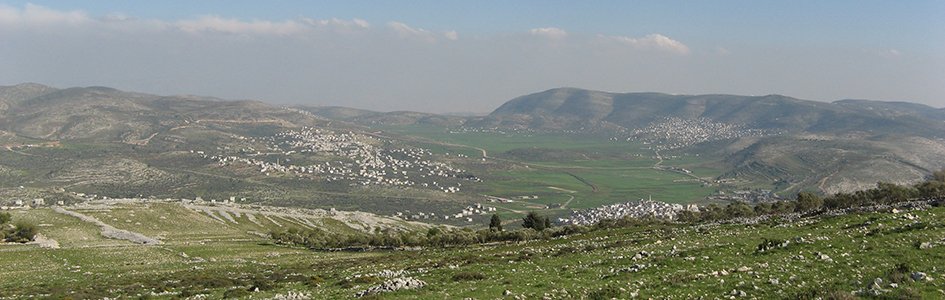
When Yosam addressed the inhabitants of Shechem (Shoftim 9:7), he stood on Har Gerizim and called out to them (in a raised voice). Yoel Elitzur (“Places in the Parsha,” Ki Tavo) discusses the acoustical qualities of this location, including someone standing on Har Gerizim being able to hear a conversation taking place on Har Eival, making it an ideal location for the blessings and curses to be proclaimed. Although there is no truth to the rumor that Har Gerizim—the location from where the blessings were proclaimed—is lush with vegetation, while Har Eival—from where the curses were uttered—is barren (they are said to have about the same level of vegetation), there should still be little doubt that the mountains to the immediate north and south of the valley within which the modern-day city of Nablus is located are Har Gerizim and Har Eival.
|
In 1879, J. W. McGarvey made a tour of the Holy Land. His visit to the area of Nablus (biblical Shechem) is particularly interesting because of his acoustical test. Today tourists are not able to visit this area, and if they were, the urbanization of the area has made a similar experience impossible today. This section is from Lands of the Bible, originally published in 1880, pages 506-8 (emphasis added). A limited preview is available at Google Books (some copies for sale here). Thanks to Paul Mitchell for discovering this nugget and sending it on. “On reaching Shechem we called on Brother El Karey, the only Baptist missionary in Palestine. I had a letter of introduction to him, given me by a Baptist preacher from London whom I met at Naples. He received us very cordially, explained to us his missionary labors, and, being a native of the place, though educated in England, he was full of the local information for which we were in search. We especially wanted to learn the best way to reach Aenon, the locality of which was definitely fixed by Lieutenant Conder, but which our dragoman had never visited. He gave us the desired information, and the next morning, leaving our tents pitched at Shechem, we made an excursion to that interesting spot.  Mt. Ebal, view north from Mt. Gerizim, July 2007 Our route took us back through the valley, and we resolved that while passing between the two mountains of Ebal and Gerizim, in the still morning air, we would try the experiment of reading the blessings and curses. It will be remembered by the reader that, in compliance with directions given before the death of Moses, Joshua assembled all the people on these two mountains, stationing six tribes on one, and six opposite to them on the other, and he stood between and read to them all the blessings and curses of the law (See Deut 27-28, Josh 8:30-35). It has been urged by some skeptics that it was impossible for Joshua to read so as to be heard by the whole multitude of Israel. It is a sufficient answer to this to show that while Joshua read, the Levites were directed to repeat the words “with a loud voice” (Deut 27:14), and that it was an easy matter to station them at such points that their repetitions, like those of officers along the line of a marching army, could carry the words to the utmost limits of the multitude. But it is interesting to know that the spot chosen by God for this reading is a vast natural amphitheatre, in which the human voice can be heard to a surprising distance. About half-way between Shechem and the mouth of the valley in which it stands there is a deep, semicircular recess in the face of Mount Ebal, and a corresponding one precisely opposite to it in Mount Gerizim. No man with his eyes open can ride along the valley without being struck with this singular formation. As soon as I saw it I recognized it as the place of Joshua’s reading. It has been asserted repeatedly by travelers that, although two men stationed on the opposite slopes of these two mountains are a mile apart, they can read so as to be heard by each other. We preferred to try the experiment in stricter accordance with Joshua’s example; so I took a position, Bible in hand, in the middle of the valley, while Brother Taylor and Frank, to represent six tribes, climbed halfway up the slope of Mount Gerizim; and Brother Earl, to represent the other six tribes, took a similar position on Mount Ebal. I read, and they were to pronounce the amen after each curse or blessing. Brother Taylor heard me distinctly, and I could hear his response. But Brother Earl, though he could hear my voice, could not distinguish the words. This was owing to the fact that some terrace-walls on the side of the mountain prevented him from ascending high enough, and the trees between me and him interrupted the passage of the sound. The experiment makes it perfectly obvious that if Joshua had a strong voice,–which I have not,–he could have been heard by his audience without the assistance of the Levites. As to the space included in the two amphitheatres, I think it ample to accommodate the six hundred thousand men with their families, though of this I cannot be certain. If more space was required, the aid of the Levites was indispensable.” UPDATE: Biblical Studies and Technological Tools has found and posted better images of the natural amphitheater, using Google Earth, HolyLand 3D and Microsoft Virtual Earth. |
Once we’ve established that the mountains currently identified as Har Gerizim and Har Eival are the same mountains the Torah refers to by those names, we should verify which one is which. I am unaware of anyone who doubts that Har Gerizim is the mountain south of Shechem, with Har Eival to its north, but how do we know? For one thing, Har Gerizim is sacred to the Samaritans; they still bring the Passover offering there every year. They’ve been around since the First Temple, so the association of Har Gerizim with the southern mountain goes back at least that far. There’s no reason to assume they switched the names—even though they did switch the names in their version of the Torah, with the commandments done (according to them) on Har Gerizim.
There’s an interesting nuance regarding how the associated commandments were performed. Rather than always being described as being done “on” each mountain (as they are in Devarim 11:29), the stones are supposed to be set up “in” Har Eival (Devarim 27:4). And while the first set of Tribes are to stand “on” Har Gerizim (27:12), the second set stood “in” Har Eival (27:13). This is mirrored in Yehoshua (8:30), where the altar was built “in” Har Eival. The topography of the mountains bears this out, with significant indentations in the slopes of Har Eival creating the impression of something in an indentation being “in” the mountain, not just “on” it.
Rabbi Dov Kramer was never fond of mountain climbing—especially after rupturing his quad tendon a few months ago—so he appreciates Google Earth.

As Joshua led the Israelites into the Promised Land, they paused at Mount Gerizim and Mount Ebal to enact, as commanded by Moses, an interesting object lesson:
When the LORD your God brings you into the land you are to possess, you must pronounce the blessing on Mount Gerizim and the curse on Mount Ebal (Deuteronomy 11:29 NET).
Mount Gerizim was the location where Abraham camped and built his first altar in Canaan (Genesis 12:6, 7). Jacob settled at Shechem, which was near the two mountains, and dug a well from which Jesus later asked the Samaritan woman for a drink (Genesis 33:18–20; John 4:5–7).
Mount Gerizim was fertile, and Ebal was comparatively barren. Thus, Gerizim represented life and harmony with God, whereas Ebal represented death and disconnection from God.
As they entered the Promised Land, the twelve tribes were divided: six tribes descended from Rachel and Leah gathered before Mount Gerizim, while the remaining tribes—those descended from the handmaidens, along with Leah’s youngest son Zebulun and Reuben, who had defiled his father’s bed—assembled before Mount Ebal.
The priests carrying the ark of the covenant stood between Mount Gerizim and Mount Ebal, while half the tribes stood before each mountain. Joshua then built an altar on Mount Ebal, offered sacrifices to the Lord, and inscribed the law on stones. He afterward read aloud all the words of the law—the blessings and the cursings—as Moses had commanded.
What did all of this represent?
The Object Lesson Explained
Blessings, life, and health come from living in harmony with God’s design laws for life. We cannot experience health while violating the laws of health. Conversely, we cannot avoid healthy results from harmonizing with the laws of health. God’s laws are the laws that the Creator has built reality and life to operate upon. Break them and we naturally injure ourselves, thereby experiencing the curse of sickness, disease, decay, and death. This curse of sickness and death is the one all humanity is suffering under because of Adam’s sin, because Adam broke God’s design law for life and corrupted himself with fear and selfishness.
Every human being since Adam is born infected with sin, with a spirit of fear and selfishness, and is dead in trespass and sin (Psalm 51:5; Ephesians 2:1)). We are born with a terminal sin condition that we did not choose and for which we are not guilty, but that condition, without remedy, will still cause us suffering and death. This is like a child born HIV-infected because both parents are HIV positive; the child did nothing wrong but still has a condition that, without remedy, will cause symptoms and death.
We cannot cure, heal, cleanse, or save ourselves because eternal life requires a sinless spirit/life which we do not possess; we cannot do any work that will provide us with a new life, a new sinless spirit of love and trust. We can be saved from the curse of sin only by the sacrifice of Jesus, who took our sin-infected, corrupt, and terminal humanity upon Himself, merged it with His sinless life, and, at the cross, purged the death-causing principle, destroyed the infection of fear and selfishness, and arose in a cleansed and purified humanity to become the second Adam, the new head of humanity.
Jesus became a real human, partaking of the life descended from Adam down the generations through David (Romans 1:3), was really tempted in all ways like us but was without sin (Hebrews 4:15), and chose with human abilities to say no to every temptation, destroyed and purged the infection of fear and selfishness, and arose in a sinless humanity, becoming our Savior (Hebrews 5:8, 9); He then took humanity redeemed, purified, and perfected back to heaven and presented Himself, in His humanity, to His Father as the supreme gift of love. I can hear Him saying to His Father upon His return, “Father, I have finished the work you gave me to do. I have saved humanity. I have brought the one lost sheep home to you!”
Because of Jesus, the species human was put right (justified) with God—and humanity will now live forever. And Jesus now reigns over God’s creation, not only as the Son of God, but as the Son of man!
And through what Jesus accomplished, He made it possible for every other member of the human family, every single human sinner, to receive a new sinless life—His life—through faith, through trust. We can be reborn with a new spirit, a new life, a new animating energy of love and trust (John 3:3), which is the very life of Christ. We can become partakers of the divine nature (2 Peter 1:4) and exchange our natural, fear-driven terminal life of sin for His sinless life of love and trust, and then, like Paul, we can say it is no longer “I that live but Christ lives in me” (Galatians 2:20). As Paul also wrote,
You, however, are controlled not by the sinful nature [fear and selfishness] but by the Spirit, if the Spirit of God lives in you. And if anyone does not have the Spirit of Christ, he does not belong to Christ (Romans 8:9 NIV84).
As Paul told Timothy,
For God has not given us a spirit of fear, but of power and of love and of a sound mind (2 Timothy 1:7 NKJV).
God did not give us a spirit of fear. No! That came from Adam. That is our natural, carnal, fallen animating motivation. God, through Christ, destroyed that fear-based, me-first life and restored in the human species His Spirit of perfect love and trust, and we can have that life restored in us as our motivation to action when we trust Him and open our hearts to Him. This is being reborn, recreated, renewed. This is dying to self. This is healing of our heart and mind.
We can leave the dead life behind and join Jesus and the living saints (elders on thrones in heaven, see Revelation 4:4) by partaking of Jesus through faith. We can move from our natural terminal, fear-based, sin-sick state of living to a faith-filled, love, truth, and freedom state of living, which is symbolized by moving from Ebal to Gerizim.
But the only way to do this is through trusting in Jesus and partaking of the new life He provides. If we reject Jesus, if we refuse to trust Him, if we turn away from Him, then we reap what our natural state causes: pain, suffering, and death—the curses of sin.
Deuteronomy chapter 28 contains a long list of curses that God will bring upon the people if they break their covenant with Him. However, when people read the Bible through the lie that God’s law functions like human law, imposed rules that are enforced through the infliction of external punishments, then they falsely conclude that God uses His power to inflict those curses.
But when people return to worshiping God as Creator and realize the truth that all God’s laws are design laws, the protocols He built into the operations of reality, and that breaking them severs our connection with God, life, and health, and causes pain, suffering, and death, they then realize that God actually uses power to protect, to heal, to save—and it is only when God stops using power that people begin suffering the curses of sin, which are inevitable without divine intervention. Right in Deuteronomy 28:20, God describes the cause of the curses:
The LORD will send you curses, confusion, and punishment in everything you do. You will be destroyed and suddenly ruined because you did wrong when you left him (NCV, emphasis mine).
The LORD will send on you curses, confusion and rebuke in everything you put your hand to, until you are destroyed and come to sudden ruin because of the evil you have done in forsaking him (NIV84, emphasis mine).
The LORD will send on you cursing, confusion, and rebuke in all that you set your hand to do, until you are destroyed and until you perish quickly, because of the wickedness of your doings in which you have forsaken Me (NKJV, emphasis mine).
The LORD will send against you curses, confusion, and rebuke in everything you do until you are destroyed and quickly perish, because of the wickedness of your actions in abandoning Me (HCSB, emphasis mine).
Our natural state inherited from Adam is terminal in sin, or as the Bible says, “dead in your transgressions and sins” (Ephesians 2:1 NIV84). Again, we are like the baby born HIV-infected—without healing, there is only sickness, suffering, and death. We can receive blessings, health, and life only by partaking of the free remedy procured by Jesus. If we reject that remedy, if we abandon, forsake, turn away from God, then the natural result is to reap the curse of sin. As Paul wrote,
The one who sows to please his sinful nature, from that nature will reap destruction (Galatians 6:8 NIV84).
Or as James wrote,
Sin, when it is full-grown, brings forth death (James 1:15 NKJV).
Jesus proved this in His sacrificial, substitutionary death. Note what He experienced when He became sin for us even though He knew no sin (2 Corinthians 5:21), and, thereby, took the curse of sin upon Himself:
Christ redeemed us from the curse of the law by becoming a curse for us, for it is written: “Cursed is everyone who is hung on a tree” (Galatians 3:13 NIV84).
What did the Father actually do to His Son at the cross? He abandoned Him, let Him go, pulled back His divine power that had been protecting Jesus throughout His earthly life. The Father did not inflict injury, pain, or death upon Jesus, but as Jesus Himself testified:
“My God, my God, why have you forsaken me?” (Matthew 27:46 NIV84).
If we do not trust Jesus and partake of the remedy He freely provides to us, then the only possible outcome is to reap the curses that sin brings. The only way to get from Ebal (curses) to Gerizim (blessings) is by partaking of Jesus, which is symbolized by the ark of the covenant. The gospel covenant must be experienced by the sinner. The sinner must be restored to unity, at-one-ment, with God. And this is possible only by partaking of Christ and being reborn.
Again, this was all symbolized by the ark of the covenant.
The Ark and Jesus
Remember that three objects were placed inside the ark: manna, the Ten Commandments, and Aaron’s rod that budded—in that order. And this represents the covenant and how we participate in it.
The manna represents the bread that came down from heaven, the living Word of God. Jesus is the Word made flesh (John 1:1, 14); He told us that we must eat His flesh and drink His blood if we are to be saved (John 6:53). Jesus is the way, the truth, and the life (John 14:6). In order for us to leave the barren wasteland of Ebal—this world of sin—we must first partake of the truth embodied, revealed, and fulfilled in Jesus. This truth destroys the lies and wins us to trust.
Then, as we choose to trust and open our hearts to God, the Holy Spirit enters our hearts and we receive a new life, the life of Christ, which is the fulfillment of God’s living law, symbolized by the placing of the Ten Commandments into the ark. Jesus is the fulfillment of the law (Matthew 5:17). We have the law written upon our hearts and minds when we receive this new life (life of Christ) through faith (Hebrews 8:10). This is also symbolically taught in the communion service by the partaking of the wine. The bread in the communion service represents the truth, just as the manna does, while the wine represents the blood of Christ, which represents His sinless life. As Leviticus tells us, the life is in the blood (17:11).
Thus, in theater and in symbol, we are taught the way we move from death (Ebal) to life (Gerizim), in reality, in fact, is by receiving the life of Christ via the indwelling Holy Spirit.
And then, we who were dead in trespass and sin are reborn with a new life, and from that new life (Christ living in us), we bring forth the peaceable fruits of righteousness, the fruits of a righteous character. And this is symbolized by Aaron’s dead rod that came to life, budded, and produced fruit.
The events recorded in Joshua as the children of Israel entered Canaan are not only historical, they are also theater, object lessons, acted-out drama depicting the reality of what God has done through Jesus to redeem humanity from sin and how we can participate through faith in the free gift of salvation.
God is calling each of us to internalize the truth, to open our hearts in trust, to receive through faith the indwelling Holy Spirit, and to be reborn with the life of Christ, as Paul wrote:
Anyone who is joined to Christ is a new being; the old is gone, the new has come. All this is done by God, who through Christ changed us from enemies into his friends and gave us the task of making others his friends also. Our message is that God was in Christ making the whole human race his friends. God did not keep an account of their sins, and he has given us the message which tells how he makes them his friends. Here we are, then, speaking for Christ, as though God himself were making his appeal through us. We plead on Christ’s behalf: let God change you from enemies into his friends! (2 Corinthians 5:17–20 GNT).
spacer
Joshua’s Altar and the Mount Ebal Curse Tablet
An archaeological find confirms biblical history.
by Simon Turpin on July 12, 2023

Critical scholars often view the historical accounts in the Old Testament as fiction or mythology. But what happens when archaeology confirms what we read in the Old Testament? Recent archaeological discoveries at Mount Ebal strongly confirm a historical event in the Old Testament.
Has Joshua’s Altar Been Found?
In Deuteronomy 27, before Israel had crossed the Jordan to take possession of the land of Canaan, Moses charged them that when they entered Canaan, six tribes (Simeon, Levi, Judah, Issachar, Joseph, and Benjamin) should stand on Mount Gerizim to read and recite the blessings that would come to them if they kept God’s law. The other six tribes (Reuben, Gad, Asher, Zebulun, Dan, and Naphtali) were to stand on Mount Ebal and read and recite the curses that would come upon them if they disobeyed God’s law.
In 1980, Professor Zertal discovered a large rectangular altar (30 meters square and 3 meters high, see below) on Mount Ebal, and from 1982–1989, excavation followed. Zertal believed the large rectangular structure was Joshua’s covenant ceremony altar (Joshua 8:30–35). Zertal’s discovery was initially met with skepticism by many in the archaeological community, but several respected archaeologists (e.g., Professor Benjamin Mazar, Hebrew University) were convinced. The excavations around the large structure revealed large amounts of ash and over 1000 bones from young, choice male animals (mainly kosher). This indicated the site was used for animal sacrifices conducted according to biblical standards. Based on the pottery and scarabs found, Zertal dated the altar from the thirteenth to twelfth centuries (c. 1225 BC).3 If this is Joshua’s altar, then it presents a problem for the exodus and conquest of Canaan taking place in the fifteenth century BC (1446–1400 BC). However, Zertal’s excavations also document the presence of an earlier altar underneath the massive rectangular altar (see below).4 The earlier altar was circular, had a diameter of only 2 meters, and was made from unworked, medium-size stones. Zertal noted that immediately on top of this smaller altar was a ten-centimeter layer of clean ash and animal bones, most of which were burnt (cf. Deuteronomy 27:7; Joshua 8:31). Zertal believed the smaller round altar was built before the larger rectangular one, but he dated it to around the same period (c. 1250 BC).
Several years ago, archaeologist Dr. Scott Stripling turned his attention to Zertal’s discoveries at Mount Ebal. Due to political reasons, however, Dr. Stripling was unable to continue Zertal’s excavations on Mount Ebal, but he was able to wet-sift the material excavated by Zertal that was left in dump piles next to the large structure. Dr. Stripling agrees that the smaller circular altar was built before the larger rectangular altar. However, Dr. Stripling not only believes that Zertal’s altar has been misdated, but that the round altar is most likely Joshua’s altar and should be dated to the fifteenth century BC (c. 1400 BC).5 Dr. Stripling supports this interpretation from evidence discovered from the wet-sifting of Zertal’s excavated material. Dr. Stripling found pottery from an earlier period in the fill, suggesting an earlier use of the site.
The round altar at Mount Ebal could very well be Joshua’s altar and is consistent with a fifteenth-century exodus and the conquest of Canaan under Joshua.
In the material associated with the round altar, a scarab belonging to Pharaoh Thutmose III (c.1504–1450 BC) was found. The traditional view is that the Thutmose III scarab is commemorative and belongs to the thirteenth century. Dr. Stripling, however, argues, “This is nothing new. The identification of Eighteenth Dynasty [fifteenth century] scarabs from sites like Mount Ebal, Shiloh, and Jericho are often judged to be commemorative because they challenged the dominant late-date theory. The theory now drives the interpretation.”6 If the Thutmose III scarab is not commemorative, as Stripling believes, then it provides evidence for the earlier construction of the smaller circular altar. The round altar cannot be an earlier Canaanite altar as Joshua was commanded to tear down their altars (Judges 2:2; cf. Exodus 34:13). Furthermore, all the stones belonging to the round altar are unworked, which fits with the requirement of Joshua 8:31. The round altar at Mount Ebal could very well be Joshua’s altar and is consistent with a fifteenth-century exodus and the conquest of Canaan under Joshua.

Joshua’s altar on Mount Ebal. Image courtesy of Melissa Barreiro/Armstrong Institute of Biblical Archaeology
A Curse Tablet on Mount Ebal
In 2022, a research team led by Dr. Stripling from the Associates for Biblical Research (ABR) revealed the discovery of a lead tablet (2 cm by 2 cm) from Mount Ebal that they claim contains the oldest extant Hebrew inscription.7 The tablet was found in 2019 through a project to wet-sift the east dump piles from Zertal’s excavation at Mount Ebal. The archaeological context and epigraphical analysis indicate that the curse tablet (Defixio) is believed to date to the Late Bronze Age II period (c. 1400–1200 BC).8 This is at least two centuries older than any known Hebrew inscription from ancient Israel.9 The folded lead tablet contains an ancient Hebrew inscription which was inscribed on the lead with an iron stylus (cf. Job 19:23–24) in proto-alphabetic script (or proto-Hebrew script) and consists of 48 letters (one is a form of the divine name YHW (YHWH) in conjunction with another Hebrew name for God, El).10 The inscription is a chiastic parallelism and reads,
You are cursed by the god yhw, cursed.
You will die, cursed—cursed, you will surely die.
Cursed you are by yhw—cursed.11

Mount Ebal Curse Tablet. Image courtesy of Associates for Biblical Research
This discovery confirms that the Hebrews worshipped one God but had different names for him (Deuteronomy 4:35, 6:4, 10:17).
The use of the two Hebrew names together (YHW and El) to refer to the same God refutes a major element of the liberal documentary hypothesis. Critical scholars believe that the Torah was not written by Moses in the fifteenth century BC but was compiled in different periods (c. 960–550 BC) by many authors (abbreviated as J, E, D, and P), who worshipped different gods, YHWH and El/Elohim. This discovery confirms that the Hebrews worshipped one God but had different names for him (Deuteronomy 4:35, 6:4, 10:17). It also confirms that the Hebrews were literate (Deuteronomy 6:9).
The location and date correspond perfectly to what Scripture states in Deuteronomy 11:29, “And when the Lord your God brings you into the land that you are entering to take possession of it, you shall set the blessing on Mount Gerizim and the curse on Mount Ebal.” According to Deuteronomy 27 and Joshua 8, Mount Ebal was the mountain of the curse (see above).12 If the tablet dates to around 1400 BC, then this would correspond to the conquest of Canaan under Joshua and firmly root the exodus some 46 years before (40 years in the wilderness + around 6 years for the conquest of Canaan), right in the range of 1446 BC, the biblical date of the exodus (see 1 Kings 6:1).
At Mount Ebal, Joshua wrote on stones a copy of the law of Moses (Joshua 8:32). This foreshadowing event helps us understand our own reality. In Galatians 3:10, the Apostle Paul writes, “For all who rely on works of the law are under a curse; for it is written, ‘Cursed be everyone who does not abide by all things written in the Book of the Law, and do them.’” As descendants of Adam, mankind is under the curse of the law and that curse needs to be removed. Paul goes on to say in Galatians 3:13, “Christ redeemed us from the curse of the law by becoming a curse for us—for it is written, ‘Cursed is everyone who is hanged on a tree.’” For all those who trust in Christ, his death on the cross has removed the curse of sin. Jesus came from heaven, the place of blessing, to earth, the place God cursed (Genesis 3:17), to offer himself as a sacrifice for the forgiveness of sins so that we would not receive the curse that we do deserve but would receive the blessings that we do not deserve (Ephesians 1:3).
spacer
Bible Encyclopedias Preferences
Cyclopedia of Biblical, Theological and Ecclesiastical Literature
(always with the prefix הִר גְּרַזַּים, Hai Geasizzimn, Mount of the Gerazites [from גְּרַזַּי, Gerizzi’, dwellers in a shorn (i.e., desert) land, from גָּרִז, ga-rac’, to cut off; possibly the tribe subdued by David, 1 Samuel 27:8]; Sept. Γαριζίν, Josephus Γαριζείν ) and EBAL were two mountains of Samaria, forming the opposite sides of the valley which contained the ancient town of Shechem, the present Nablu’s. From this connection it is best to notice them together. The valley which these mountains enclose is about 200 or 300 paces wide, by above three miles in length; and Mount Ebal rises on the right band and Gerizim on the left hand of the valley (which extends west-northwest) as a person approaches Shechem from Jerusalem (see Ritter, Erdk. 16:641 sq.). These two mountains were the scene of a grand ceremony — perhaps the most grand in the history of nations — duly performed by Joshua as soon as he gained possession. of the Promised Land (Deuteronomy 27; Joshua 8:30-35). See below. These mountains are mentioned by Josephus as being similarly situated on either side of Shechem (Ant. 4:8, 44). He also refers to the temple built upon one of them by the Samaritans after the exile as the seat of their national worship (Ant. 11:7, 2; 8, 2-6), as related in the Apocrypha (2 Maccabees 6:2). See below. In order to justify their traditions in this respect, they have corrupted the reading of their text of the Pentateuch in Deuteronomy 27:4, so as to read “Gerizim” instead of “Ebal.” It was from the top of this mountain that Jotham uttered the famous parable of the trees to the Shechemite insurrectionists under Abimelech, gathered in the plain below (Judges 9:7), a position from which he could easily be heard (see Hackett’s Illustra. of Script. page 198). The ascent of the hill is so difficult that, were any of the followers of Abimelech could climb it, Jotham would be far away among the defiles of the neighboring mountains. (See JOTHAM).

Mount Gerizim has been fully described by several travelers who have ascended it. The latest and most complete account of the objects of interest extant upon it may be found in M. Saulcy’s Narrative, chapter 8, where also its history is given in detail. See also Robinson’s Bibl. Researches, 3:96 sq.; Olin’s Travels, 2:340 sq. Dr. Robinson says: “Mounts Gerizim and Ebal rise in steep, rocky precipices immediately from the valley on each side, apparently some 800 feet in height. The sides of both these mountains as here seen (i.e., from Nablus) were, to our eyes, equally naked and sterile. The side of the northern mountain, Ebal, along the foot, is full of ancient excavated sepulchres. The southern mountain is now called by the inhabitants Jebul et-Ter, though the name Gerizim is known at least to the Samaritans. The modern appellation of Ebal we did not learn.” Dr. Olin states that the summit of Gerizim is somewhat higher than that of Ebal. The top of Gerizim affords a commanding view of a considerable region, chiefly occupied with mountains of inferior elevation, but also embracing several fruitful valleys, especially those of Nablus and of wady Sahl, through which lies the road to Jerusalem. A great number of villages are seen all along its north-eastern side, upon high and apparently precipitous spurs of the mountain which push out into the valley from (wady Sahl) the main ridge. Cultivation is carried quite to the top of the mountains, which are adorned with plantations of fruit-trees, while every level spot and a vast number of small fields, supported by terraces, are sown in wheat. A considerable portion of the table-land on the summit of Gerizim itself exhibits marks of recent tillage. Mount Ebal, as viewed from Gerizim; spreads out, like the latter, into a table-land, but is apparently rocky and more broken, and less susceptible of cultivation. Mount Garizim is ascended by two well-worn tracks, one leading from the town of Nabluis at its western extremity, the other from the valley on its northern side, near one of the two spots pointed out as Joseph’s tomb. It is on the eastern extremity of the ridge that the holy places of the Samaritans are collected. First, there occurs the small hole in the rocky ground where the lamb is roasted on the evening of the Passover; next, the large stone structure occupying the site of the ancient temple. In one of the towers of this edifice, on the north-east angle, is the tomb of a Mussulman saint, Sheik Ghranem. Under the southern wall of this castle or temple. is a line of rocky slabs, called the “ten stones,” in commemoration of the ten (or twelve) stones brought by Joshua, or of the ten tribes of the northern kingdom; they have every appearance of a large rocky platform, divided by twelve distinctly marked natural fissures. Beyond this platform, still further to the east, is a smooth surface of rock, sloping down to a hole on its south side; the scene, according to Samaritan tradition, which some recent travelers have endeavored to vindicate, of Abraham’s sacrifice (Moriah, Genesis 24), of his meeting with Melchizedek (Genesis 14; so Theodotus in Eusebius, Praep. Ev. 9:22), and several other sacred events. (See Stanley’s Sinai and Palest., page 245.) Mr. Bartlett also ascended Mount Ebal, but he says he “could discover no trace of by-gone generations, though the view, like that from Gerizim, is splendid and extensive” (Footsteps of our Lord, page 186). The remains of the temple on Mount Gerizimr are fully described by Thomson (Land and Book, 2:213 sq.). — Kitto, s.v. (See SHECHEM)

Foundations of Samaritan Temple in Gerizim
(See SAMARITANS).
spacer