As usual, today’s post contains some very interesting twists, turns and tie-ins. Anyone who reads my posts is well aware that I search for roots and spiritual connections.
I want to state here that when I include information on spirits, gods, goddesses, fallen angels and such, it is not to give them credence, validity, honor or glory. I bring them to your attention so that you can readily see that the spirit realm is very real and that ALL pagan deities and spiritual entities that are not of the True and Living God of the bible are agents of darkness and children of the Fallen. Nothing good can come from them. They may appear to provide you with gifts, comforts or guidance, but their ultimate goal is your destruction.
I have been laboring many long hard years to bring this to your attention. For millennia the “Scientific” Community a striven to discredit all things spiritual and deny the existence of demons, demigods, gods and godesses, dismissing ALL mythology including the bible. Scientist have historically claimed mythology was created by simple minded people in order to make sense of the world around them. In this post you will see that even “scientific” documents are filled with references to those very entities, recognizing their power and influence on our past and present.
As I have written many times, the elite WORSHIP these entities. You had better take heed. They take it very seriously! It is apparent in everything they do. They do not make a move without consulting the spirits. They honor those spirits by naming everything after them, by displaying their symbols, by configuring everything they do by their numbers. That is because they are directly descended from the Fallen Angels (as many of them proclaim) or they are serving the demonic entities that control and/or possess them.
Understand that Fallen Angels, nature spirits and demons are VERY REAL and they do have power, at present, though it will be short-lived. Before Christ came, the entire world was under their control. Spirits ruled everything. Every realm, every geographic area, every facet of everyone’s life had a ruling spirit to whom the people had to make concessions, offerings and sacrifices. Humanity was subject to every whim of the most evil and destructive entities imaginable whose only desire was for their destruction. Humanity was subject to sin, unable to resist, they willingly committed every kind of evil, under the influence of the dark spirits. That is the slavery from which Christ redeemed us.
Those entities have made a huge come back lately due to the spiritual void created by our educations system. People have forgotten GOD or turned their back on Him in preference to the prince of darkness and his minions. People are turning to demonic spirits by the millions. Inviting them in and serving them. VOLUNTARILY!! Woe, Woe to those fools. Exchanging the gift of eternal life in glory, for mere potence in this world and eternal damnation.
Today, we are focusing on the Mythologies connected with dreams, visions, weather, and science. Especially science related to geoengineering and the recreation of the human race, and the narcoleptic stupor into which humanity has been lulled.
As you view this post, I beg you to ask GOD to speak to your heart and reveal the TRUTH to you. Spiritual truth can only be discerned spiritually. If you are under the lordship of the dark side, you will not see or hear the TRUTH.
I PRESENT THE FOLLOWING TO YOU IN THE HOPE THAT YOU ARE ABLE TO DISCERN WHAT IS REVEALED HERE.

177 Views – 2 months ago
spacer

spacer
ONEIROI
Greek NameΟνειρος Ονειροι |
TransliterationOneiros, Oneiroi |
Roman NameSomnium, Somnia |
TranslationDream (oneiros) |
THE ONEIROI were the dark-winged spirits (daimones) (demons/fallen angels) of dreams which emerged each night like a flock of bats from their cavernous home in Erebos—the land of eternal darkness beyond the rising sun. The Oneiroi passed through one of two gates (pylai).
spacer
|
oneiromancy(n.)
|
|
|
|
Thermopylae/Pylai
|
|
Pyli, Greece: The Gateway to the Mountains |
 |
spacer
The first of these gates, made of horn, was the source of the prophetic god-sent dreams, while the other, constructed of ivory, was the source of dreams which were false and without meaning. The term for nightmare was melas oneiros (black dream).
According to some the leader of the Oneiroi was Morpheus, a god who appeared in the dreams of kings in the guise of a man bearing messages from the gods.
FAMILY OF THE ONEIROI
PARENTS
[1.1] NYX (no father) (Hesiod Theogony 212; Sappho Frag 63, Statius Thebaid 10.112)
| NYX was the goddess of the night, one of the primordial gods (protogenoi) who emerged as the dawn of creation.
She was a child of Khaos (Chaos, Air), and coupling with Erebos (Darkness) she produced Aither (Aether, Light) and Hemera (Day). Alone she spawned a brood of dark spirits including the three Fates, Sleep, Death, Strife and Pain. Nyx was an ancient deity usually envisaged as the very substance of the night–a veil of dark mists drawn across the sky to obscure the light of Aither, the shining blue of the heavens. Her opposite number was Hemera (Day) who scattered the mists of night at dawn. |
[1.2] EREBOS & NYX (Hyginus Preface, Cicero De Natura Deorum 3.17)
|
|
[2.1] HYPNOS (Ovid Metamorphoses 11.592)
|
hypno-
|
NAMES
[1.1] MORPHEUS, IKELOS-PHOBETOR, PHANTASOS (Ovid Metamorphoses 11.592)
[2.1] EPIALES ? (Alcaeus Frag 406)
ENCYCLOPEDIA
ONEIROS (Oneiros), a personification of dream, and in the plural of dreams. According to Homer Dreams dwell on the dark shores of the western Oceanus (Od. xxiv. 12 ), and the deceitful dreams come through an ivory gate, while the true these ones issue from a gate made of horn. (Od. xix. 562, &c.) Hesiod (Theog. 212) calls dreams the children for the children of Night, and Ovid (Met. xi. 633), who calls them children of Sleep, mentions tree of them by name, viz. Morpheus, Icelus or Phobetor, and Phantasus. Euripides called them sons of Gaea, and conceived them as genii with black wings.
|
genii(n.)
represented as malevolent descendants of the fallen angels, later as angelic genii |
|
jinn(n.)
|
spacer
I′CELUS, the son of Somnus, and brother of Morpheus, was believed to shape the dreams which came to man, whence he derived his name. The Ovid (Met. xi. 640) says, the gods called him Icelus, but men called him Phobetor.
Source: Dictionary of Greek and Roman Biography and Mythology.
NAMES OF ONEIROI
Greek NameΜορφευς Φαντασος Ικελος Φοβητωρ |
TransliterationMorpheus Phantasos Ikelos Phobêtôr |
Latin SpellingMorpheus Phantasus Icelus Phobetor |
TranslationForm, Shape (morphê) Phantasm (phantasioô) Resembling (ikelos) To Be Feared (phobêtos) |
ApplicationShape Shifter, Transformer, Mimic Fantasy, Illusion, Surrealism, Whimsy Disguise, Deception, Impersonation Phobia, WORST Nightmare, Monsters |
Hypnos: The God of Sleep
Family and Relationships
-
Children: Hypnos is the father of the Oneiroi, the personifications of dreams. His children include:
-
Morpheus: The god of dreams who can take any human form in dreams.
-
Phobetor: The creator of nightmares, often depicted as frightening animals.
-
Phantasus: The creator of illusory dreams, lacking a distinct form.
Nyx: The Goddess of Night
Hypnos plays a crucial role in Greek mythology, representing the essential human experience of sleep. His gentle nature and the calming influence of sleep are celebrated, and he is often invoked in myths where sleep is a necessary respite from the struggles of life. His interactions with other gods and mortals highlight the importance of sleep in the cycle of life and death.
In summary, Hypnos is the central figure in Greek mythology associated with sleep, complemented by his family and the overarching influence of Nyx, the goddess of night. Together, they embody the profound and often mysterious nature of sleep and dreams in ancient Greek culture.
spacer

The Oneiroi: Morpheus and His Brothers, Ancient Greek Dream Gods
Regardless of his parentage, Morpheus is said to have numerous siblings, collectively known as the Oneiroi (the Greek word for dream, incidentally, being oneiros). Apart from Morpheus, two other Oneiroi can be identified by their names – Phobetor and Phantasos.

Waterhouse ‘Sleep and His Half-Brother Death’ (1874). (Public Domain)
THANATOS – Greek God of Death (Roman Mors)Thanatos the personified spirit of non-violent death, son of Nyx (Night) and brother of Hypnos (Sleep). He appeared in several myths, such as the abduction of Alkestis and the imprisonment by Sisyphos, and was depicted as a winged or beardless man. |
‘

The Winged Man’ (1880) by Odilon Redon. When not appearing in dreams, Oneiroi were said to have possessed human forms with wings on their backs.
The Importance of Dreams in Ancient Greece
Dreams had such an important role in ancient Greece that writers put them into categories – insignificant dreams that just reflected everyday fears and hopes of the day, and the significant ones that were visions of the future, visitations by ghosts or gods, and symbolic prophetic dreams that had to be interpreted. Some dreams were also thought to be able to heal. As Miriam Kamil notes:
“Prophetic dreams appear frequently in Greek literature, from myth to history to ancient inscriptions. Greek religious culture allowed people to believe in the truth of these apparent dreams from the gods. Among religious Greeks, this belief was so strong that people bought dream books and practiced rituals to induce prophetic dreams.”
spacer
Morpheus in Classical Literature
In Classical literature, Morpheus makes an appearance in Ovid’s Metamorphoses.In the story of Alcyone and Ceyx, Ovid mentions that Ceyx undertook a journey across the sea to consult an oracle. During his voyage, however, a tempest broke out, sinking his ship and resulting in his death.
Zeus’ wife Hera then sent Iris, the messenger of the gods, to the hall of Somnus in the Underworld, as she wanted to send a dream to Alcyone about the death of her husband, Ceyx.It is in this part of the Metamorphoses that Morpheus is described as being one of the one thousand sons of Somnus.

‘Morpheus and Iris’ (1811) by Pierre-Narcisse Guérin. (Public Domain)
| In ancient Greek religion and mythology, Iris (/ˈaɪrɪs/; EYE-riss; Ancient Greek: Ἶρις, romanized: Îris, lit.‘rainbow,’[2][3] Ancient Greek: [îːris]) is a daughter of the gods Thaumas and Electra,[4] the personification of the rainbow and messenger of the gods, a servant to the Olympians and especially Queen Hera.[5]
Iris is represented either as a rainbow or as a beautiful young maiden with wings on her shoulders. As a goddess, Iris is associated with communication, messages, the rainbow, and new endeavors. This personification of a rainbow was once described as being a link between the heavens and earth.[37] In some texts she is depicted wearing a coat of many colors. With this coat she actually creates the rainbows she rides to get from place to place. Iris’ wings were said to be so beautiful that she could even light up a dark cavern, a trait observable from the story of her visit to Somnus in order to relay a message to Alcyone.[38] After Ceyx drowned in a shipwreck, Hera made Iris convey her orders to Hypnos, the god of sleep. Iris flew and found him in his cave, and informed him that Hera wished for Ceyx’s wife, Alcyone, to be informed of her loved one’s death in her dreams. After delivering Hera’s command, Iris left immediately, not standing to be near Hypnos for too long, for his powers took hold of her, and made her dizzy and sleepy.[17] While Iris was principally associated with communication and messages, she was also believed to aid in the fulfillment of humans’ prayers, either by fulfilling them herself or by bringing them to the attention of other deities.[39] Zephyrus, who is the god of the west wind, is often said to be her consort. Together they had a son named Pothos,[9] or alternatively they were the parents of Eros,[10] the god of love, according to sixth century BC Greek lyric poet Alcaeus, though Eros is usually said to be the son of Ares and Aphrodite. According to the Dionysiaca of Nonnus, Iris’ brother is Hydaspes.[11] Iris is also known as one of the goddesses of the sea and the sky. Iris links the gods to humanity. She travels with the speed of wind from one end of the world to the other[12] and into the depths of the sea and the underworld. |
Ovid also describes Morpheus as being the most talented of his brethren in mimicking human beings. His mimicry of humans is not limited to physical appearances, but also includes voice, mood, gait, and even choice of words. Thus, he is the best choice for the gods when they wish to send images of human beings to sleeping mortals.
According to Ovid, after Morpheus appears as Ceyx in Alcyone’s dream to relate his fate, the grief-stricken widow wakes up to see the body of her husband washed up on the shore. Filled with sorrow, Alcyone commits suicide by throwing herself into the sea. The gods, taking pity on them, then transformed them into Halcyon birds.
spacer

Ceyx/Morpheus appears to Alcyone. Engraving by Virgil Solis for Ovid’s ‘ Metamorphoses.’ (Public Domain)
spacer
Portraying an Abstract Idea, Morpheus Lives On
One of the ways that Morpheus continues to ‘live on’ in the human mind today is as a drug. Morphine, which was isolated from opium in 1805, is named after Morpheus because it induced a euphoric, dream-like state of mind in those who took it.
Like many of the Greek deities, Morpheus can be said to be a personification of an abstract idea, similar to that of Thanatos (death) or the Furies (vengeance). By giving these concepts a concrete form, the Greeks would have been able to better explain these forces that ruled human existence.
Although belief in Morpheus as a god of dreams may not be as strong today as it was during the time of the Greeks, it has had an impact on the English language. The expression ‘in the arms of Morpheus’ is understood to mean ‘to be asleep’. This impact, however, is not merely restricted to Morpheus, but also to various other personified deities of Greek mythology.
Top Image: ‘Morpheus’ (circa 1771) by Jean-Bernard Restout. Morpheus is one of the ancient Greek Oneiroi. Source: Public Domain
By Ḏḥwty
spacer
Trivia
Phantasos governs good dreams. However, the majority of his dreams are somewhat cryptic. The word “Fantasy” comes from his name. Phantasos often takes the form of a woman, as his dreams usually deceive people.
spacer
spacer

Phantasos
In Greek mythology, Phantasos is a fascinating figure associated with dreams and the world of the unconscious. He is one of the Oneiroi, the personifications of dreams, and is often depicted as a being who brings forth visions during sleep. Phantasos is particularly linked to the more surreal and bizarre aspects of dreams, which is why he plays a crucial role in the ancient Greek understanding of the dream world. His name itself derives from the Greek word for “to appear” or “to show,” emphasizing his function in manifesting dream imagery.
Phantasos in Literature
Phantasos appears in various works of ancient literature, most notably in Ovid’s Metamorphoses. In this epic poem, Ovid describes the different forms that dreams can take, with Phantasos representing the more fantastical and surreal aspects. He is depicted as a shape-shifter, able to assume various forms and create bizarre scenarios that challenge the boundaries of reality. This ability to manipulate the dream landscape is a key characteristic of Phantasos, setting him apart from his brothers. The vivid imagery associated with Phantasos serves to remind readers of the power of dreams to transport individuals to realms beyond their waking experience.
Another important aspect of Phantasos in literature is his relationship with human beings. He is often portrayed as a guide through the dream world, leading individuals to confront their fears and desires. This guiding role is significant, as it suggests that dreams, even those influenced by Phantasos, can serve a purpose in helping individuals understand themselves better. The interplay between the dreamer and Phantasos reflects a larger theme in mythology: the connection between the divine and the human experience.
Symbolism of Phantasos
Phantasos is rich in symbolism, representing not only the nature of dreams but also the complexities of the human psyche. His ability to create strange and fantastical visions highlights the unpredictable nature of dreams, which can evoke both wonder and fear. This duality is a central theme in Greek mythology, where the gods often embody contrasting traits. Phantasos, with his whimsical yet eerie characteristics, serves as a reminder of the thin line between reality and fantasy.
- Dreams as Reflections: Phantasos symbolizes the idea that dreams reflect our innermost thoughts and feelings.
- Surreal Experiences: His role emphasizes the surreal and often nonsensical nature of dreams.
- Fear and Wonder: Phantasos embodies the dual emotions that dreams can invoke.
Moreover, Phantasos can also be seen as a representation of the unknown. Dreams often take us to places we have never been or introduce us to concepts we have never considered. Phantasos, with his mysterious nature, invites individuals to explore the depths of their own minds and confront the fears that may lie within. This journey into the unknown can be both frightening and enlightening, showcasing the transformative power of dreams
Phantasos and Modern Interpretations
In modern interpretations of mythology, Phantasos continues to hold significance as a symbol of the dream world. Many psychologists and dream analysts reference figures like Phantasos to explain the complexities of dreams and their meanings. The notion that dreams can be influenced by external forces, including mythological figures, adds depth to contemporary understandings of the subconscious.
Additionally, Phantasos has inspired various forms of artistic expression, including literature, visual arts, and theater. His character serves as a muse for artists exploring the themes of dreams, reality, and the human experience. The dreamlike quality associated with Phantasos invites creativity and imagination, leading to new interpretations and representations in modern art.
Phantasos in Popular Culture
Phantasos has found his way into popular culture, often appearing in various forms of media. From movies to video games, the influence of this mythological figure can be seen in how dreams and the subconscious are portrayed. For instance, in films that explore dream manipulation, such as Inception, the surreal and unpredictable nature of dreams, akin to Phantasos’s influence, is central to the plot. This connection between mythology and modern storytelling illustrates the timeless relevance of Phantasos and the themes he represents.
Furthermore, video games that incorporate dream elements often reference mythological figures like Phantasos to create rich narratives. Players may encounter dreamscapes that challenge their perceptions and push the boundaries of reality, mirroring the experiences associated with Phantasos. This integration of mythology into popular culture highlights the enduring fascination with dreams and the figures that embody them.
The Role of Dreams in Ancient Greek Culture
In ancient Greek culture, dreams held significant importance and were often viewed as messages from the gods. The Greeks believed that dreams could offer guidance, predictions, and insights into one’s life. This belief is reflected in the role of Phantasos and his brothers, who were seen as intermediaries between the divine and human realms. The interpretation of dreams was a serious endeavor, and many sought the counsel of priests and oracles to decipher their nighttime visions.
Moreover, dreams were often linked to religious rituals and practices. Individuals would engage in incubation, a practice where they would sleep in a sacred space, hoping to receive divine messages through their dreams. This practice underscores the cultural significance of dreams and the belief that they could provide insights into personal and communal matters. Phantasos, as a figure representing the dream world, is an essential part of this cultural framework, emphasizing the interconnectedness of the divine and the human experience.
spacer
Phantasos and Psychological Perspectives
From a psychological perspective, Phantasos can be seen as a representation of the unconscious mind and the complexities of human thought. The dreams that he evokes can symbolize unresolved conflicts, desires, and fears that individuals may not be consciously aware of. This aligns with the theories of psychologists like Sigmund Freud and Carl Jung, who emphasized the significance of dreams in understanding the human psyche.
Freud, in particular, believed that dreams were a window into the unconscious, revealing hidden desires and emotions. Phantasos, as a figure who brings forth strange and surreal visions, embodies this concept by representing the chaotic and often confusing nature of the unconscious mind. Jung, on the other hand, viewed dreams as a means of integrating different aspects of the self, highlighting the transformative potential of dream experiences. The exploration of Phantasos within psychological frameworks underscores the ongoing relevance of mythology in understanding human behavior and thought processes.
Phantasos in Comparative Mythology
Phantasos can also be examined through the lens of comparative mythology, where similarities and differences between mythological figures across cultures are explored. Many cultures have their own representations of dream deities or personifications of the unconscious. For example, in Egyptian mythology, the god Thoth is associated with wisdom and writing, and is sometimes linked to dreams and the afterlife. Similarly, in Native American traditions, dream catchers are used to filter dreams, allowing positive visions to enter while trapping negative ones.
These cross-cultural comparisons highlight the universal human fascination with dreams and the subconscious. Phantasos, as a unique figure within Greek mythology, offers insights into how the ancient Greeks understood and interacted with the dream world. The study of dream deities across different cultures reveals common themes, such as the dual nature of dreams and their potential to influence human behavior and thought.
spacer

The Pleiades in Ancient Greek Cosmology
The Pleiades were the seven daughters of the pre-Olympian Titan Atlas, and Pleione, a nymph. According to myth, the Pleiades, named Maia, Electra, Alcyone, Taygete, Celaeno, Merope, and Asterope, were dedicated to Artemis, the Greek goddess of the moon and the hunt.
Orion the Hunter had been placed in the sky, along with the scorpion that killed him, by Zeus. Prior to his death, Orion saw the seven sisters and set off to capture them. Zeus, in pity for their plight, turned them into stars and placed them in heaven.
Artemis was furious with Zeus and the mortal Orion. She convinced Zeus to send a monstrous scorpion to attack Orion — the hunter died from the stings. After his death, Zeus placed Orion the sky in eternal pursuit of the sisters, and perpetual flight from the scorpion, or scorpio constellation. The cluster was also used by the ancient Mediterraneans to signal the beginning and end of sailing season according to the Oxford English Dictionary.
So the Hunter became the Hunted. Forever in pursuit of the Pleiadies including Alcyone, and being pursued by the scorpion.
spacer
Meaning & History
Latinized form of Greek Ἀλκυόνη (Alkyone), derived from the word ἀλκυών (alkyon) meaning “kingfisher” (8. Verb. (figuratively) To seek for game or plunder; to thieve.). In Greek myth this name belonged to a daughter of Aeolus and the wife of Ceyx. After her husband was killed in a shipwreck she threw herself into the water, but the gods saved her and turned them both into kingfishers. This is also the name of the brightest of the Pleiades, the seven stars in the constellation Taurus.
Moving through the photon belt
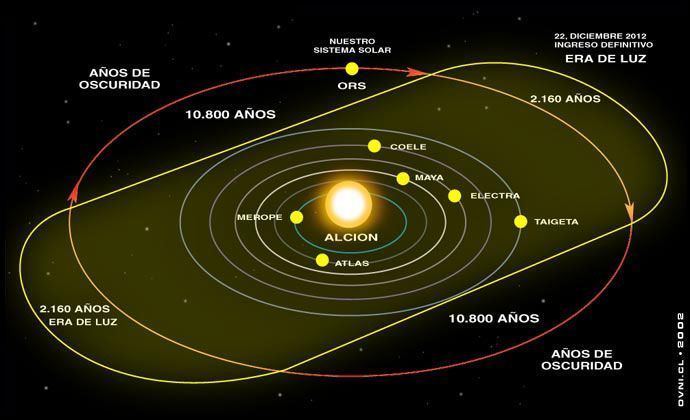
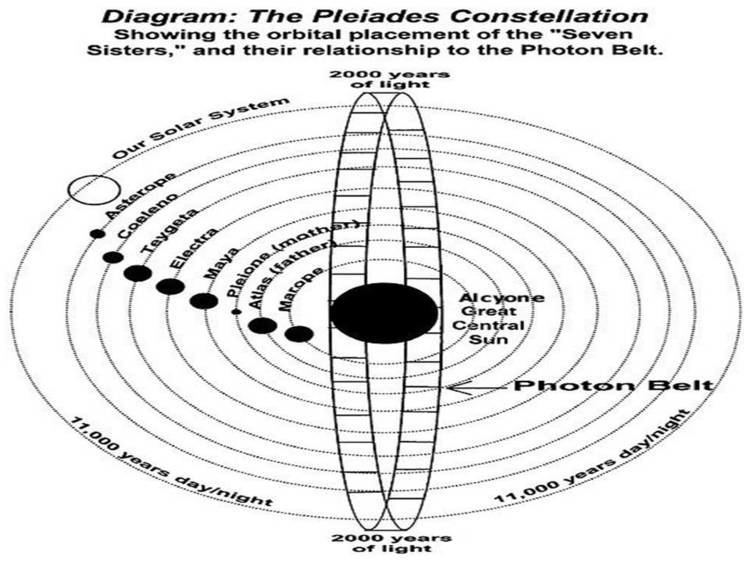
The Photon Belt (also called the Photon Band, Photon Ring, Manasic Ring, or Golden Nebula) is a spiritual belief, largely linked to some parts of the New Age Movement. It postulates that a belt or ring of photons is going to envelop the Earth, causing a cataclysm and/or initiating a spiritual transition, with the time period leading up to “the Shift” referred to as “The Quickening.” The concept of the Photon Belt also ties into various phenomena including belief in extraterrestrial intelligence and 2012 millenarianism.
2012 the photon belt and your new reality
Concept
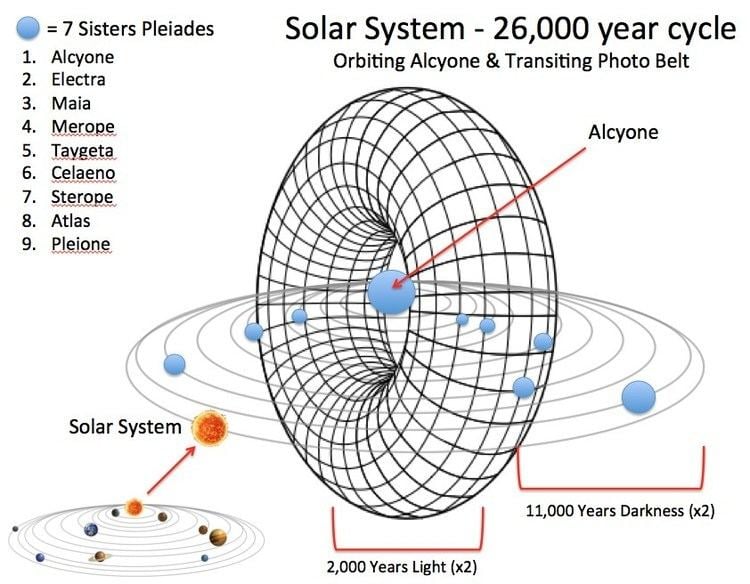
Symbols in the ground and in the sides of the arena seem to be related to the stars. Notice the shape of the arena compared to the Alcyone map above. Also note the circles in the ground of the arena. These are very likely deliberately drawn on as star maps, part of the ritual. It is eerily similar to the image above related to the Photon Belt, Alcyone and the Pleiades. Don’t you agree? 
I this photo the area circled in orange is that same Sacrificial Arena, or what is left of it. The area I have circled with red is showing the road ways leading to and from the arena. Do you see that the roads or paths to the Sacrificial arena form the penis? taking you right to the arena entrance. Suggestive of sexual insertion. The Sun Dial (Altar) is to the right on top of the ridge, right where the roads form a Y. Straight ahead from the arena at the far end, is Epstein’s Mansion. The core of the Photon Belt beliefs is that there is an immense belt of photons orbiting around the Pleiades. According to some New Age beliefs, Earth will pass through this belt of photons, resulting either in humanity’s elevation to a higher plane of existence, the end of the world, or both. Authors Virginia Essene (born 1928) and Sheldon Nidle write that the Photon Belt represents a temporary window for spiritual transition during which time humans can reach a higher level of existence, which they term the “galactic” level.
History
Criticism
While the concept of the Photon Belt is a part of New Age philosophy, some parts of the story can be analyzed scientifically. There is no scientific evidence for the existence of any sort of “photon belt.”


-
A photon is a boson–one of the elementary particles that carry the four forces of physics–in this case, the force that produces light, i.e., the electromagnetic force. To the extent that such a thing as a “photon belt” is physically possible, it would require the gravitational pull of a black hole, with light rays being bent around the black hole near the event horizon, forming a photon sphere. Barring interaction with gravity or matter, photons otherwise always travel in straight lines.
-
Alcyone is a star in the Pleiades cluster, some 440 light-years away. The core of the Pleiades cluster is approximately 8 light-years across. The Sun, and with it the Earth, is moving away from Alcyone. (I do not agree with the either the New Agers, Nor the “Scientists”. I believe the Word of God, who created the sun and moon and all the stars and planets (which are only moving stars).a
spacer
THE PLAN – We should have listened!

IMPORTANT UPDATES: 2021-07-27; 12:55:11 Tags: COMMUNIST DC, WEF GREAT RESET, 5G, Transhumanism, COVID, Global Government, KAMALA, Obama, Indian Variant, Avatar, Photon Belt, Alcyone When you know the truth about the Global Government, 5G, Transhumanism, and COVID you will understand that by complying with this evil agenda you are contributing to and aligning yourself (giving allegiance) … Click Here to Read More
THE PHOTON BELT LIE
Tage: Pleiades, NASA, Cosmic Shift, Golden Nebula, super-consciousness, Ascension, Quikening, Fifth Dimension The PHOTON BELT seems to be an invention of New Agers/Magicians/UFO Worshipers and StarGazers. The thing that you must be leary of is that it seems to be being used to explain away all the bizarre activity that is going on in our … Click Here to Read More
DONUTS ANYONE?

RESTORED: 8/12/22; Restored 5/22/25 In so much of the current news and developments I have been noticing the donut shape appearing more and more frequently. It stirred me to start a post. In my research, I found a lot of information. It is my hope that what follows will help all to see multiple truths. … Click Here to Read More


Aeolus
Aeolus :: God of the Wind
Greek Gods / Aeolus
Aeolus: The Keeper of the Winds
In Greek mythology, Aeolus was the Keeper of the Winds, who controlled the four winds that blew across the earth. The four winds were Boreas (the north wind), Zephyrus (the west wind), Eurus (the east wind), and Notus (the south wind). Aeolus was a son of the god of the sea, Poseidon, and was known for his great power over the winds and his ability to create storms.
Aeolus and the Argonauts
Aeolus was first mentioned in the story of the Argonauts, a group of heroes who set out on a quest to find the Golden Fleece. When the Argonauts reached the island of Aeolia, they were welcomed by Aeolus and his wife, Arne. Aeolus provided the Argonauts with a bag of wind to help them on their journey, but one of the heroes, named Eurylochus, opened the bag and released the winds, causing a great storm that almost sunk their ship. Despite this mishap, the Argonauts were able to continue their journey and eventually succeeded in their quest.
Aeolus and Odysseus
Aeolus also appears in the story of Odysseus, the hero of the Trojan War. When Odysseus and his men arrived on the island of Aeolia, Aeolus welcomed them and offered to help them on their journey home. He gave Odysseus a bag of wind to help him sail back to Ithaca, but once again, one of the sailors opened the bag and released the winds, causing a great storm that forced Odysseus and his men to drift for nine days before they were able to reach land again.
Despite the setbacks caused by the release of the winds, both the Argonauts and Odysseus were able to continue their journeys and achieve their goals, thanks to the help of Aeolus and his control over the winds.
The Symbolism of Aeolus
Aeolus, as the keeper of the winds, represents the unpredictable and uncontrollable nature of the forces of nature. His story serves as a reminder of the dangers of hubris and the need to respect the power of the natural world. In modern times, the name Aeolus has also been used as the name for various weather-related systems and technologies, such as the Aeolus satellite, which is used to study the Earth’s winds.
spacer
Anemoi
In ancient Greek religion and myth, the Anemoi (Ancient Greek: Ἄνεμοι, lit. ‘Winds’) were wind gods who were each ascribed a cardinal direction from which their respective winds came (see Classical compass winds), and were each associated with various nature, seasons and weather conditions. They were the progeny of the goddess of the dawn Eos and her husband, the god of the dusk, Astraeus.[1]
spacer
 |
 |
 |

Etymology
The earliest attestation of the word in Greek and of the worship of the winds by the Greeks, are perhaps the Mycenaean Greek word-forms 𐀀𐀚𐀗𐀂𐀋𐀩𐀊, a-ne-mo-i-je-re-ja, 𐀀𐀚𐀗𐄀𐀂𐀋𐀩𐀊, a-ne-mo,i-je-re-ja, i.e. “priestess of the winds”. These words, written in Linear B, are found on the KN Fp 1 and KN Fp 13 tablets.[2][3]
Mythology

The Anemoi are minor gods and are subject to Aeolus. They were sometimes represented as gusts of wind, and at other times were personified as winged men. They were also sometimes depicted as horses kept in the stables of the storm god Aeolus, who provided Odysseus with the Anemoi in the Odyssey. The Spartans were reported to sacrifice a horse to the winds on Mount Taygetus.[4] Astraeus, the astrological deity (sometimes associated with Aeolus), and Eos/Aurora, the goddess of the dawn, were the parents of the Anemoi, according to the Greek poet Hesiod.
Of the four chief Anemoi, Boreas (Aquilo in Roman mythology) is the north wind and bringer of cold winter air, Zephyrus (Favonius in Latin)[5] is the west wind and bringer of light spring and early-summer breezes, and Notus (Auster in Latin) is the south wind and bringer of the storms of late summer and autumn; Eurus, the southeast[6] (or according to some,[7] the east) wind, was not associated with any of the three Greek seasons, and is the only one of these four Anemoi not mentioned in Hesiod’s Theogony or in the Orphic Hymns.
The deities equivalent to the Anemoi in Roman mythology were the Venti (Latin, “winds”).[citation needed] These gods had different names, but were otherwise very similar to their Greek counterparts, borrowing their attributes and being frequently conflated with them. Ptolemy’s world map listed 12 winds: Septentrio (N), Aquilo (NNE), Vulturnus (NE), Subsolanus (E), Eurus (SE), Euroauster (SSE), Austeronotus (S), Euronotus (SSW), Africus (SW), Zephirus (W), Eurus (NW), Circius (NNW).
Boreas
Boreas is the god of the north wind and the harshest of the Anemoi. He is mostly known for his abduction of the Athenian princess Orithyia, by whom he became the father of the Boreads. In art, he is usually depicted as a bearded, older man. His Roman equivalent is called Aquilo.
Boreas’s dominion extended beyond just the winter wind. As a wind deity, he also held sway over aspects of life influenced by the wind’s direction and strength. Sailors would pray to Boreas to grant them safe voyages, with the right wind to fill their sails. Similarly, farmers sought his favor to protect their crops from harsh winter winds.
The worship of Boreas was particularly prominent in Athens, where he was credited with aiding the Athenians by sending his winter winds to disrupt an invading Persian fleet. A temple was dedicated to him near the River Ilissos, and he was honored as a divine protector of the city.
Boreas, the God of the North Wind, therefore, is a multifaceted deity. His sometimes harsh, sometimes beneficial nature speaks volumes about the ancient Greeks’ understanding of their climate.
Zephyrus

Zephyrus (Gk. Ζέφυρος [Zéphyros]),[5] sometimes shortened in English to Zephyr, is the Greek god of the west wind. The gentlest of the winds, Zephyrus is known as the fructifying wind, the messenger of spring. It was thought that Zephyrus lived in a cave in Thrace.
Zephyrus was reported as having several wives in different stories. He was said to be the husband of Iris, goddess of the rainbow. He abducted the goddess Chloris, and gave her the domain of flowers. and changed her name to Flora after they married. With Chloris, he fathered Karpos (‘fruit’). He is said to have vied for Chloris’s love with his brother Boreas, eventually winning her devotion. Additionally, with yet another sister and lover, the harpy Podarge (also known as Celaeno), Zephyrus was said to be the father of Balius and Xanthus, Achilles‘ horses.
In the story of Eros and Psyche, Zephyrus served Eros (or Cupid) by transporting Psyche to his abode.
Zephyrus was also claimed to have killed one of Apollo’s many male lovers Hyacinth out of jealousy. Hyacinth was killed by a discus thrown by Apollo. Though according to some sources, his death was said to be an accident, others said that Zephyrus was the true culprit, having blown the discus off course.

Notus
Notus (Νότος, Nótos) was the Greek god of the south wind. He was associated with the desiccating hot wind of the rise of Sirius after midsummer, was thought to bring the storms of late summer and early autumn, and was feared as a destroyer of crops.[8]
Notus’ equivalent in Roman mythology was Auster, the embodiment of the sirocco wind, a southerly wind which brings cloudy weather, powerful winds and rain to southern Europe. (Auster named the compass point Australis and the country’s name Australia.) The Auster winds are mentioned in Virgil‘s Aeneid Book II, lines 304–307:
|
in segetem veluti cum flamma furentibus Austris incidit, |
Just as when a flame falls on the standing grain while the South Winds rage, |
Another Roman poet, Tibullus 1.1, lines 47–48, speaks of the pleasure of lying in bed on rainy winter days:
|
aut, gelidas hibernus aquas cum fuderit Auster, |
or when the winter South Wind has poured out his cold waters, |
The name Australia (the “southern land”) is derived from Auster.[9]
The tales surrounding Notus provide insights into how the ancient Greeks understood and coped with their climate’s challenges. As the embodiment of the southern wind, Notus was a force to be respected and revered.
While his winds could be harsh and his storms severe, the ancient Greeks understood that these were vital aspects of the natural world, necessary for the cycles of life to continue.
Notus, as the God of the South Wind, offers a potent symbol of the dual nature of the natural world: its power to both give and take away, to nurture and to disrupt.
The Greeks recognized this duality and personified it in Notus, understanding that, like the scorching winds of late summer, life’s challenges can be intense but are a necessary part of the cycle of life.
spacer
Eurus
Eurus (Εὖρος, Euros) according to some was the southeast wind, but according to others the east wind.[7] On the Tower of the Winds in Athens, Eurus occupies the southeast side, while Apeliotes is in the east. However, it is widely accepted[by whom?] that Eurus is the east wind, while Apeliotes is the southeast wind.
Eurus’ Roman counterpart is Vulturnus, according to Pliny the Elder;[10] but for Aulus Gellius Volturnus was the equivalent of the southeast wind Euronotus.[11] In the Latin poems, the name Eurus is generally used for the east or southeast wind, as in Greek.[12]
Eurus is a wind of storm, described as a turbulent wind during storms and tossing ships on the sea.[13][14] He is referred to as the “savior of Sparta” in a Homeric paean, or poem.[15] Eurus is also called the “hot wind” by Nonnus in Dionysiaca. Eurus is closely related to Helios in passages of the Dionysiaca, being called from his place near Helios‘ palace, Phaethon, where the sun rose in the east.[16]
Lesser winds
Four lesser wind deities appear in a few ancient sources, such as at the Tower of the Winds in Athens:

Kaikias (or Caecius) is the Greek deity of the northeast wind. He is shown on the monument as a bearded man with a shield full of hailstones.

Apeliotes (or Apheliotes; the name means ‘from the (rising) sun’) is the Greek deity of the southeast wind.[17] As this wind was thought to cause a refreshing rain particularly beneficial to farmers, he is often depicted wearing high boots and carrying fruit, draped in a light cloth concealing some flowers or grain. He is clean-shaven, with curly hair and a friendly expression. Because Apeliotes is a minor god, he was often syncretized with Eurus, the east wind.[citation needed] The Roman counterpart of Apeliotes is Subsolanus.[18]

Skiron was the name used in Athens for the wind which blew from the Scironian rocks (a geographical feature near Kineta to the west of Athens).[19] On the Tower of the Winds, however, he appears on the northwest side. His name is related to Skirophorion, the last of the three months of spring in the Attic calendar. He is depicted as a bearded man tilting a cauldron, representing the onset of winter. His Roman counterpart is Caurus[20] or Corus.[21] Caurus is also one of the oldest Roman wind-deities, and numbered among the di indigetes (‘indigenous gods’), a group of abstract and largely minor numinous entities. The Roman poet Virgil writes when describing steppe winter weather near the Sea of Azov:[22]
|
Semper hiemps, semper spirantes frigora cauri |
Always winter, always the northwest winds breathing cold |

Lips is the Greek deity of the southwest wind, often depicted holding the stern of a ship. His Roman equivalent was Africus, due to the Roman province Africa being to the southwest of Italy. This name is thought to be derived from the name of a North African tribe, the Afri.
Other minor wind deities included:
- Argestes “clearing”, a wind blowing from about the same direction as Skiron (Caurus), and probably another name for it
- Aparctias, sometimes called the north wind instead of Boreas
- Thrascias, the north-northwest wind (sometimes called in Latin Circius)
- Euronotus, the wind blowing from the direction, as its name suggests, between Euros and Notus, that is, a south-southeast wind (Euroauster to the Romans)
- Iapyx, the northwest wind about the same as Caurus. It was this wind, according to Virgil, that carried the fleeing Cleopatra home to Egypt after she was defeated at the battle of Actium.[23]
- Libonotus, the south-southwest wind, known as Austro-Africus to the Romans
- Meses, another name for the northwest wind
- Olympias, apparently identified with Skiron/Argestes
- Phoenicias, another name for the southeast wind (‘the one blowing from Phoenicia‘, due to this land lying to the southeast of Greece)
spacer
Wind rose of ancient Greece, created by the scholar Adamantios Korais around 1796
|
 |
 A wind rose is a diagram used by meteorologists to give a succinct view of how wind speed and direction are typically distributed at a particular location. Historically, wind roses were predecessors of the compass rose (also known as a wind rose), found on nautical charts, as there was no differentiation between a cardinal direction and the wind which blew from such a direction. Using a polar coordinate system of gridding, the frequency of winds over a time period is plotted by wind direction, with colour bands showing wind speed ranges. The direction of the longest spoke shows the wind direction with the greatest frequency, the prevailing wind.
History

The Tower of the Winds in Athens, of about 50 BC is in effect a physical wind rose, as an octagonal tower with eight large reliefs of the winds near the top. It was designed by Andronicus of Cyrrhus, who seems to have written a book on the winds. A passage in Vitruvius‘s chapter on town planning in his On Architecture (De architectura) seems to be based on this missing book. The emphasis is on planning street orientations to maximize the benefits, and minimize the harms, from the various winds. The London Vitruvius, the oldest surviving manuscript, includes only one of the original illustrations, a rather crudely drawn wind rose in the margin. This was written in Germany in about 800 to 825, probably at the abbey of Saint Pantaleon, Cologne.[1]
Before the development of the compass rose, a wind rose was included on maps in order to let the reader know which directions the 8 major winds (and sometimes 8 half-winds and 16 quarter-winds) blew within the plan view. No differentiation was made between cardinal directions and the winds which blew from those directions. North was depicted with a fleur de lis, while east was shown as a Christian cross to indicate the direction of Jerusalem from Europe.[2][3]
Use
Presented in a circular format, the modern wind rose shows the frequency of winds blowing from particular directions over a specified period. The length of each “spoke” around the circle is related to the frequency that the wind blows from a particular direction per unit time. Each concentric circle represents a different frequency, emanating from zero at the center to increasing frequencies at the outer circles. A wind rose plot may contain additional information, in that each spoke is broken down into colour-coded bands that show wind speed ranges. Wind roses typically use 16 cardinal directions, such as north (N), NNE, NE, etc., although they may be subdivided into as many as 32 directions.[4][5] In terms of angle measurement in degrees, North corresponds to 0°/360°, East to 90°, South to 180° and West to 270°.
Compiling a wind rose is one of the preliminary steps taken in constructing airport runways, as aircraft can have a lower ground speed at both landing and takeoff when pointing against the wind.
spacer
Copilot Answer

Halcyon Genus
Mythological Significance
Conclusion
Halcyon birds are not only fascinating creatures in the natural world but also carry significant cultural and mythological weight. Their association with calmness and peace, rooted in ancient stories, continues to resonate in modern language and symbolism. Whether admired for their beauty in nature or revered in myth, halcyon birds embody a rich tapestry of meaning that spans both science and storytelling.
spacer
 Halcyon or Alcyone and science
 Halcyon or Alcyone and science
Greek Myths & Greek Mythology/ https://www.greekmyths-greekmythology.com › halcyon-days
spacer
Halcyon Days: Mythology, Astronomy and Weather
Dec 19, 2024 · Halcyon Days, a term often associated with tranquility and peace, finds its roots deeply embedded in Greek mythology. These days represent a unique period of calm weather, …

Halcyon Days: Mythology, Astronomy and Weather
Halcyon Days, a term often associated with tranquility and peace, finds its roots deeply embedded in Greek mythology. These days represent a unique period of calm weather, traditionally occurring in winter, and have captivated human imagination for centuries. The concept of Halcyon Days offers a compelling intersection of mythology, astronomy, and weather patterns, weaving together ancient wisdom and modern scientific understanding.
The Myth of Halcyon and Ceyx
At the heart of the Halcyon Days lies the poignant myth of Halcyon and Ceyx, a story of love, loss, and divine intervention. Their love was so profound that they often compared themselves to Zeus and Hera, an act of hubris that angered the gods. As punishment, Zeus struck Ceyx’s ship with a thunderbolt during a sea voyage, leading to his demise.
Grief-stricken, Alcyone threw herself into the sea upon learning of her husband’s fate. Moved by their tragic love, the gods transformed the couple into halcyon birds, a species associated with kingfishers. Zeus decreed that the seas would remain calm for 14 days during or after the winter solstice, allowing Alcyone to nest safely on the beach. These peaceful days became known as the Halcyon Days or Alkyonides Meres (Αλκυονίδες Μέρες) in Greek.
Astronomical Connections – The Star Alcyone

The astronomical aspect of Halcyon Days centers around the star Alcyone, a prominent member of the Pleiades constellation. Alcyone is one of the brightest stars in this cluster, visible to the naked eye during certain times of the year. The visibility of Alcyone in the night sky coincides with the Halcyon Days (Alkyonides Meres in Greek), creating a link between celestial events and earthly phenomena.
The Pleiades constellation, also known as the Seven Sisters, has been a subject of fascination across various cultures. Its appearance in the night sky has traditionally been used to mark seasonal changes and agricultural cycles.
The alignment of Alcyone’s visibility with the Halcyon Days underscores the ancient Greeks’ reliance on celestial events to understand and predict earthly occurrences.
The Weather Phenomenon of Halcyon Days
Timing of Halcyon Days
The Halcyon Days in Greece are a meteorological phenomenon that occurs during the winter months, typically encompassing the period of the winter solstice and extending into the weeks that follow. While the exact dates of the Halcyon Days can vary from year to year, they are generally observed between mid-December and mid-February.
The Greek Meteorological Service provides a more specific timeframe for the occurrence of Halcyon Days. According to their definition, Halcyon Days can take place between December 15 and February 15. However, the most frequent occurrences are observed between January 16 and January 31.
 It is crucial to understand that the Halcyon Days are not tied to a fixed set of dates each year. Instead, they are a weather pattern that can manifest randomly within the broader winter period. The duration of Halcyon Days can vary, with some instances lasting for only 3-5 days before dissipating. However, it is not uncommon for multiple occurrences of Halcyon Days to be observed throughout the winter season.
Characteristics and Frequency
Halcyon Days are characterized by a distinct weather pattern that includes mild temperatures, often reaching up to 20°C (68°F), sunny, clear skies, and an absence of wind. These days typically occur in the Mediterranean region, particularly in Greece, where the myth originated. During this time, the weather remains stable, creating an ideal environment for outdoor activities such as olive picking and other agricultural activities.
For a period to be considered “halcyon days,” the mild weather conditions must extend over a large geographical area, such as an entire country, rather than being localized. This is due to the presence of an extensive anticyclone over the region, which does not occur every year.
The calm and pleasant weather during this time stands in stark contrast to the typically stormy winter conditions in Greece.
Modern Observations
Contemporary meteorological data supports the historical accounts of Halcyon Days. The Greek Meteorological Service defines them as “three or four consecutive days characterized by sunshine and a high temperature difference between day and night, sometimes between 15 and 20 degrees Celsius”.
Despite the common belief that halcyon days appear annually, their frequency has been linked to the global increase in the Earth’s temperature, which has led to a higher probability of anticyclones forming in the Mediterranean region. In some cases, two periods meeting the criteria for halcyon days can be observed within the same winter season.
Role of Barometric Pressure and Wind Patterns

Barometric pressure and wind patterns play a crucial role in the occurrence of Halcyon Days. The high-pressure systems suppress the development of storms and strong winds, creating the serene conditions associated with this phenomenon. The stability of these systems allows for prolonged periods of calm weather, which is essential for the Halcyon Days experience.
Influence of the Mediterranean Sea and Mountains
The Mediterranean Sea and surrounding mountains also contribute to the region’s climate, influencing the formation and persistence of the weather patterns that lead to Halcyon Days.
Ecological Impact
The myth of Halcyon Days is closely linked to the nesting habits of kingfishers, which are said to breed during this tranquil period. In reality, observations of bird behavior during Halcyon Days reveal that many species, not just kingfishers, take advantage of the calm weather to engage in nesting and other reproductive activities.
The stable weather conditions provide an optimal environment for birds to build nests, lay eggs, and rear their young. The absence of strong winds and storms reduces the risk of nest destruction, while the clear skies and mild temperatures create favorable conditions for foraging and feeding offspring.
 Kingfishers, in particular, benefit from the calm seas during this period. These birds often nest in burrows near water bodies, and the tranquil conditions allow them easier access to their prey. The mythological connection between Halcyon’s transformation and the kingfisher’s nesting habits reflects an ancient understanding of the relationship between weather patterns and animal behavior.
Increased Atmospheric Pollution in Cities
Halcyon days are often associated with serious episodes of atmospheric pollution in cities. The anticyclonic conditions that characterize these periods can lead to the trapping of pollutants near the ground, resulting in the formation of smog.
Ancient Greek Drama as Historical Evidence
A study led by Dr. Christina Chronopoulou from the National and Kapodistrian University of Athens has shed new light on ancient Mediterranean climate patterns using an unexpected source: open-air Greek theater performances. The research, published in the journal Weather, focuses on the meteorological phenomenon known as the Halcyon Days, which allowed Athenians to enjoy outdoor theatrical performances during midwinter.
Dr. Chronopoulou and her team analyzed 43 plays from the 5th and 4th centuries BC, including works by Aeschylus, Sophocles, Euripides, and Aristophanes. Their investigation revealed numerous references to weather conditions, providing valuable insights into the climate of classical Greece.
The study centered on the open theater of Dionysus, located on the southern slopes of the Acropolis in Athens. Historical evidence suggests that performances were held between January 15 and February 15, typically a period of harsh winter weather. However, the regularity of these events and the lack of any recorded postponements indicate the presence of a consistent period of mild weather.
Aristophanes‘ comedies, in particular, frequently mention the Halcyon Days. For example, in his play “Acharnians” (425 BC), he refers to the Lenean competition, a winter festival, describing a time when foreigners were absent and the weather was favorable for outdoor gatherings.
Similarly, Aeschylus‘ “Agamemnon” (458 BC) contains vivid descriptions of clear night skies, allowing for stargazing and astronomical observations. These references further support the existence of a period of stable, mild weather during the winter months.
Dr. Chronopoulou concludes that the combination of regular winter performances and textual evidence from the plays strongly suggests the occurrence of summery conditions in January during the 5th and possibly 4th centuries BC. This research demonstrates the value of interdisciplinary approaches in climate studies, using historical and cultural sources to reconstruct past weather patterns.
Halcyon Days: Myth Meets Nature
In conclusion, Halcyon Days represent a fascinating blend of mythology, astronomy, and meteorology. This period of calm weather, rooted in ancient Greek myth, continues to captivate our imagination and influence our understanding of the natural world. As we explore the connections between celestial events, weather patterns, and ecological behaviors, we gain a deeper appreciation for the intricate relationships that shape our environment.
- Alcyone, the brightest star in the Pleiades [link]

The source of the name Alcyonium is the Greek myth of Ceyx and Alcyone, which gave rise also to the metaphor “halcyon days”. Ovid’s well known version of the myth is the best introduction to … spacer
HAL is a multi-disciplinary open access archive for the deposit and dissemination of scientific research documents, whether they are published or not. The documents may come from teaching and research institutions in France or abroad, or from public or private research centers.
To cite this version: E A Robson. THE STORY OF ALCYONIUM: FROM HALCYON BIRDS TO ZOOPHYTES. Vie et Milieu / Life & Environment, 2002, pp.217-222.
The influence of Greek mythology upon biological nomenclature is considérable (Thompson 1895, 1947) though nowadays often forgotten. As the ancient origins of names recède into the mists of time the names become detached from them. Freed from their original context many names in use since the eighteenth century or earlier have survived farreaching changes in the perspectives of science. The history of the name Alcyonium, briefly presented here, is an example which illustrâtes how nomenclature may evolve from myth and poetry as well as science. I hope Pierre Tardent would have liked this story, for he appreciated the resources of history and would never underestimate what earlier authors had discovered (Tardent 1987, 1993). The story runs from antiquity to the eighteenth and nineteenth centuries and is set in scientific perspectives earlier than our own. Before telling it, an attempt is made to recapture thèse perspectives and to bring less familiar modes of thought into the picture. This account begins with thumbnail sketches which recède century by century from modem times to the Renaissance (Singer 1931, 1959, Singer & Underwood 1962, Bodenheimer 1958, Petit & Théodoridès 1962, and also Roger 1997, Jahn 1998).
Glancing back 50 years we see the post-war 1950’s as trailblazing years for modem physiology, for medicine and for the future molecular biology and genetics. Powerful computers were being developed and chess players felt challenged. The theory of plate tectonics was still dormant and its implications were not generally recognized. On the other hand the centenary of “The Origin of Species” was about to be celebrated.
Stepping a hundred years thence to the 1850’s one finds horsepower coexisting with steam as railways and factories developed. Darwin’s séminal influence was as dawn still below the horizon. But new precepts of comparative anatomy and physiology were already being adopted, the cell theory had gained ground and génération and development were beginning to be understood. Scientific knowledge was increasingly enriched by travel and exploration. Scientists communicated through letters and meetings, and published thanks to a growing number of scientific societies and journals. Their early éducation at this time might include Latin if not Greek.
The century before this differed even more from our own. In the 1750’s Linnaeus’ work shone like a beacon. It may be recalled that at this time Aris218 ROBSON EA totle’s “Ladder of Nature” still spanned the living world (Singer 1931, 1959) and fossils remained puzzling. Many fine naturalists turned their attention to animais and plants, sometimes minerais; and they created or enriched muséums and wrote books. By 1750 microscopy had become an important tool. Leeuwenhoek’s sophisticated use of simple lenses for high magnification had been unique, but for other researchers even low magnifications were far better than none. The observant naturalists who transcribed what they saw were often pioneers (Trembley 1744). To an enthusiastic contemporary the century was remarkable for the discoveries of electricity and of Hydra spp. (Le Cat 1754). At the frontiers of science knowledge was communicated really fast through correspondence and meetings. It was an exhilarating period even if those interested in new ideas were sometimes held back by the influences of legend and history. Within medicine we would recognize the basis of anatomy and of some aspects of physiology and pharmacy, although in 1750 much still lay ahead: most of the basis of modem chemistry, the contributions to physiology of von Haller and J Mûller, and advances in the understanding of disease due to Jenner, Pasteur and Lister. Latin served as a lingua franca for spécial texts, and was an accessible médium.
Hydra Linnaeus, 1758Published in: Linnaeus, C. (1758). Systema Naturae per regna tria naturae, secundum classes, ordines, genera, species, cum characteribus, differentiis, synonymis, locis. Editio Decima, Reformata [10th Revised Edition], Vol. 1: 824 Pp. Laurentius Salvius: Holmiae., Tomus I. Editio Decima, Reformata, [iii], 824 p. Impensis Direct. Laurentii Salvii. Holmiae [Stockholm], 1758. https://doi.org/10.5962/bhl.title.542
|
|||||||||||||||||||||||||||||||||||||
Authorship
Types
Variants
Homonyms
Concise hierarchy(Kingdom) Animalia – (Phylum) Cnidaria – (Class) Hydrozoa – (Order) Anthoathecatae – (Family) Hydridae |
|||||||||||||||||||||||||||||||||||||
  ResearchGate
| Taxonomy and anatomy of Hydra spp. (A) A …A longitudinal cross section (inset) shows the two germ layers of Hydra and the most common cell types comprising the same. |
|||||||||||||||||||||||||||||||||||||
| Frontiers in Cell and Developmental Biology
|
|||||||||||||||||||||||||||||||||||||
|
|||||||||||||||||||||||||||||||||||||


spacer
To step across another hundred years towards 1650 is to expérience in a différent era the full vigour of scientific discovery and discussion. Charters were granted to the Royal Society in 1662 and to the French Académie des Sciences in 1666. The giants on whose shoulders we stand include Newton, Boyle, Hooke, Malpighi, Haies and many others whose achievements still influence today’s young scientist. By 1650 entrainment in Latin and Greek scholarship had become less germane to science and thus from the beginning, the Royal Society of London’s Transactions, for example, were published in English.
The records of yet earlier authors in the sixteenth century are of significant interest here as will be seen. Works on natural history, whether erudite compilations (e.g. Gesner 1555, Aldrovandi 1603) or new (Belon 1555) provided detailed reviews of ancient literature, both Greek and Latin. Scholars of ail persuasions used Latin themselves and were steeped in Homer and Ovid and so familiar with classical mythology.
The subject of this narrative are the soft corals représentée! by Alcyonium digitatum (L.), a British coastal species commonly known as dead man’s fïngers. It is in the family Alcyonaceae, order Alcyonacea, subclass Alcyonaria (Hickson 1930) otherwise Octocorallia (Manuel 1981, Fabricius & Alderslade 2001).
The source of the name Alcyonium is the Greek myth of Ceyx and Alcyone, which gave rise also to the metaphor “halcyon days”. Ovid’s well known version of the myth is the best introduction to other sources (e.g. Graves 1992, Forey 2002).
Alcyone, daughter of Aeolus god of the winds and of Anarete was the wife of Ceyx, son of Lucifer. They were king and queen of Trachis. Ceyx and Alcyone found perfect happiness together but tragedy befell them. Ceyx decided to consult an oracle and despite Alcyone’s pleadings, he set sail, promising to return. His ship was wrecked in a storm and Ceyx was drowned. Alcyone, anxious with waiting, prayed for his safe return until Juno, weary of pétitions, sent her messenger to the god of sleep, who dispatched Morpheus to appear in the form of Ceyx in Alcyone’s dream. Alcyone sees her drowned husband only too clearly and awakes in anguish, crying out and too distraught to take comfort. She throws herself into the sea to join him and as she does so she is transformed. Jupiter takes pity on the bereft lovers and Alcyone and Ceyx are turned into halcyon birds.
Halcyons are kingfishers, but to relate the myth as transcribed to détails of the birds known to Aristotle or other ancient observers is not straightforward. One might think of terns or gulls or else gannets but the halcyon had a tapered beak and was brightly coloured, with blue head and back and a reddish breast (Thompson 1895, 1910, Belon 1555: 218). None of the présent species of kingfisher corresponds to halcyons in nesting habits or distribution.
There is more to the myth. Halcyon birds make a nest which floats unharmed upon a tranquil sea for seven days before and seven days after the winter solstice. The winds drop as Aeolus restrains them. The female lays her eggs and broods, the young birds are hatched and they fly away as the calm halcyon days end. Then Aeolus releases the unruly winds. The substance of the nest is uncertain, including sea foam and perhaps fishbones, but carefully fashioned with the beak to be seamless and unbreakable (e.g. Aldrovandi 1603: 497).
Sailors’ legends follow: occasional sightings of “halcyon birds” or calm midwinter spells in the Gulf of Corinth confirm the myth. Halcyon birds in flight are propitious as they bring good weather. A female flying alone is heard to call repeatedly, as if in distress. Maritime legends about halcyons including the médicinal properties of sea foam persist well into the sixteenth century (e.g. Belon 1555: 219).
Ovid’s transcriptions of earlier sources have stood the test of centuries and have influenced almost every Western writer (Hughes 1997: vii). The myth of Ceyx and Alcyone retains ail its vitality. It has inspired poetry, opéra and works of art (Reid 1993). The phrase “halcyon days” is still a literary or political metaphor indicating a fortunate period of untroubled calm (Simpson & Weiner 1989). Halcyon birds have featured in heraldry and also as THE STORY OF ALCYONIUM emblems (Giovio 1574, Scorza 1981). Fig. 1 is a device from Giovio (1562) which shows halcyon birds on their floating nest during the days of calm weather. The rubric and accompanying verse (Mr CG Wagstaff kindly furnished this translation) are innovative: “The halcyon birds know the elected time for the sea not to harm their nests or their eggs. Unhappy the man who knows not how to wait to give effect to his design”. Giovio’s device for the Fieschis refers to their strategy for taking up arms in revenge, which proved successful. It was an âge when both myth and observation were signifïcant. Paulo Giovio (1483-1552) and the naturalist Pierre Belon (1517-1564) were near contemporaries.
The term Alcyonium sprang from the coexistence of myth, legend and reality. Halcyon birds’ nests of sea foam interwoven with fishbones might later reappear among the floating flotsam and jetsam of Mediterranean coasts. Poorly specified objects were called alcyonium or alcyoneum from an219 Distinctions between animais and plants were sharpened by Abraham Trembley’s séminal experiments on freshwater Hydra spp. (Trembley 1744). Thèse were greeted with amazement if not disbelief. That animais which captured prey and walked about could bud, and even regenerate like plants, one type being green besides, caused a great stir, and an upheaval of previously held ideas (e.g. Réaumur 1742, Dawson 1987). Trembley’s beautiful work is still as good as new and marks the rise of expérimental biology (Baker 1952, Lenhoff & Lenhoff 1986, Tardent 1987). Trembley sent hydra to de Réaumur, who in 1741 confirmed his conclusions. It was he who suggested the term “polype” for hydra by analogy with the Polypi (i.e. cephalopods) of ancient authors, whose eight arms capture prey (Réaumur 1742: li-lxxx; Baker 1952). cient times (e.g. Pliny: see Thompson 1895). Light weight or of spongy texture, perhaps compound in origin, they might include soft corals, sponges, ascidians, bryozoans and encrusted algae detached by wave action (e.g. Ellis 1755, Ellis & Solander 1786, Johnston 1838). Some of the sponges referred to as alcyoniums had ancient médical uses, an aspect of sea foam which influenced later halcyon legends (e.g. Thompson 1895, 1947, Belon 1555: 219). By the end of the sixteenth century the misapprehension that the several kinds of alcyonium were halcyons’ nests had faded away.
The soft coral Alcyonium digitatum appears in the lOth édition of Linnaeus’ “Systema Naturae”, the species described as Alcyonium ramosodigitatum molle by John Ellis (1755) and shown in Fig 2. It was well known from flatfish grounds (Ray 1724). English fishermen called it dead man’s hand, or dead man’s toes, or cow-paps (Johnston 1838). The Mediterranean species Alcyonium palmatum (Pallas 1766) was called manus marina (the sea hand) (Gesner 1558:619, Aldrovandi 1606:593). Ancient Greek sponge divers would probably have seen it.
Early in the eighteenth century the boundaries between animais and plants were by no means clear (Robson 1975). In Aristotle’s “Ladder of Nature” animais were higher than plants, and minerais were inanimate. The idea of a zoophyte, in the sensé of an animal with vegetable attributes, began with Aristotle. Later naturalists observed that there were aquatic plants with stony parts (lithophytes). If the natural world showed every aspect of intergradation lithophytes and zoophytes offered catégories which avoided taxonomic boundary problems and were consistent with contemporary outlook. The word “zoophyte” was widely used until the late nineteenth century, by then in a descriptive sensé (Simpson & Weiner 1989).
Linnaeus (1758) placed A. digitatum in his Zoophyta nonetheless. Thèse were composite animais with plant-like stems in which he included sea pens, gorgonians, hydroids and Hydra. He placed corals under Lithophyta. Ray (1724), however, had included Alcyonium digitatum and several lithophytes and zoophytes of Linnaeus (e.g. corals) under aquatic plants (Plantae Submarinae). Ellis (1755) used Ray’s Latin description of A. digitatum. His English rendering for Fig. 2 is “Alcyonium of a soft fleshy Nature, with its Surface full of Stars”. Ellis used low magnification (a microscope by John Cuff with single lenses) to great advantage and he was besides an acute and thoughtful observer. He saw living polyps of hydroids and later those of Alcyonium digitatum (Ellis 1754, 1755, 1763). In the sponge Halichondria panicea, whose texture resembled that of A. digitatum, there were no polyps. Instead, oscula opened and closed and water passed through them (Ellis 1763, 1765). He was in no doubt that ail of thèse spécimens were animal in nature.
Comparable but less detailed observations were made by Bernard de Jussieu in 1741. Familiar with Hydra spp. and the earlier view of Peysonnel (1752) that corals were animais, he visited the north coast of France and upon studying Tubularia indivisa and Alcyonium digitatum he had reached the same conclusions (de Jussieu 1742, Allman 1871).
spacer


Although Linnaeus (1758) incorporated his discoveries Ellis did not think that zoophytes had affinities with plants. His careful observations resolved uncertainties about the status of those with branching skeletons such as gorgonians (Ellis 1776). As he was still called “the father of English Zoophytology” in 1883 (Simpson & Weiner 1989) his concluding views on myth and natural history may be quoted:
“… although they grow in a branched form, they are no more allied to vegetables than they are to the ramified configurations of sal ammoniac; to the élégant branched figures in the Mocha and other gems, called dendrites; to the arbor Dianae, or the arborescent figures of the Cornish native copper: consequently, that animal life does not dépend on bodies growing according to a certain external form. Hence it appears, that this metamorphosis of a plant to an animal is a flowery expression, and in my opinion, better suited to the poetical fancy of an OVID, than to that précise method of describing which we so much admire in a natural historian.” (Ellis 1776).


During the nineteenth century the range of soft corals and related Anthozoa (sea fans, sea pens, red coral and others) became better known: knowledge of local marine species increased as did the collection of spécimens from much further afield. Several higher taxonomic terms derived from the name Alcyonium were introduced, such as the subclass Alcyonaria (Fabricius & Alderslade 2001: 8). Thèse aspects may be traced in a splendid history of researches on Anthozoa by Carlgren (1903). For earliest use of the term Alcyonaria see Dana (1846), Milne-Edwards (1857) and Hickson (1930). For inspired illustrations of soft corals see Saville Kent (1893) and Fabricius & Alderslade (2001). Hickson’s fïrst impressions are still vivid (Hickson 1889): “This was my first introduction to a coral reef... I was not prepared to find such brilliancy and variety of colour…” “… it was impossible to put one’s foot down on anything save living zoophytes…” and while out on low spring tides “…watching… the slow and graceful waving movements of the Alcyonarian polypes…”. ACKNOWLEDGEMENTS. – I would like to thank Library Staff at the British Library, The Institute of Classical Studies, the Linnean Society, the Natural History Muséum, the Royal Collège of Surgeons, the Royal Society, the University of Reading, the Wellcome Library, and the Librarians and Photocollection Staff at the Warburg Institute for their help, and Mrs M Barratt for typing the manuscript.
spacer

Maia: The eldest and perhaps most famous sister, Maia bore Hermes, the messenger god, after a liaison with Zeus.
Electra: Also united with Zeus, Electra became the mother of Dardanus and Iasion. Dardanus is the legendary ancestor of the Trojans, linking the Pleiades to the epic narratives of the Trojan War.
Taygete: She was pursued by Zeus and, in some accounts, transformed into a doe to escape him. Eventually, she bore Lacedaemon, the mythical founder of Sparta.
Alcyone: United with Poseidon, she became the mother of several children, including Hyrieus, Hyperenor, and Aethusa.
Celaeno: Also a consort of Poseidon, she bore Lycus and Nycteus.
Sterope (aka Asterope): Sometimes said to be the wife of Oenomaus or consort of Ares, she is associated with the lineage of heroes and kings.
Merope: The only sister to marry a mortal, King Sisyphus of Corinth. Their union resulted in the birth of Glaucus. Merope’s marriage to a mortal is often cited as the reason why her star in the Pleiades cluster appears dimmer than the others.


Source: https://www.greekmythology.com/Myths/Figures/The_Pleiades/the_pleiades.html
spacer

Will the Hoover Dam Be Destroyed? Confirmed Stargate Portal for Malicious Use
The Latin translation of “Pacis Quod Alcedonia” is “Still, Halcyon days of Peace”. Halcyon, or Alcyone A, (the ‘A’ seen in NASA and on the sweater worn by Sam Witwicki is in a star system in the constellation Taurus and is the brightest star in the Pleiades open cluster and named after the mythological figure Alcyone, one of the mythological Pleiades sisters. The seven sisters of this system is parallel to the ‘Sector 7’ reference in the film Transformers which is covered by the ‘First Seven’ founders of Hoover Dam. Either this Stargate is a corridor to Pleiades in the constellation Taurus or Leo or Orion, all, or one that goes anywhere.
Photo Credit: File: Alcyone in Hoover Dam star map.jpg

Here we see the exact same figure on Epstein’s Island. Most people thought it was just a compass. I believe it is more importantly to the elite, Alcyone.

Now, we all know that Epstein was some kind of a freak with an egg shaped penis, which is why he was given special status with the Ruling elite. He felt obligated to populate the earth with his own sperm. He was a pedophile, a torturer and abuser of children and a cannibal. He WAS NOT ALONE! He had many supporters, both financially and philisophically. He also had company in his abuse of young women and little children. He was extremely interested in the “science” of polluting our DNA. He is reportedly a racist Eugenist. He was Jewish and often pronounced that anyone who is not Jewish is unworthy. When we look at the structures, statues and symbols on his island, there can be no doubt that he was conducting rituals and calling on spirits.
spacer

spacer

|
|
|


Clearly you see the colors of the Epstein’s Temple on the Greek Flag, and the emblem of the Sun on the Flag here connects to the worship of the SUN. The Greek Key is a pattern used frequently on Greek items. It is similar in design to the symbols on the ground around the Temple. Not a match, but in the vein.

spacer

spacer
These people worship the SUN. Very clearly, or they worship the SUN in the form of the Ancient Gods
spacer

 |
 |
| Sundial? From Epstein Island | Ancient Greek Sun God Tapestry |
spacer

Ok, this is not a SUNDIAL… It is not a method of telling time… At least not our kind of time. It is likely a way of telling when to Sacrifice, as I believe that this is an ALTAR to one or more god(s). The hours and minutes are not properly marked.
Do you notice that at certain points on the face there are some very large rocks/stones? And a few of those are huge, especially the one at the 12 mark. It appears to be a rock for an offering/sacrifice. Do you notice how the flame from the sun runs right up onto the rock and ends at the edge of it? This is also true on the sides where you see the numeral VI. Half way down the side. The same numeral on each side, one at the 3:00 placement and one at the 9:00 placement. This is NOT a time clock. How can there be two VI s and not a VI at all where there should be?
Could this have something to do with the Epstein Foundation name? J. Epstein VI Foundation
I guess we can take Jeffrey at his word when he said the VI in his foundation name stands for Virgin Island. It could very well be that he chose those islands because they were in the VIRGIN ISLANDS. Sort of a middle finger to us all, in that he was raping, torturing and sacrificing innocent virgins on his property everyday.
It still troubles me that the “Sundial” had two VIs but neither one of them where 6 would be on a clock. And there were very few other numerals. The remaining ones being at the top of the dial and spaced very closely together. It is possible the VI in the name has some other hidden meaning, so we will look at some things associated with the number 6/ VI.
Definitions for VI
VI
Here are all the possible meanings and translations of the word VI
Princeton’s WordNet
-
six, 6, VI, sixer, sise, Captain Hicks, half a dozen, sextet, sestet, sextuplet, hexad(noun) – the cardinal number that is the sum of five and one
Noun 1.  Captain Hicks – the cardinal number that is the sum of five and one
-
United States Virgin Islands, American Virgin Islands, VI(adj) – more than 130 southeastern Virgin Islands; a dependent territory of the United States
-
six, 6, vi, half dozen, half-dozen(adj) – denoting a quantity consisting of six items or units
Wiktionary
-
Vi(ProperNoun) – diminutive of the female given names Violet and Viola.
Freebase
-
vi – vi is a screen-oriented text editor originally created for the Unix operating system. The portable subset of the behavior of vi and programs based on it, and the ex editor language supported within these programs, is described by the Single Unix Specification and POSIX. The original code for vi was written by Bill Joy in 1976, as the visual mode for a line editor called ex that Joy had written with Chuck Haley. Bill Joy’s ex 1.1 was released as part of the first BSD Unix release in March, 1978. It was not until version 2.0 of ex, released as part of Second Berkeley Software Distribution in May, 1979 that the editor was installed under the name vi, and the name by which it is known today. Some current implementations of vi can trace their source code ancestry to Bill Joy; others are completely new, largely compatible reimplementations. The name vi is derived from the shortest unambiguous abbreviation for the command visual in ex; the command in question switches the line editor ex to visual mode. The name vi is pronounced, or. In addition to various non–free software implementations of vi distributed with proprietary implementations of Unix, several free and open source software implementations of vi exist. A 2009 survey of Linux Journal readers found that vi was the most widely used text editor among respondents, beating gedit, the second most widely used editor by nearly a factor of two.
The New Hacker’s Dictionary
-
vi – [from ‘Visual Interface’] A screen editor crufted together by Bill Joy for an early BSD release. Became the de facto standard Unix editor and a nearly undisputed hacker favorite outside of MIT until the rise of EMACS after about 1984. Tends to frustrate new users no end, as it will neither take commands while expecting input text nor vice versa, and the default setup on older versions provides no indication of which mode the editor is in (years ago, a correspondent reported that he has often heard the editor’s name pronounced /vi:l/; there is now a vi clone named vile). Nevertheless vi (and variants such as vim and elvis) is still widely used (about half the respondents in a 1991 Usenet poll preferred it), and even EMACS fans often resort to it as a mail editor and for small editing jobs (mainly because it starts up faster than the bulkier versions of EMACS). See holy wars.
Anagrams for VI » IV
How to say VI in sign language? 

Numerology
-
Chaldean Numerology -The numerical value of VI in Chaldean Numerology is: 7
-
Pythagorean Numerology – The numerical value of VI in Pythagorean Numerology is: 4

, lives in Hyderabad, Telangana, India (2012-present)
6 is a special according to mathematics. –6 was the first perfect number to be discovered.
Perfect numbers are those whose sum factors is equal to the number itself . – Ex :6=1×2×3=1+2+3
According to Greek mythology, the number 6 is also symbol of Venus, goddess of love.
Even God created everything in 6 days according to Bible.
“Six is a number perfect in itself, not because God created all things in six days; rather, the convert is true God created all things in six days because the number is perfect.” Saint Augustine (The City of God)
6 is the sixth largest natural number and seventh largest while number.
The factors of six other than one and itself are 2 and 3. Therefore 6 has 4 divisors — 1, 2, 3, and 6. And it’s proper divisors are 1, 2, and 3. Since the sum of these three numbers give back 6, this is the smallest perfect Granville number.
6 is the smallest number that is neither a prime number nor a perfect square.
Six is written as VI in Roman numerals.
In binary system (base 2), 6 is written as 110. In ternary system (base 3), 6 is written as 20. In quaternary system (base 4), it is written as 12. In quinary system (base 5), it is written as 11. In senary system (base 6), it is written as 10. For all other system, it is written as 6 itself.
6 is the only number that is the sum and product of three consecutive numbers.
Notice the colors of the benches around the Sundial. They are repeated throughout the island at ritual spots.
Lavender – Intuition, Paranormal, Peace, Healing
Pink – Positive self love, friendship, harmony, joy
Yellow – Realizing and manifesting thoughts, confidence, bringing plans into action, creativity, intelligence, mental clarity, clairvoyance.
Green – Money, Fertility, Luck, Abundance, Health (not to be used when diagnosed with Cancer), Success
Turquoise – change, travel, intellect, invention, creativity, humanity
spacer APEP

spacer
Notice the bench like structures around the clock, when the light hits them a certain way, they look like Gallows, as in for death by hanging. Notice all the rocks/stones around the dial, placed at each numeral, and notice that rocks/stones frame the road. This is true throughout the entire island. Each of the rocks/stones placed there very deliberately by hand.
spacer

Below: What are those flat surfaces below each of the written numbers? It looks like each of the rocks placed by a numeral has something written on it. It also appears that I may be wrong about the letter on the main stone. It looks like it probably is not the Hebrew Letter. You can easily see that this stone is large enough to be used for sacrifice. We have no idea what type of stones are represented here, so we can’t begin to guess what gods or what else they might represent.
However, we can clearly see the that stones on the sundial are semiprecious or crystal. Each of a different color. Now that we are familiar with the

spacer

ABOUT THE STONES
Gem lore is endless. Every culture has its own beliefs about specific stones, and those beliefs are often tied to that culture’s history, geography, and spiritual practices.
Much of the traditional gem lore that has survived was passed down through treatises on precious stones called lapidaries. According to Maria Leach’s Standard Dictionary of Folklore, “Belief in the supernatural properties of precious stones goes back beyond recorded history. An early cuneiform tablet gives a list of stones facilitating conception and birth and inducing love and hate. These ideas of the ancients were woven into the astrological cosmos of the Babylonians… Source: http://www.ellensteiber.com/thestones.htm
Symbolism and ancient wisdom in stones
EPSTEIN – THE DARKNESS RUNS DEEP ON HIS VIRGIN ISLAND
RESTORED 3/18/22: RESTORED 1/9/24 all links addressed. Style Insider/August 15, 2019 · “On my own island or on my own ranch, I can think the thoughts I want to think. I can do the work I want to do and I’m free to explore as I see fit“ Jeffrey Epstein/2003 We as human beings cannot afford … Click Here to Read More
COVID 19 – PANGOLIN CONNECTION – THE ELITE and THE HUNT
WOW, when I first came across the news articles stating that the Pangolin was to blame for the virus, I was curious. Never had I heard of a Pangolin. Little did I know where this path of research would lead me. I am certain that you will be as surprised, intrigued and angered by this … Click Here to Read More


CRISPR – Part 1- GENETIC MANIPULATION the Springboard
RESTORED This series of articles deals with the “science” and technology known as Genetic Manipulation. The first video is very informative. It was presented at an Open Mind Conference, on January 10, 1983. It was hosted by a gentleman named Richard Heffner and is comprised of his interview with a gentleman named Lewis Thomas, Chancellor … Click Here to Read More

CRISPR – Part 2- The DESTROYER
Clustered Regularly Interspaced Short Palindromic Repeats Read more here: Source __ You may not have heard about CRISPR, but you need to educate yourself. This technology is a very evil instrument that is about to bring about some very horrific changes in your WORLD! Explainer: How CRISPR works CRISPR Gene-Editing Might Cause 1,000s of Unintended … Click Here to Read More
CRISPR – Part 3- THE ULTIMATE END
RESTORED 2/26/22 It does not take a rocket scientist to understand that playing around with DNA is a HUGE RISK even under the very best of circumstances and with strict oversight. The very fact that “Science” has decided to release this technology to the world is insane. The fact that the world at large seems … Click Here to Read More
CRISPR – Part 4 – Unleashed
I am going to lead this article, not with the Headline Story, but with some historical items. I wanted to show that this is not a big surprise, as they would like us to believe. The “Scientific” community has no ethical or moral compulsion. They are interested in only two things, FAME, and MONEY. Money … Click Here to Read More
CRISPR – PART 5 – OUR FUTURE
What they show us, what they allow us to see, is such a miniscule portion of what they are doing behind the curtain and what they have already done. I knew when I first learned about Crispr that it was going to play a humungous role in our destruction. Once the developed CRSPR CAS 9 … Click Here to Read More
CRISPR – PART 6 – TRIBULATION LIKE YOU NEVER DREAMED
As you view this post you may find yourself in a state of disbelief. Trust me, I understand. When I first learned about this stuff and a lot other things that have been revealed to me, I had the same reaction. I beg you, don’t let your discomfort with the material cause you to reject … Click Here to Read More


spacer

spacer
THE UN IS NOT YOUR FRIEND! Part 1 of 11 – The Real Story
RESTORED: 08/28/2021 – RESTORED 3/8/22 My brother, father, grandfather and yours went willingly into battle, sacrificing everything, for many of them even their lives, for our rights. Including the right to life, liberty and the pursuit of happiness and many more. I shudder to think how we have squandered so precious a gift. May God … Click Here to Read More
THE UN IS NOT YOUR FRIEND – Part 7 – REWILDING Project – PART 1

You may or may not have heard of the Rewilding Program. They have tried their best to gloss it over at least in the public eye. They have taken to referring to it as Conservation Biology. It sounds more palatable. Don’t be fooled! This the New World Agenda to CONTROL EVERY ASPECT OF YOUR LIFE. … Click Here to Read More
THE UN IS NOT YOUR FRIEND – Part 8 – ReWILDING Project – Part 2
UN AGENDA TO DEPOPULATE THE WORLD USING WILD BEASTS RESTORED: 3/21/22 Revelation 6:7-8 The Fourth Seal of Judgment “When the Lamb opened the fourth seal, I heard the voice of the fourth living creature say, “Come!” I looked, and there before me was a pale horse! Its rider was named Death, and Hades was following … Click Here to Read More
THE UN IS NOT YOUR FRIEND – Part 9 – REWILDING – Part 3 – RESOURCES AND Further Information
RESTORED: 3/21/22 This section of the Article is designed to bring you a little more in-depth information on REWILDING…but also to provide you with some excellent resources whether you just want to educate yourself on the topic or you want to actively become involved in the effort to maintain your freedom. Agenda 21 Course Understanding … Click Here to Read More
he UN IS NOT YOUR FRIEND – Part 11 – COVID 19 – DEPOPULATION, REWILDING AND CLIMATE RESET
RESTORED: 3/21/22 COVID 19 is everyday manifesting the UN/ELITE/ROYAL Agenda. I hope that you are awake and observant. This year is going to be a very big year for you. YOUR LIFE if you continue to have one, is NEVER GOING TO BE THE SAME AGAIN. THAT IS A PROMISE! Please as you review the … Click Here to Read More

spacer