We will NEVER KNOW what really happened on the Conception. There is plenty of evidence, but NO PROOF. My heart goes out to the family and friends of all 34 victims. It also goes out to the Captain, who has taken the blame. Surely, he is culpable at least to a point. But, I believe the truly guilty parties are much higher up. At least as high as the owners of the Conception and Truth Aquatics, Inc. Still, I think if the truth be known, there are some very powerful people who orchestrated this disaster for reasons of a spiritual nature.
In this post you will find the outcome of the investigation. I hate loose ends. It is good for the soul to have closure. Even when the results/outcomes are not what they should be.
spacer

Truth Aquatics operated the vessel out of Santa Barbara Harbor and was one of three dive boats in its fleet. The Conception was under charter to Worldwide Diving Adventures for a Labor Day weekend scuba trip when the fire occurred Wikipedia.
The company’s owner, Glen Fritzler, was later involved in legal proceedings following the disaster, including wrongful death lawsuits, and sold the remaining vessels in his fleet to Channel Islands Expeditions in 2021 KTLA.
spacer

This story is free to read because readers choose to support LAist. If you find value in independent local reporting, make a donation to power our newsroom today.
In its preliminary report on the fire aboard the Santa Barbara-based dive boat Conception that killed 34 people, the National Transportation Safety Board (NTSB) says no mechanical or electrical issues were reported by the crew, and that the fire did not appear to originate in the engine compartment. The report also does not determine a cause of the fire.
The report contains new details from the NTSB investigators’ interviews with the five surviving crew members. It appears from the report that nobody was standing watch, awake in the middle of the night.
This size vessel was required to have an overnight watch, said U.S. Coast Guard Capt. Monica Rochester.
Those five had been sleeping in berths behind the wheelhouse –– which is an upper level of the three-story dive boat. Top was the wheelhouse, middle floor was the salon, and the lower floor was the bunkroom.
A noise woke one crew member who was sleeping upstairs in the wheelhouse berths. He saw a fire burning in the back of the boat, on the sun deck, and it appeared to be burning up from the salon level. He woke up his fellow crew members, and the captain called in the distress message to the Coast guard.
The crew members tried to get to the 34 people sleeping down in the bunk room, but fire blocked them. They couldn’t climb down the ladder on the back of the boat to get to the main deck because the ladder was on fire. So they jumped to the main deck and one of them broke his leg doing that.
From there, they couldn’t get into the salon and galley — that middle level — because it was also full of fire, and the fire blocked the main way out of the bunk room. They also tried to open a window in the front of the boat to help people escape but they couldn’t get it open.
At that point, they were overwhelmed by the smoke and they jumped off the boat, which was about 20 yards from shore. Two crew members swam to the back of the boat and climbed aboard, and they opened the engine compartment – and there was no fire there. They boarded their small auxiliary boat and picked up the other crew members.
At that point, they used the boat to get to a nearby boat — the Grape Escape — and put out the call for the Coast Guard to help.
The preliminary report will be followed in coming months by a close look at the boat’s smoke detection and alarm systems, evacuation routes and the training of the crew for emergency situations like the fire.
THE OWNER’S LAWYER RESPONDS
The language of the NTSB preliminary report, based on those interviews with the five surviving crew members says, “At the time of the fire, five crewmembers were asleep in berths behind the wheelhouse, and one crewmember was asleep in the bunkroom..”
A lawyer for the owner of the scuba diving boat is disputing federal investigators’ claims that all six of the vessel’s crewmembers were sleeping when the blaze erupted in the middle of the night.
Douglas Schwartz, who represents Truth Aquatics, says a crewmember “checked on and around the galley area” around 2:30 a.m. on Sept. 2.
UPDATES:
1:01 p.m.: This article was updated to reflect the requirement for night watchperson.
4:18 p.m.: This article was updated to include a response from the boat owner’s lawyer.
Conception Dive Boat Fire Started in Plastic Trash Can


The fire that killed 34 people aboard the Conception dive boat on Labor Day four years ago near Santa Cruz Island started in a plastic trash can on the main deck, according to a report by the Los Angeles Times.
The Times said it reviewed a 197-page confidential report prepared by investigators with the federal Bureau of Alcohol, Tobacco, Firearms and Explosives, who arrived at a conclusion somewhat at odds with the previous working theory that the fire likely was sparked by lithium-ion batteries.
The report was written after ATF investigators built a full-scale mock-up of the Conception’s middle deck, and conducted a series of burn tests, the Times reported.
The deadly fire ignited in the pre-dawn hours on Sept. 2, 2019, as the Conception was anchored at Platt’s Harbor, on the island’s east side, at the end of a three-day holiday weekend scuba diving excursion.
The flames quickly engulfed the 75-foot, wooden-hulled vessel, trapping the 33 passengers and one crew member who were sleeping in the bunk room on the bottom deck.
Five crew members who were asleep on the top deck — including Capt. Jerry Boylan — escaped the burning boat and survived.
The Santa Barbara County sheriff’s Coroner’s Bureau determined that all the victims died of smoke inhalation.
A parallel investigation into the cause of the fire by the National Transportation Safety Board focused on charging areas where divers plugged in lithium-ion batteries that are used to power cameras, lights, computers and cell phones. Such batteries are sometime prone to catching fire.
However, the NTSB was unable to determine what sparked the blaze, saying it most likely was caused by “the electrical distribution system of the vessel, unattended batteries being charged, improperly discarded smoking materials, or another undetermined ignition source.”

The NTSB also reported in 2020 that there were polyethylene trash cans made by Rubbermaid throughout the Conception that were “highly combustible.”
The ATF said it found no evidence to support that the fire started where a tangled web of lithium batteries had been charging, although it noted that such batteries can ignite when they malfunction, the Times reported.
According to the Times, the report authored by ATF Special Agent Derek J. Hill in January 2021 concluded that “after conducting a systematic fire scene examination, reviewing witness statements, examining pre-fire and fire photographs and videos, and conducting test fires, by inspecting physical evidence, interpreting fire patterns, considering fire dynamics,” agents determined “the fire originated in the garbage container located under the staircase.”
While the ATF report zeroed in on a 23-gallon Rubbermaid Slim Jim trash bin that had been placed beneath the stairs of the main deck as the fire’s point of origin, it does not indicate what sparked the flames, the Times reported.
The report states that the cause remains “undetermined as investigators cannot rule out discarded smoking material, the open flame ignition of combustible materials such as paper towels located with the garbage container or an event unknown to investigators.”
ATF officials cited crew member Mickey Kohls telling NTSB and U.S. Coast Guard investigators he emptied four smaller trash bins into the 23-gallon receptacle about 2:35 a.m. the night of the fire, according to the Times report.

He was awakened about 3:12 a.m. by a popping sound and saw a glow from the middle deck.
Boylan, 69, of Santa Barbara, who has been accused of multiple failures in the deadly fire, has pleaded not guilty to a federal charge of misconduct or neglect of a ship officer.
The one-count indictment alleges that he “acted with a wanton or reckless disregard for human life by engaging in misconduct, gross negligence, and inattention to his duties on such vessel.”
The charge contained in the indictment alleges that Boylan — who “was responsible for the safety and security of the vessel, its crew, and its passengers” — failed his responsibilities in several ways, including by:
» Failing to have a night watch or roving patrol
» Failing to conduct sufficient fire drills and crew training
» Failing to provide firefighting instructions or directions to crewmembers after the fire started
» Failing to use firefighting equipment, including a fire ax and fire extinguisher that were next to him in the wheelhouse, to fight the fire or attempt to rescue trapped passengers
»Failing to “to perform any lifesaving or firefighting activities whatsoever at the time of the fire, even though he was uninjured”
» Failing to use the boat’s public address system to warn passengers and crewmembers about the fire
» Becoming the first crew member to abandon ship “even though 33 passengers and one crewmember were still alive and trapped below deck in the vessel’s bunkroom and in need of assistance to escape”
» Ordering other crew members to abandon the ship instead of instructing them to fight the fire or engage in other lifesaving activities
Boylan has denied any wrongdoing, and is scheduled to go to trial next month in federal court.
Numerous civil lawsuits also have been filed by family members of those who perished in the fire. They are at various stages in the legal process.
SPACER
Investigators said the deaths might have been prevented if the boat had maintained a watch by the crew as required. The captain was convicted of seaman’s manslaughter for safety lapses connected with the disaster, and is serving a four-year prison sentence.
Several safety improvement recommendations came out of the disaster. Six-year anniversary of dive boat fire in Channel Islands, which killed 34 people | KCLU
Legal Definition and Scope
Historical Background
Penalties
Recent Applications
Other historical cases include the General Slocum fire of 1904, where the captain was held criminally liable for the deaths of over 1,000 passengers, and the Staten Island Ferry MV Andrew J. Barberi crash in 2003, which resulted in seaman’s manslaughter charges for the pilot and city director of ferries. Wikipedia+1
Key Points
-
Applies to negligence, misconduct, or inattention on commercial vessels.
-
Covers officers, owners, inspectors, and corporate management.
-
Intent to kill is not required; simple negligence is sufficient.
-
Penalties include prison, fines, and restitution.

Boylan found guilty in 2023 of one count of misconduct or neglect of ship officer, also known as “seaman’s manslaughter”, for one of the deadliest maritime disasters in recent U.S. history.
The fatal fire happened in the early morning hours of Sept. 2, 2019, while the dive boat was anchored off the shoreline of Santa Cruz Island, which is about 22 miles southwest of Santa Barbara.
A total of 39 people — 33 passengers and six crewmembers — were aboard the ship when it caught on fire. Those who were asleep below deck, were still alive and in need of assistance to escape, prosecutors said. Boylan and four crew members escaped.
Susana Solano Rosas, who lost three children and her husband in the fire, said she felt relief that there was a conviction, but wasn’t happy with the outcome.
“I’m very, very disappointed in the sentencing… for the loss of 34 lives. I’ve lost my belief in our justice system that we have in our country because I would have expected 10 years,” said Solano Rosas.
The United States Attorney’s Office said Boylan failed to perform his duties as the captain by being the first crewmember to abandon the ship without using the public address system to warn the occupants about the fire. Additionally, federal prosecutors claimed that Boylan did not attempt to fight the fire with the onboard equipment — which included an extinguisher — and did not post a night watch, which allowed the blaze to spread through the vessel undetected.
Defense attorneys argued that the flames quickly closed in on Boylan, but he stayed aboard until he made the mayday call to the Coast Guard and only jumped when he was sure he would not live otherwise.
Surviving crew members told the National Transportation Safety Board that the boat’s smoke alarms never went off. A preliminary NTSB report found that all six crew members were asleep when the fire broke out, a violation of Coast Guard rules requiring there to be a night watchman on duty.
Although federal safety investigators never found the cause of the fire, officials blamed the owners of the vessel, Truth Aquatics Inc., for a lack of oversight, though they were not charged with a crime. It was originally thought the fire may have been sparked by overheated lithium ion batteries.
It took rescue boats about an hour to reach the disaster. By that time, the Conception was totally engulfed in flames and all 34 victims had died.
“The key issue here is the defendant’s duties as captain,” according to the U.S. Attorney’s Office.
Boylan was originally charged in December 2020 with 34 counts of seaman’s manslaughter, but after the defense objected, prosecutors refiled an indictment on the single count covering all the deaths.
At his sentencing Thursday, Boylan was ordered to surrender on July 11 or shortly thereafter to begin his prison time.
Kathleen McIlvain held a picture of her son Charlie as she thanked all the agencies involved in the investigation but was disappointed with the sentencing.
“Our lives are changed forever. I don’t really know how, that we go forward, but we’ll give it a shot for Charlie,” McIlvain said.
James Adamic lost his sister Diana Adamic, brother-in-law Steven Salika and niece Tia Salika-Adamic. He was angered not by the sentencing, but by Boylan’s lack of accountability.
“I don’t care much about the sentence, what angers me is that his statement. Jerry Boylan’s statement was not an admission of responsibility, it was that he felt sadness over the loss. Who doesn’t,” Adamic said. “He never once said ‘I was wrong,’ and that’s the part that angers me tremendously.“
Randy Thompson with the U.S. Coast Guard Investigative Service called the dive boat disaster a terrible tragedy.
“I hope the maritime industry takes significant notes from what has happened here today and makes changes that need to happen to make the industry safer for everyone,” Thompson said.
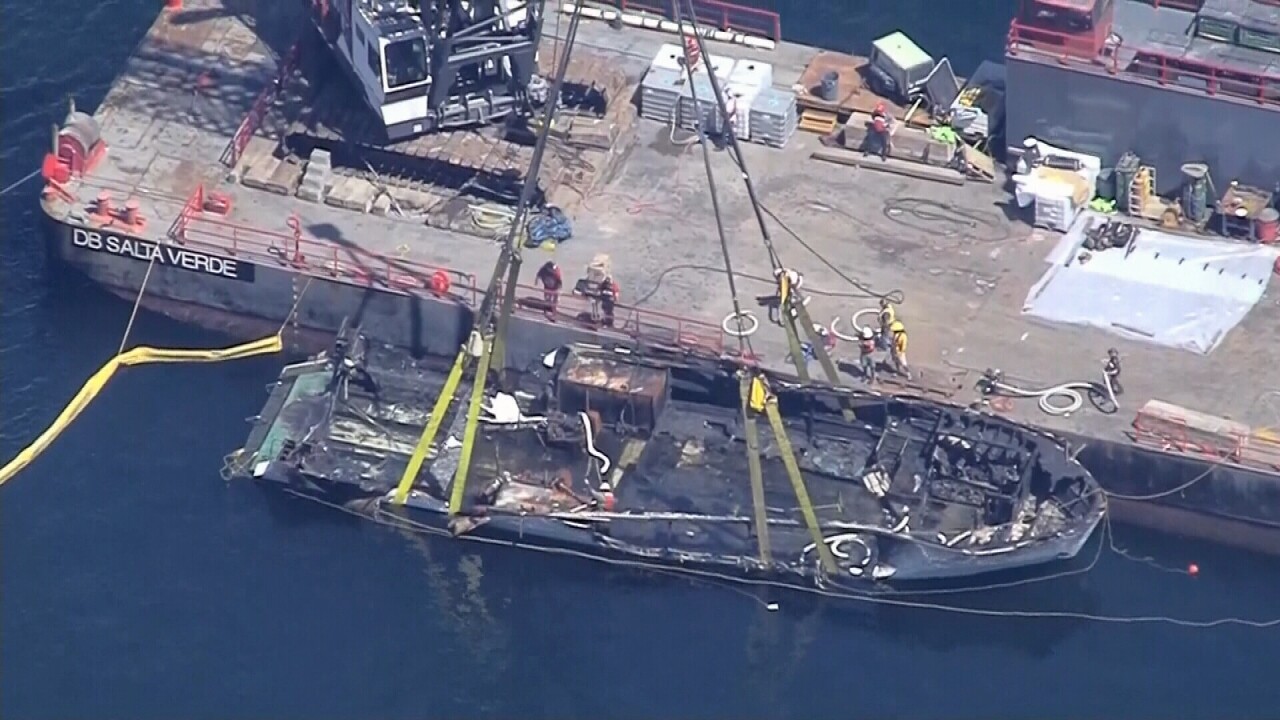
A scuba dive boat captain was ordered Wednesday to pay about $32,000 in restitution to the families of three of the 34 people killed in a fire aboard the vessel in 2019.
Jerry Boylan’s criminal negligence as captain of the Conception led to the deadliest maritime disaster in recent U.S. history. Wednesday’s restitution order by a federal judge comes nearly five years after the Sept. 2, 2019, tragedy off the central California coast, which prompted changes to maritime regulations and several ongoing lawsuits.
Boylan was convicted last year of one count of misconduct or neglect of ship officer following a 10-day trial in federal court in downtown Los Angeles. The charge is a pre-Civil War statute colloquially known as seaman’s manslaughter that was designed to hold steamboat captains and crew responsible for maritime disasters.
He was sentenced to four years in prison and three years of supervised release. Boylan was also ordered to pay restitution to the families of the victims.
Wednesday’s order granted restitution payments to just three of the victims’ families who submitted documentation for $32,178.82 in funeral expenses. Several other cases are still in dispute, as well as claims for lost property on the boat.
Other claims for restitution for psychological counseling, lost income, travel expenses and legal fees were not granted.
Several families said they did not know to keep receipts for funeral expenses, or that it was too emotionally difficult to go through which physical belongings were lost on the boat.
“It’s too hard,” said Christina Quitasol, who lost her sisters Evan, Nicole, and Angela Quitasol as well as her father Michael Quitasol. She described covering her entire living room with documents and files sorted by family member.
“It’s expensive to lose five members of one family,” Christina Quitasol said, but she emphasized that at the end of the day, it wasn’t about money, but accountability.
“Holding Boylan accountable for what was lost,” she said. “Their lives were priceless and to value them at the cost of their funeral expenses is upsetting and sickening.”
At a previous hearing, Boylan’s attorney Gabriela Rivera said Boylan had no significant assets and would not be able to pay restitution. Rivera said Boylan was living off Social Security payments, had no family, and no “meaningful job prospects.”
Prosecutors disagreed, arguing that Boylan had assets totaling six figures and that a restitution order would mean that if he ever did come into money, he would have to pay the victims.
Boylan was out on bond and scheduled to report to the Bureau of Prisons by Aug. 8, but his defense attorney argued at a Monday hearing to allow him to remain out of prison while his appeal is ongoing. The judge did not issue a final ruling yet.
The Conception was anchored off Santa Cruz Island, 25 miles south of Santa Barbara, when it caught fire before dawn on the final day of a three-day excursion, sinking less than 100 feet from shore.
Thirty-three passengers and a crew member perished, trapped in a bunkroom below deck. Among the dead were the deckhand, who had landed her dream job; an environmental scientist who did research in Antarctica; a globe-trotting couple; a Singaporean data scientist; and a family of three sisters, their father and his wife.
Boylan was the first to abandon ship and jump overboard. Four crew members who joined him also survived.
Prosecutors blamed Boylan for failing to post the required roving night watch and properly train his crew in firefighting. The lack of the roving watch meant the fire was able to spread undetected across the 75-foot boat while passengers were sleeping. The exact cause of the blaze remains undetermined.
Victims’ families are still locked in civil lawsuits against boat owner Glen Fritzler and his wife, who own Truth Aquatics Inc., which operated the Conception and two other scuba dive boats. Also pending is a case against the Coast Guard for what they allege was lax enforcement of the roving watch requirement.
SPACER
9th Circuit Upholds Captain’s Conviction In Conception Fire


The captain of the Conception dive boat, where a 2019 fire off the Channel Islands killed 34 people, has lost his latest bid to overturn his conviction. A federal appeals panel on Tuesday upheld the manslaughter conviction of Jerry Nehl Boylan, who was found guilty by a jury in November 2023 and later sentenced to four years in prison. Boylan has remained free while appealing, but the ruling keeps intact a landmark case that grew out of one of California’s deadliest peacetime maritime disasters.
What the appeals court said
According to Justia, the Ninth Circuit panel, in an opinion by Judge John B. Owens, affirmed Boylan’s conviction under 18 U.S.C. § 1115 and held that the statute does not require proof of “gross negligence.” The court said any fuzziness in the jury instructions, including the use of the term “misconduct,” was harmless because the trial judge repeatedly framed the case as one involving gross negligence and the record contained overwhelming evidence. The opinion leaves in place both the jury’s verdict and the legal rationale that supported it.
Evidence that swayed the jury
At trial, prosecutors highlighted long-standing safety failures aboard the Conception, including the lack of a required overnight roving watch, inadequate fire drills, and ignored certificate-of-inspection rules that they said allowed a fire to grow unchecked. Trial testimony described crew members running past a 50-foot fire hose while passengers slept below, and detailed how Boylan called a mayday at 3:14 a.m. and then jumped overboard as the vessel burned, according to the Los Angeles Times. The jury convicted Boylan in November 2023 after a two-week trial, and a federal judge sentenced him to four years in prison in May 2024, according to AP.
Families respond
Relatives of those killed said the appeals decision brought a measure of relief after years of legal back-and-forth. “The original conviction for seaman’s manslaughter of 34 people was the correct verdict and it has been reaffirmed,” said Maggie Strom, whose husband Ted died on the Conception. Other family members told the Los Angeles Times they hope the ruling sends a clear message to vessel operators about basic safety precautions.
Regulatory fallout and safety changes
The disaster set off an intensive federal investigation and a wave of safety recommendations. The National Transportation Safety Board concluded that the probable cause was Truth Aquatics’ failure to provide effective oversight, including not maintaining the required roving patrol, and it urged steps such as interconnected smoke detectors, unobstructed secondary escape routes and mandatory safety-management systems, according to the NTSB’s investigation. Congress also pushed changes into law, with lawmakers inserting a Small Passenger Vessel Safety provision into the annual defense bill to tighten escape and alarm standards for small overnight passenger vessels, according to a press release from Rep. Julia Brownley.
Legal takeaway
From a legal standpoint, the Ninth Circuit’s opinion narrows a key defense argument by concluding that the statute’s mens rea standard is negligence rather than an elevated gross-negligence threshold, and it found that the strength of the evidence made any flaws in the jury instructions immaterial. Commentators noted that while the majority described the proof as “overwhelming,” one judge wrote separately to question parts of the reasoning, a split that could influence how future cases are argued. As Law360 observed, that tonal divide between the majority and the concurrence may figure in any attempt to seek further review.
What comes next
Boylan still has procedural options, including asking the full Ninth Circuit to rehear the case or petitioning the U.S. Supreme Court for review, though both paths are uncertain and rarely successful. Local reporting noted that Boylan was allowed to remain free on bond after his 2024 sentencing while his appeal played out, a status that will change only if the courts order him to surrender. For now, the ruling closes a long-running legal chapter while keeping attention on how aggressively the post-Conception safety reforms are enforced on the water.
SPACER
September 13, 2023
This article was co-authored by Barrett Hails for Benedict’s Maritime Bulletin and was published August 22, 2023.
On December 23, 2022, President Biden signed the James M. Inhofe National Defense Authorization Actfor Fiscal Year 2023 into law. PL 117-263, December 23, 2022, 136 Stat 2395. While the overwhelming majority of the lengthy 2400 page legislation addresses financial appropriations related to defense spending, the final “Division K” of the bill’s eleven divisions, entitled the “Don Young Coast Guard Authorization Act of 2022,”contains several significant amendments impacting the maritime industry.This includes Section 11503, which amends the Limitation of Liability Act, 46 U.S.C. §§ 30501, et seq. (the “Limitation Act”), to specifically exclude its application to “covered small passenger vessels”while maintaining its application for owners and operators of “seagoing vessels and vessels used on lakes and rivers or in inland navigation.” § 30502.
A. Introduction of Legislation to Modify the Limitation Act
While the Limitation Act has been no stranger to criticism over the years,this most recent amendment was originally introduced by Senator Dianne Feinstein (D-CA) and Representative Salud Carbajal (CA-24) in 2021 following the fire aboard the dive boat CONCEPTION off the coast of California in September 2019 which resulted in the loss of thirty-three passengers and one crewmember.The originally proposed legislation, entitled the “Small Passenger Vessel Liability Fairness Act of 2021”required, in part, that the “Coast Guard to promulgate rules that require owners or operators of small passenger vessels to provide just compensation in any claim for which they are found liable.”Further, the legislation would have been retroactive to be effective as of the date of the CONCEPTION casualty.
B. The Final Legislation
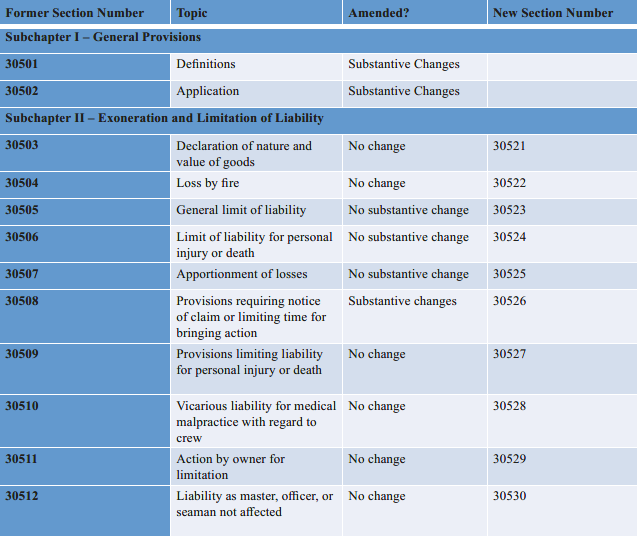
The retroactive effective date, which would have had far reaching implications for essentially all prior marine causalities, did not survive bipartisan negotiation, and the final legislation passed by Congress and signed into law on December 23, 2022, is more limited in scope, essentially carving small passenger vessels out of the Limitation Act, among other changes discussed below, and, significantly, contains no language as to its retroactivity.[1]For reasons unclear, the amendment renumbers certain sections.Practitioners will recall that previously the Limitation Act was codified as 46 U.S.C. § 181 et seq. but in 20016, was changed to 46 U.S.C. § 30501 et seq. The Limitation Act amendments renumber all sections following Section 30502, and, specifically, prior Sections 30503 through 30512 are now renumbered consecutively as Sections 30521 through 30530. No mention is made of the Supplemental Rules for Certain Admiralty or Maritime Claims and Asset Forfeiture Actions, in particular Supplemental Rule F which is entitled “Limitation of Liability” and refers to many procedures for vessel limitation actions.
The primary amendments to the Limitation Act are contained in Sections 30501 and 30502 entitled “Definitions” and “Application” respectively, as well as in Section 30526 entitled “Provisions requiring notice of claim or limiting time for bringing action”
1. Exclusion of “Covered Small Passenger Vessels”
The “Application” section, Section 30502, includes a new subsection ((b)), which reads “Exception- This chapter (except for section 30526) shall not apply to covered small passenger vessels.”In other words, if the vessel qualifies as a “covered small passenger vessel”, by the terms of Section 30502, it should be excluded from the Limitation Act.
Section 30501(1)(A) now defines a “covered small passenger vessel” as a “small passenger vessel, as defined in [46 U.S.C. § 2101] that is (i) not a wing-in-ground craft; and (ii) carrying – (I) not more than 49 passengers on an overnight domestic voyage; and (II) not more than 150 passengers on any voyage that is not an overnight domestic voyage…” 46 U.S.C. § 2101(45) defines a “small passenger vessel” as either a “wing-in-ground” craft carrying at least one passenger for hire; and a vessel of less than 100 gross tons : (A) carrying more than 6 passengers, including at least one passenger for hire; (B) that is chartered with the crew provided or specified by the owner or the owner’s representative and carrying more than 6 passengers; (C) that is chartered with no crew provided or specified by the owner or the owner’s representative and carrying more than 12 passengers;(D) that is a submersible vessel carrying at least one passenger for hire; or (E) that is a ferry carrying more than 6 passengers. Section 2101(47)(A)-(E). A “covered small passenger vessel” is also expressly defined to include wooden vessels constructed prior to March 11, 1996 which are carrying at least one passenger for hire. § 30502(B). The reason for the inclusion of wooden vessels and the 1996 date is not clear(though the CONCEPTION was a wooden vessel which was covered in fiberglass).Although Section 2101 addresses five categories of vessels as “small passenger vessels” so long as they are less than 100 gross tons,all categories require 12 or less passengers, and therefore, Section 30501, which requires either less than 49 or 150 passengers (depending on the nature of the voyage) effectively creates an additional subcategory of vessels in addition to Section 2101(47).
To summarize, unless the vessel at issue is a wing-in-ground craft, the following vessels appear to be excluded from the Limitation Act:
-
- Wooden vessels constructed prior to March 11, 1996 carrying at least one passenger for hire;
- Vessels less than 100 gross tons carrying 49 or less passengers on an overnight domestic voyage;
- Vessels less than 100 gross tons carrying 150 or less passengers that is not on an overnight domestic voyage.
2. Contractual Time Limits to Bring Actions
In addition to carving out small passenger vessels, another significant substantive change to the Limitation Act is to former Section 30508 (now 30526) which previously addressed contractual time limits for bringing notice of a claim and an action against a seagoing vessel. Section 30526 now adds “covered small passenger vessels” to these provisions setting out the permissible minimum claim time limits and provides that passengers aboard covered small passenger vessels must have no less than two years to provide notice or bring an action after injury or death.Therefore, those operating a covered small passenger vessel may now not contractually limit the time to bring a claim or notice of a claim against them to less than two years from the date of incident.The amendment does not reference or address its impact or relationship to 46 U.S.C. § 30106, which includes its three-year time limit for bringing maritime tort claims for injury or death.
From a practitioner’s perspective, the amendment appears likely to create many questions in the short term.As noted above, no reference is made to Rule F of the Supplemental Rules for Admiralty or Maritime Claimsor whether the concursus procedure remains available to those operating “covered small passenger vessels” even if limitation is not available.Further, Rule F expressly references exoneration and contemplates the filing of a complaint in federal court.Supplemental Rule F (2), (5) & (9). The amendments do not refer to any state court procedures, and therefore, whether limitation could still be raised as an affirmative defense is not known. Since no mention is made of whether the amendment is retroactive, questions will undoubtedly be raised as to whether an incident which occurred before the effective date but for which a limitation act was not filed until after the amendment took effect is timely.What if one vessel in a flotilla qualifies as a “covered small passenger vessel” but the other does not?Additionally, it is unclear what result these amendments will have on available marine insurance coverage for owners and operators of “covered small passenger vessels”who arguably may no longer have the benefit of the Limitation Act’s protection. Given the recent adoption, there does not appear to be any judicial guidance on interpreting the amendments at the time of drafting;however, the ultimate impact of carving out “covered small passenger vessels” from the Limitation Act will likely take years to fully evaluate.
The chart below references the prior statutory references with the new references, with a further indication of whether a substantive change has been made.
[1] Source of Amendment:
PL 117-263, December 23, 2022, 136 Stat 2395, James M. Inhofe National Defense Authorization Act for Fiscal Year 2023, (11) Division K “Don Young Coast Guard Authorization Act of 2022” Title CXV – Maritime, Subtitle A- Vessel Safety, Sec. 11503
spacer
VIEW THE WHOLE SERIES:
CONCEPTION- The Saga of the Fire on the Conception and why it should matter to you. – Part 2

We are still very highly suspicious of what happened on the Conception. From the voice recording as you have heard, it sounds as if the Captain says “Don’t Kill Me”. Very curious. We have not been able to establish if the Captain stated that the divers exit was Locked or Blocked. Though, from the questions … Click Here to Read More
CONCEPTION – WHAT IS HAPPENING IN SEPTEMBER??? – Part 3

Let me start by saying that EVERY SINGLE ONE of the people on that boat were there for a reason! Each one of them was a necessary part of the evil magick the elite are working. They were sacrificed. I have absolutely no doubt that this was a very deliberate and very strategic act. That … Click Here to Read More
spacer