TRUST ME, IF/WHEN THE WATERS OF THE GREAT LAKES DUMP INTO OUR ALREADY OVER STRESSED RIVER SYSTEM IT WILL AFFECT THE WHOLE NATION!
I don’t know what it will take for more people to understand that they are manipulating our atmosphere and our environment to create disasters with the intent of driving u our of our homes, businesses and automobiles. YOU WILL OWN NOTHING!!! They keep telling you that.
Today we will look at what is going on in Michigan but also provide you with tools you can use to see what is happening in your neck of the woods regarding FLOODING.
There used to be multiple websites that provided free access to maps related to Disaster such as Fires, Earthquakes, Hurricanes, Tsunamis and Flooding Worldwide. I have not been able to find one yet that is current. If you know of one, please send me a link.
I have a whole series on DAMS links will be below. This crazy weather just keeps getting crazier. THEY ARE LYING TO YOU ABOUT THE CAUSES!
Once you have viewed this post, I encourage you to research what has been going on in your area, and what is currently going on across the USA and around the WORLD. It is not by accident and these events are not ACTS OF GOD!! If you want to know what GOD has to do with any of them, think about how few people have died in these events! It is miraculous!! I have no doubt the enemy and his minions are really aggravated about that!


Overview of Michigan Dams
Major Dams and Reservoirs
-
Croton Dam (Newaygo County)
-
Hardy Dam (Newaygo County)
-
Edenville Dam (Gladwin County)
-
Sanford Dam (Midland County)
-
Cheboygan Dam (Cheboygan County)
Current Safety Concerns
Dam Management and Safety
-
Non-hydropower dams over six feet in height and impounding more than five acres are regulated.
-
Permits are required for construction or repair of regulated dams.
-
Inspections are conducted regularly, and technical guidance is provided to mitigate risks.
Resources and Maps
technical data. The Michigan Dam Inventory and online GIS tools allow users to explore dam locations, hazard ratings, and regulatory status. ArcGIS+1
Residents and stakeholders are encouraged to stay informed about local dam conditions, especially during periods of heavy rainfall or snowmelt, and to follow guidance from local authorities regarding evacuation or safety measures.
spacer
“
Thunderstorms are expected statewide, though the central to southeast Lower Peninsula has the greatest chance to see severe conditions.

“Moderate to locally heavy rainfall today may exacerbate ongoing localized flooding issues near rivers, lakes, and poor drainage areas. Please see the latest flood warnings for more information,” the NWS said.
A flood watch remains in place for Baraga, Dickinson, Iron, Marquette, Houghton, Ontonagon, Keweenaw counties in the western Upper Peninsula. Flood warnings have also continue for high water on several rivers across Michigan.
Weather officials urge residents to have multiple ways of receiving weather updates throughout the day and night.
Here’s the Michigan radar and where flood warnings are in place as of April 24:
Rain is on the move: See Michigan Doppler weather radar
Current weather warnings, advisories for Michigan
This article originally appeared on Lansing State Journal: Storms expected to arrive ahead of cold front. See current radar


4/23/26

It has been a rough spring in Michigan. Heavy rain fell on already saturated ground. Roads flooded. Waterways overflowed. And it has taken its toll on the state’s bridges.
Since the flooding began, at least 22 Michigan bridges have closed. Two of them collapsed.
Reports of the unplanned bridge closures stretched across 13 counties, including Alcona, Arenac, Grand Traverse, Iron, Manistee, Menominee, Midland, Muskegon, Newaygo, Oakland, Osceola, Van Buren and Wexford, according to the Michigan Department of Transportation (MDOT).
The flooding exposes a wider problem: aging, underfunded infrastructure vulnerable to increasingly intense storms.
The bridge count includes unplanned closures of structures that are 20 feet or longer on public roads. The closures range from a 66-year-old bridge in Iron County in the Upper Peninsula, previously rated in fair condition, to a bridge listed in poor condition in Van Buren County on the west side of the state, to multiple closures in Menominee and Grand Traverse County.
At least half of the bridges that closed unexpectedly have since reopened, an MDOT official wrote in an email on Monday afternoon, April 20.
The statewide flooding and infrastructure damage are unlike anything we’ve seen before, said Mike Shriberg, professor and director of the University of Michigan Water Center.
Flood emergency issued for Black Lake, Michigan area after massive flooding (WHIO Dayton)

What used to be the rare exception is now the new normal.
“Climate change supercharges the atmosphere,” he explained. A warmer atmosphere holds more water — think larger buckets dumping from the sky. That means bigger storms and droughts.
After a week of flooding, two Michigan bridges didn’t hold.
Both structures were county-owned and had already been closed before they collapsed, according to MDOT. The Beitner Road bridge over the Boardman River, south of Traverse City in Grand Traverse County, was rated in poor condition, according to the latest state inspection data. The Johnson Road bridge over Big Bear Creek in Manistee County was rated in fair condition before it failed.
In Grand Traverse County, two additional bridges carrying traffic on South Airport Road over the Boardman River were closed due to rising floodwaters but reopened over the weekend.
The numbers don’t surprise Shriberg.
“Right now, we are kind of running to stay in place at best,” he said, “and the landscape is changing under us … because of the impacts of climate change.”
There is no substitute for investing smartly and more in roads, dams and bridges, he said. “Every day you don’t invest, you’re moving backwards.”
Kristi Tanner is a data reporter. Contact her at ktanner@freepress.com.
This article originally appeared on Detroit Free Press: Flooding closes 22 bridges in 13 counties; half have reopened, state says
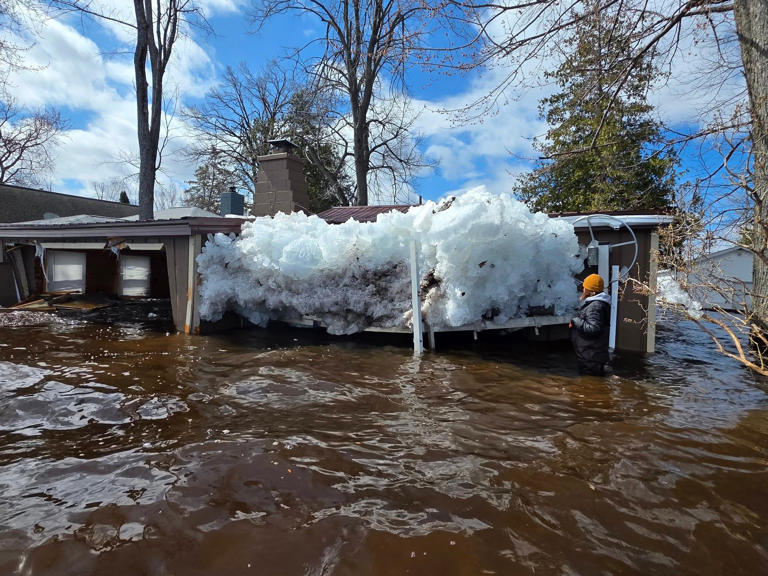
As Up North floodwaters continue to recede, lakefront cottages are facing another danger: ice tsunamis.
Some cottages on Black Lake in the upper Lower Peninsula have reportedly taken damage in recent days from windblown ice chunks that came ashore and plowed into their walls and windows.
“There is probably a piece out there that’s in the south end of the lake that’s probably 5-square-miles big — it’s a big chunk — and it’s just floating around out there,” Gil Archambo, who is supervisor for Grant Township that covers the northwest portion of the lake, said on Tuesday, April 21.
“As soon as the wind blows, in whichever direction it goes, it’s coming to shore,” he said.
“The ice is starting to do some serious damage,” Archambo said.


A significant number of cottages along Black Lake Contact JC Reindl: 313-378-5460 or jcreindl@freepress.com. Follow him on X @jcreindl
This article originally appeared on Detroit Free Press: Ice tsunami threatens Black Lake homes after flooding
spacer

spacer
State of emergency declared over rising water levels in Cheboygan
The move comes after the river rose to within 18 inches of the top of the Cheboygan Dam the past 24 hours

CHEBOYGAN, Mich. – Local and state agencies were on high alert Friday after a state of emergency was declared in Cheboygan, following rising water levels near a dam that raised concerns about potential flooding.
Governor Gretchen Whitmer activated the state’s Emergency Operations Center to coordinate response efforts among local, state, and federal agencies.
The move comes after the river rose to within 18 inches of the top of the Cheboygan Dam over the past 24 hours.
Officials said the emergency declaration ensures local leaders have access to additional state resources and could open the door for federal assistance if conditions worsen.
Response teams are exploring ways to increase water outflow and reduce pressure on the dam.
That includes evaluating whether a previously damaged hydroelectric generator can be brought back online to help manage water levels.
“This step helps position our community to stay ahead of any potential challenges,” said state Rep. Cam Cavitt, a Republican from Cheboygan.
He said local crews are already working on the ground, with support from the Michigan Department of Natural Resources and the Michigan Department of Environment, Great Lakes, and Energy, which are assisting with monitoring and response efforts.
Cavitt said he remains in close contact with local officials and will continue to provide updates as more information becomes available.
Residents in need of assistance can contact Cavitt’s office at 517-373-0833.
Copyright 2026 by WDIV ClickOnDetroit – All rights reserved.
 The Cheboygan Lock and Dam is currently at high risk of flooding,
with water levels rising to within 18 inches of the dam’s crest, prompting a state of emergency. Current SituationEmergency MeasuresRisk Management and PreparednessPotential Impact |


Residents near the Cheboygan Lock and Dam Complex should be prepared to evacuate at any time, officials said Monday, as the water level rose amid Sunday rain and the continued threat of rain through late Thursday.
A crane removed gates at the dam in order to increase water flow and manage rising water levels behind the dam along the Cheboygan River in the city of Cheboygan, the Michigan State Police’s Emergency Management and Homeland Security Division said Monday on Facebook.
The Cheboygan County Sheriff’s Office warned residents on Monday that the dam’s water levels have reached the “READY” mark as rain continued to be in the forecast for the next few days and the National Weather Service declared a flood watch until 8 a.m., Wednesday, April 15.
Under the “READY, SET, GO”safety system that the Michigan Department of Natural Resources is using to address the swelling waterway, the READY mark means water is 12 inches below the top of the dam, with levels rising 3 inches a day or more. That’s when residents in the area should plan or pack in case an evacuation is ordered.
DNR officials said water had risen to within 15 inches of the top of the dam by Sunday afternoon, and more rain and snowmelt threatened the waterway.

The Michigan Department of Transportation closed the US-23 drawbridge in Cheboygan on Monday and will raise it to protect drivers and pedestrians, according to a department press release. Engineers have not seen significant erosion around the bridge, but increased river flow could scour the sediment away from the 86-year-old bridge’s footing.
Traffic will be detoured to the Lincoln Avenue Bridge, which is upstream of the dam. There is no timeline for reopening the US-23 drawbridge. It will need to be inspected before it is reopened.
What officials are urging Cheboygan area residents to do
On Monday, the sheriff’s office urged residents to prepare a go-bag containing essential items, such as medications and important documents. It also said they should review their family’s evacuation plans, monitor official updates, and be ready to act. Before leaving, residents should secure outdoor items and move valuables to higher levels. Finally, the office said residents should avoid riverbanks and low-lying areas while traveling.
In the ready, set, go system, set means residents should pack and prepare their families and pets for a possible departure when the water reaches 6 inches below the top of the dam, with water levels rising at a rate of 3 inches per day or a prediction that the water will top the dam within 48 hours.
In the last step, GO, residents will be ordered to evacuate when the water level is 1 inch below the top of the dam, with a high probability of topping it and the possibility of the dam failing. Individuals should follow evacuation orders and be aware that roadblocks may be installed around the perimeters, according to officials.
The Cheboygan Dam is a hydroelectric dam built in 1922, according to the National Dam Inventory maintained by the Federal Energy Regulatory Commission. It is a high-hazard dam, meaning it could cause destruction and potential loss of life if it were to fail. The dam was in “fair” condition when it was inspected in September, 2022, according to the FERC inventory.
The dam is not producing power, said Bob Stuber, executive director of Michigan Hydro Relicensing Coalition, a coalition of conservation nonprofits.
The dam is part of a lock system that allows boats to move up and down the Cheboygan River, Stuber said. The DNR manages the lock system.
How state and local officials have been trying to divert water from the dam
On Sunday, DNR officials said The DNR said it placed 1,500 sandbags along the lock on Thursday and added more sandbags in strategic locations around the dam on Saturday. The sandbagging is expected to be a buffer for rising water and help channel the water, the department said.
In addition, crews on Saturday removed an old wooden debris screen in front of the dam’s Gate No. 6 after determining the removal wouldn’t damage the dam, DNR spokeswoman Laurie Abel said. This is expected to help more water flow out and lower the water level behind the dam, Abel said.
Under flooding protocols, residents near the waterway would be ordered to evacuate if the water level is 1 inch below the top of the dam, but they are asked to prepare amid rising levels before then.
On Friday, Gov. Gretchen Whitmer The forecast for the Cheboygan area on Monday is partly sunny with a high of 52 degrees, with scattered thunderstorms Monday night. There is a 30%-60% chance of scattered showers on Tuesday and a 40% chance Tuesday night.
The rain is expected to continue through Wednesday and Thursday, including a chance of thunderstorms on Thursday night.
This article originally appeared on The Detroit News: Cheboygan Dam area residents warned to pack for evacuation
spacer

Gate releases at the Mio and Tippy dams triggered flash flood warnings on the Au Sable and Manistee Rivers on Sunday and Monday, April 12 and 13, 2026.Garret Ellison
MANISTEE COUNTY, MI — Gate releases at two Consumers Energy hydroelectric dams have triggered flash flood warnings along stretches of the Au Sable and Manistee rivers in northern Michigan.
The National Weather Service in Gaylord said high flows released through Mio Dam and Tippy Dam were causing flash flooding in low-lying areas across parts of Manistee, Alcona and Oscoda counties.
The Au Sable River near Red Oak upstream of Mio Dam is under a major flood warning and is expected to reach 8.5-feet on Wednesday, which would be the highest known river flow and height at that location.
At Tippy Dam, the weather service warned about impacts to High Bridge Campground downstream.
People downstream of the hydro facilities are advised to move to higher ground and avoid flooded areas.
The Manistee County Sheriff’s Office said Monday morning that there is “no imminent threat to the dam or surrounding area” but “residents can expect higher than normal water levels and minor flooding along the river over the next couple days.”
Consumers Energy spokesperson Brian Wheeler said that Mio, Tippy, Alcona, Foote and Cooke dams have reached what’s called Condition C, a federal designation that indicates an unusual situation has occurred but a dam failure is not expected.
“We open gates to create a “run of river” when we reach this high water-flow level,“ Wheeler said. ”This designation is based on historical data and engineering studies, and is different for each dam. We follow standard water management protocol in this situation.”
“We provide notifications to local emergency management officials, who then notify communities of the potential for flooding downstream due to high water levels,” he said.
Mio is the uppermost Consumers dam on the Au Sable River. Downstream are the Alcona, Loud, Five Channels, Cooke and Foote dams.
The gate releases are hitting rivers already swollen by northern Michigan’s broader flood pattern. A flood watch covers all of the Upper Peninsula and northern Lower Michigan as multiple waves of showers and thunderstorms are bringing heavy rainfall on top of melting snowpack and already saturated soils.
Additional waves of rain and thunderstorms are expected Tuesday and Wednesday night into Thursday.
Overview of Dams in Michigan
Safety and Regulation
Notable Dams
Resources for More Information
-
This information highlights the importance of dams in Michigan, their regulatory environment, and ongoing efforts to ensure their safety and functionality.
 b 2 Sources
spacer
Aging. Deteriorating. Dangerous. That’s how EGLE describes dams in Michigan
Check the data on dams in your Michigan county here

Aging. Deteriorating. Dangerous. That’s how EGLE describes dams in Michigan.
EGLE said that there’s just not enough money to take care of Michigan’s dams — especially the ones that have gone decades putting off maintenance. And it’s putting people and property at risk.
“Neglect any infrastructure long enough, and it will fail,” said Luke Trumble, head of the Michigan Department of Environment, Great Lakes, and Energy’s (EGLE) Dam Safety Unit. “Dams that have lasted a lifetime can fail in an instant. Preventive action must be our top priority when people’s lives and homes are at risk.”


National Inventory of Dams
There are more than 2,500 dams in Michigan and 1,039 of them are tracked by the National Inventory of Dams — that’s the database maintained by the U.S. Army Corps of Engineers.
The National Inventory of Dams only includes dams that meet certain criteria:
-
Dams that have a high hazard potential. That means that if the dam failed it could flood main highways, homes, and people could die.
-
Dams that have a significant hazard potential.
-
Dams that meet a minimum height and reservoir size.
What is a high hazard dam?
If a high hazard dam were to fail then flooding would impact main highways, or expressways, flood homes, potentially wash out commuter railways, and more, according to Trumble. The biggest takeaway is that a high hazard dam failure could lead to loss of life.
The National Inventory of Dams has 161 dams in Michigan with high hazard potential. Three of those dams do not have an emergency action plan in place — that’s the plan the dam owner and emergency responders are supposed to have in case the dams fail.
How do Michigan’s dams compare the the nations?
According to the National Inventory of Dams the national average dam age is 64 years old. Michigan’s average dam age is older than that . . . our dams average 80 years old.
“Since 2020, the State of Michigan has awarded grants and emergency funds, improved enforcement, and expanded its Dam Safety Unit, but it’s not enough to hold back the pressure on Michigan’s numerous aging, deteriorating, dangerous dams,” Trumble wrote in an Oct. 21, 2025 article for EGLE.
Here’s a chart that shows how Michigan’s dams compare to the nationwide data. The numbers in this chart come from the National Inventory of Dams. Click the tabs to switch between Michigan’s data and the nationwide data.

How are the dams in your county? Check here
This data comes from the National Inventory of Dams and only includes information for the dams the military tracks. Click the dropdown menu to choose your county.
USE THE FOLLOWING TOOL TO SEE THE HOW THE DAMS IN YOUR COUNTY MEASURE UP. In the DROP DOWN SELECT YOUR COUNTY AND IT WINDOW THAT WILL SHOW YOU THE STATS.
Which county has the most dams?
This chart includes data from the National Inventory of Dams and Michigan’s List of Dams — just click the tabs to switch between the maps.

Across both datasets Oakland County has the most dams. There are 69 dams in Oakland County tracked by the National Inventory of Dams and 150 dams on Michigan’s list.
In the box below: Hover over the map or click on a county to see the number of dams in that county.
High hazard potential dams without emergency action plans
There are 161 dams in Michigan that are classified as having a high hazard potential. Only three of those do not have a required Emergency Action Plan in place.
There are three dams in Michigan on the National Inventory of Dams that do not have emergency action plans:
-
Impoundment No 1 in Chippewa County. It’s privately owned by Michigan Limestone OPLTD. Its stated purpose is tailings and it was last inspected on March 15, 2010.
-
Lake 13 Dam in Clare County. It’s privately owned by the Lake 13 Association. Its stated purpose is recreation and it was last inspected on Oct. 14, 2019.
-
Myers-Henderson Detention Pond in Shiawassee County. It’s privately owned by the Eaton County Drain Commissioner. Its stated purpose is flood risk reduction. It was last inspected on Oct. 30, 2020.
High hazard potential dams that aren’t required to have an emergency action plan
There are four dams on the National Inventory of Dams that are not required to have an Emergency Action Plan in place:
-
Brown Bridge Dam in Grand Traverse County. It’s government-owned by the city of Traverse City. Its stated purpose is recreation and it was last inspected on June 18, 2008.
-
Grand Rapids West Side Dam in Kent County. It’s government-owned by Kent County. Its stated purpose is recreation and it was last inspected on January 1, 1901.
-
Middle Comstock Dam in Kalamazoo County. It’s government-owned by Comstock Township. Its stated purpose is recreation and it was last inspected on Nov. 29, 1979.
-
Lower Comstock Dam in Kalamazoo County. It’s government-owned by Comstock Township. Its stated purpose is recreation and it was last inspected on Nov. 29, 1978.
Copyright 2025 by WDIV ClickOnDetroit – All rights reserved.
spacer
|
|
|
|
| Edgar Cayce Future Map Of The United States | World Maps Library – Complete Resources: Edgar Cayce Maps North America |
Edgar Cayce Map Of USA Printable – Edgar Cayce Predictions |


The Edgar Casey Future Map of the USA has been around since the early 1930’s. I do not give credence to any New Age “Prophet” especially one who receives their “messages” during Altered States of Consciousness or communication with some spirit other than the Holy Spirit of God. Those who belong to God do not need any go-between. We have direct access to the throne by the power of the blood shed for us on Calvary. We have the leading and guidance of the HOLY SPIRIT of GOD living in us.
At the same time, those who do not belong to God are pagans who are manipulated, controlled, and slaves to demonic spirits. They put full confidence in all the magic arts and spiritual rituals and traditions. They also know full well that there are spiritual entities who rule this earth. These people live their lives based on those beliefs and practices.
Then there are those who are the kings and princes of this world. The power brokers. Those elite who rule over the masses. They use tools like the Edgar Casey Map to develop their devices and plan out their stretgy to gain complete power over the people of the earth.
My point is, they have held these maps out to the public as predictive programming. A tool to aid in bringing the public to believe in things like Global Warming, Ice Ages, Climate Change, Pole Shifts, Space Travel, etc.
They have been manipulation humans, the weather, the environment… to bring about their goals. They manipulate the world economy, our food and water sources, our worldview, our imaginations and they will not stop until they take EVERYTHING… including your heart, mind and spirit.
spacer
DAM SHAME – USA
UPDATE ADDED 9/11/24; UPDATE ADDED 9/13/24 This is not the first time I have visited this topic, but the gravity of the situation demands attention. I have no doubt in my mind that they plan on causing the earth to be flooded. They love to show the Map of the Prediction of what the USA … Click Here to Read More
It’s A DAM SHAME! Prado DAM MURAL
spacer This amazing mural has stood for the honor and glory of the United States of America for many years. It is a major bastion of American Freedom and a treasure to all true Patriots. I am certain that in the minds of the Ruling Elite this monument cannot be allowed to continue to … Click Here to Read More
Millions Could Be Washed Away
TAGS: La Palma, volcanic activity, Earthquakes, Tsunami, Tsunami Travel Times, Atlantic Ocean, Pacific Ocean, Fault Lines, Flooding, Canary Islands, US East Coast, US West Coast, New Madrid Fault Line, Fracking, NOAA, NAFTA, Super Highway, Nuclear Power Plants, Dams, Geo-Magnetic Storms, CME, Electro-Magnetic Waves, Frequencies, Sound Waves, Geo Engineering, Weather Manipulation, Glaciers, Global Warming, MAPS, Edgar … Click Here to Read More
It’s a DAM Shame – Part 5 – 2020 NO IMPROVEMENT
Photo Credit: Pinterest Whether the dams are destroyed by weather or by terrorism, poor maintenance just old age, they will inundate our countryside and kill countless people. Though many of these aging and dilapidated dams have already been dismantled, thousands more remain a deadly threat. A great tool for depopulation, which is the stated goal … Click Here to Read More
LEVEE BREACHES, DAM BURSTS, RIVER SURGES, FLOODING
In the current state of our Earth, there is an overabundance of catastrophic events. Too many to cover in any one article or series of articles. I have broken the weather down to Earthquakes, Severe Weather, and Flooding. I may have to add categories as things progress. In this series of articles, I will be … Click Here to Read More


THE UN IS NOT YOUR FRIEND – Part 5 – DISASTERS TO DEPOPULATE
THE MAJORITY OF THIS DOCUMENT WAS WRITTEN/COMPILED BY A MINISTRY CALLED “THE CUTTING EDGE” Kudos to them and many thanks. Please visit their website by clicking. HERE I wish I had an update to this article because there has been an enormous increase in disasters since this article was written. I am sure you can … Click Here to Read More

DISASTERS TO IMPLEMENT AGENDA 2021/2030
If you believe the UN and Climate Change… you believe that HUMANS are UNSUSTAINABLE!! Ok, it was originally called AGENDA 2021, later changed to AGENDA 2030. WHY? Did they not reach their goals for 2021 because they were unable? OR Did they move the date out due to new developments that will allow their plans … Click Here to Read More

SPACER