
UPDATE: 8/30/22; RESTORED 5/11/26
What on earth is SAMA?
Samaveda is believed to be origin of Indian music. It gives us knowledge of various chants that have divine effect on our body, mind and soul according to different times of a day. Source
–Pagan Influences on American Society
Cynthia Pawl, December 11, 2015, updated 6/24/18
I work in the medical field. Yesterday, I received an email, from my facility’s education department. They were requesting that I sign up for a course, called SAMA Training. The email stated this was a recommended course, so it was not mandatory for me. The email also advised that attendees should wear pants, preferable workout clothes. Curious as to what the course was about, I asked around. I wanted to see if anyone else on my team had any idea. No one had a clue, though they were busy signing up. Not comfortable committing to something about which I knew nothing, I decided to search the internet for information.
UPDATE: 8/30/22
Well, well, well. Lo and Behold. In researching Wandering Stars, I found the following insight on SAMA. It is SUN WORSHIP. SAMA is the Ancient Name of the SUN God!! Which makes perfect sense as we know that YOGA is Sun Worship! Yoga is a discipline that teaches you to Breathe and pose your body in a manner that gives glory to the SUN. These Sama/Satori also are focused on teaching you breathing and using your body, but to control your emotion and gain control over others.
Classical planet From Wikipedia, the free encyclopedia
Babylonian astronomy
| Sumerian language | Akkadian language | English language | Presiding deity |
|---|---|---|---|
| Bišebi | Šamaš | Sun | Šamaš |
Wow, it was not easy to find. It seemed almost like it was deliberately being concealed. I did finally find an article and here it is:
Here is SAMA According to their website: https://www.samatraining.com/
 |
Satori Alternative to Managing Aggression (SAMA)
Non-Violent Crisis Intervention Training
Satori alternatives to managing aggression are an integrated system of how to:
- assist in preventing physical aggression
- contain a person when he is a danger to himself or others
- handle special situations like retrieving objects
- protect oneself or others from aggressive acts
Satori comes from a Japanese word which means clear understanding, and clear understanding is what people say they experience from this program. This program can and has been successfully applied to virtually any population.
This program teaches verbal de-escalation and physical protection skills. These crisis intervention principles are used to assist someone in the work or home environment who is in distress and may become aggressive. The program is used by many service organizations to support their risk management efforts. It is typically used by healthcare, residential care, childcare, and social services workers, and by foster/adoptive parents who may need to protect themselves and others in volatile situations.
Mild to moderate physical abilities are required
 It can be used by:
 It can be used by:
- foster parents
- those working with the children, adolescents, or senior citizens
- law enforcement agencies, residential treatment centers, private homes
- those working with the mentally ill
- meets the requirements for TBSI (Texas Behavior Support Initiative)
The primary goal of the Satori method of behavior escalation is to prevent aggression from becoming physically harmful. The emphasis of the course focuses on verbal de-escalation in all interactions.
All staff at Texas NeuroRehab Center that interact with the children and adolescents are trained in Satori, and recertified every six months.
Safety is the most important element in managing behaviors with SAMA.
To learn more about the SAMA methods, please visit www.satorilearning.com
Well, that seemed harmless enough. However, it did not really tell me much. Something inside me was uncomfortable and needed to know more about this entire subject. They seemed to be evasive and deliberately deceptive. One thing they made clear is that this course is all about Satori. I decided to look up the meaning and origin of that word. The thing that struck me first was the Oriental symbol at the top of the page. I dug a little deeper into the subject of Satori and even found a website. You can check it out yourself. This website also was not to enlightening.. Off to Wikipedia…
Sama
Sama is believed to have originated from the Austronesian root word sama meaning “together”, “same”, or “kin”.
Sama (様【さま】) is a more respectful version for people of a higher rank than oneself or divine, …When used to refer to oneself, sama expresses extreme arrogance (or self-effacing irony), as in praising one’s self to be of a higher rank, as with ore-sama (俺様, “my esteemed self”). Wikipedia
Babylon Translation
Sama Translation On Other Language: English Romanian
 Sama in English
Sama, Saman (Sanskrit) [from the verbal root sam to be quiet, calm, resigned] Tranquility, calmness, equanimity, absence of passion, emancipation from all the illusions of existence; the fifth of the eight bhava-pushpas (flowers of being) of Buddhism: self-restraint, charity, impersonal affection, veracity, meditation, patience, resignation, and selfless devotion. Through the practice of the eight flowers, sama secures the conquest and final delivery from all kinds of mental and psychological agitation.
Saman [from the verbal root Sam] has an almost identical meaning; also a particular kind of sacred text or verse intended to be chanted — one of the four kinds of Vedic composition. See also SAMA-VEDA
Dictionary source: YOGA
More: English to English translation of Sama

Satori (悟り?) (Chinese: 悟; pinyin: wù; Korean: 오 o; Vietnamese: ngộ) is a Japanese Buddhist term for awakening, “comprehension; understanding”.[web 1]It is derived from the Japanese verb satoru.[1] In the Zen Buddhist tradition, satori refers to the experience of kenshō,[2]“seeing into one’s true nature“. Ken means “seeing,” shō means “nature” or “essence.”[2]
Satori and kenshō are commonly translated as enlightenment, a word that is also used to translate bodhi, prajna, and buddhahood.
D.T. Suzuki: “…. looking into one’s nature or the opening of satori”;[3] “This acquiring of a new point of view in our dealings with life and the world is popularly called by Japanese Zen students ‘satori’ (wu in Chinese). It is really another name for Enlightenment (“Annuttara-samyak-sambodhi”)”.[4][note 1]
Satori is often used interchangeably with kenshō.[2] Kenshō refers to the perception of the BuddhaNature or emptiness. According to some authors, kenshō is a brief glimpse, while satori is considered to be a deeper spiritual experience.[citation needed]
Distinct from this first insight, daigo-tettei is used to refer to a “deep” or lasting realization of the nature of existence.[2]
Importance of Satori
According to D. T. Suzuki, Satori is the raison d’être of Zen, without which Zen is no Zen. Therefore every contrivance, disciplinary and doctrinal, is directed towards satori.[6]
This view is typical of Rinzai, which emphasizes satori. The Sōtō school rejects this emphasis and instead emphasizes “silent illumination” through the practice of zazen.
Attaining satori
Satori is considered a “first step” or embarkation toward Buddhahood:
Ch’an expressions refer to enlightenment as “seeing your self-nature”. But even this is not enough. After seeing your self-nature, you need to deepen your experience even further and bring it into maturation. You should have enlightenment experience again and again and support them with continuous practice. Even though Ch’an says that at the time of enlightenment, your outlook is the same as of the Buddha, you are not yet a full Buddha.[7]
The student’s mind must be prepared by rigorous study, with the use of koans, and the practice of meditation to concentrate the mind, under the guidance of a teacher. Koans are short anecdotes of verbal exchanges between teachers and students, typically of the Song dynasty, dealing with Buddhist teachings. The Rinzai-school utilizes classic collections of koans such as the Gateless Gate. The Gateless Gate was assembled by the early 13th-century Chinese Zen master Wumen Hui-k’ai (無門慧開). Wikipedia
As stated in the definition above, the trainee should have refresher experiences over and over again. That is why the SAMA training has to be maintained by regular subsequent “refresher” training ongoing. “
Satori – noun. Zen Buddhism the state of sudden indescribable intuitive enlightenment.
Word Origin: Japanese Collins English Dictionary – Complete & Unabridged 2012 Digital Edition, © William Collins Sons & Co. Ltd. 1979, 1986 © HarperCollins Publishers 1998, 2000, 2003, 2005, 2006, 2007, 2009, 2012 Word Origin and History for satori
Satori – noun. 1727, from Japanese, said to mean literally “spiritual awakening.” Online Etymology Dictionary, © 2010 Douglas Harper
Zen – noun. a Japanese school, of 12th-century Chinese origin, teaching that contemplation of one’s essential nature to the exclusion of all else is the only way of achieving pure enlightenment. (modifier) of or relating to this school Zen Buddhism. Word Origin: Japanese, from Chinese ch’an religious meditation, from Pali jhāna, from Sanskrit dhyāna
Buddhism – [boo-diz-uh m, boo d-iz-] – noun. a religion, originated in India by Buddha (Gautama) and later spreading to China, Burma, Japan, Tibet, and parts of southeast Asia, holding that life is full of suffering caused by desire and that the way to end this suffering is through enlightenment that enables one to halt the endless sequence of births and deaths to which one is otherwise subject. (In other words, it is a religion that teaches salvation by your personal achievements, and teaches a continuous cycle reincarnation.)
WOW, certainly I had learned enough to know that this is not something I would participate in voluntarily. I decided to share my discovery, with my workmates, who were all happily completing their registration. One lady asked what the course was about, and someone laughingly responded: “it is your ninja training”. I said, “Don’t laugh, that is pretty accurate”. They all turned and looked at me like I was crazy. When I tried to share what I had learned, they just shut me down. They did not want to hear it. One lady said that, since I did not have patient contact, I could excuse myself, but for them it was mandatory! Whoa… that is disconcerting.
I was happy not to have to attend the course, but something inside me just could not leave it at that. I had an opportunity to meet with the instructor for the course. He claims to be a Christian and he told me that I had no clue what I was talking about. He dismissed me as crazy and walked away. I sent him a copy of what I had discovered so far.
I continued to investigate and found even more that I am convinced is related or at least possibly related. Through my investigation, I have found that SAMA seems to be a base or core for a lot of words and/or practices, beliefs or teachings. I know that for this ‘Program” the letters stand for “Satori Alternative to Managing Aggression”. I am certain that they struggled hard to find an acronym that allowed them to get folks to call it SAMA without having to give a clear disclosure of the spiritual aspects of what they are teaching. It is just a ruse to get you to speak the name.
This next bit that I uncovered, may or may not apply to this SAMA course. Whether it does or not, we have already seen enough to know whatever they are teaching it is totally, and deeply rooted in Zen Buddhism.
Ok, I can already hear your protests… “but I don’t practice the religious aspects, I am only using the physical exercise, or the mental exercise, or the therapeutic relaxation methods.” Well, you will probably not accept this, but the TRUTH is that you are participating in the “Spiritual” aspects whether you know it or not. The demons don’t care whether you ‘know’ what you are doing. In fact, they prefer that you remain ignorant. It makes their job much easier. But there is the reality of guilt by association. Believe me the designers of the course, or the program or the ‘training’ you are actively partaking in, KNOW full well that these are SPIRITUAL/Religious rituals/activities. So, besides the fact that you are opening yourself to demonic activity, you are WORSHIPING FOREIGN gods! Every move, every sound, every breath, every meditation, was designed thousands of years ago, to conjure spirits and to worship them. When you join in these activities you are turning your back on the TRUE AND LIVING GOD, and giving yourself over to serve demonic beings. That is the TRUTH, plain and simple. Deny it all you want, it won’t change a thing.
SAMA? Or SAMADHI?
Samadhi: The Height of Divine Consciousness
Samādhi ( Sanskrit: समाधि, Hindi pronunciation: [səˈmaːd̪ʱi]), also called samāpatti, in Hinduism, Buddhism, Jainism, Sikhism and yogic schools refer to a state of meditative consciousness. It is a meditative absorption or trance, attained by the practice of dhyāna. [1] Insamādhi the mind becomes still. It is a state of being totally aware of the present moment; a one-pointedness of mind [web 1]. When someone dies in India, it is not uncommon to say, that person has gone to ‘Samādhi’. The tombstone area is also referred to as a place of ‘samādhi’.

At first, it takes all your effort, then you find your inner rhythm, and once you do, it’s as if the mountain itself lifts you up and carries you. Upon reaching the summit, you find yourself filled with great delight and a sense of fulfillment. When you return home, it takes almost a month to recuperate. But you remember the exquisite joy you felt when you reached the peak. That sublime feeling stays with you like a sweet whisper calling you to return to your inner Self. That’s what this progressive threefold practice entails: first comes concentrated effort, known as dharana; second, the effortless flow of being there with full awareness of yourself and your entire surroundings, known as dhyana; and third, becoming one with that state of experience brought about by this effortless flow. This is known as samadhi.
coy.org/original-yoga/how-to-meditate/the-breath-of-life-the-practice-of-breath-meditation/the-hindu-tradition-of-breath-meditation/
The Hindu Tradition of Breath Meditation
02/17/16 at 4:41 PM Ministry of Truth – The spiritual deception of Yoga
This is an excellent site. Very clearly lays out what his happening in our schools, the chakras, sexual aspects of yoga.
This type of thing has been a major contributing factor to the downfall of our nation. Mysticism, witchcraft, eastern religion, Satanism and a whole host of pagan practices have become so commonplace in our nation that people just accept them as normal. We see people embracing martial arts, meditation, yoga, astral projection, voodoo, spell casting, animal sacrifice, cutting, piercings, tattoos, magic, channeling, child sacrifice (abortion), bestiality, every kind of sexual perversion, torture, UFOlogy, and who knows what else.
Sama as the Center and Root of Eastern Religious Practice
In Eastern spiritual traditions, Sama—meaning “listening” or “musical audition”—is a profound practice that serves as both a center and root of religious experience, especially in Sufism and in the broader Vedic and devotional traditions.
In Sufism
In the Sufi tradition, Sama is the practice of listening to music, chanting, and sometimes whirling to draw the heart toward the Beloved (God) and to experience divine love and unity www.zendehdelan.org+1. It is not merely entertainment; it is a disciplined spiritual discipline where music, rhythm, and movement are used to elevate the soul, prepare it for deeper mystical insight, and align the practitioner with the Divine.
- Purpose: To awaken the heart, reveal spiritual truths, and foster vajd (pure joy) through direct experience of the Divine call www.zendehdelan.org.
- Role: Sama is considered an outward manifestation of the inner spiritual core, where the seeker hears and feels the Beloved’s call beyond the physical senses www.zendehdelan.org.
- Historical link: The 13th-century poet and mystic Jalaluddin Rumi is especially associated with Sama, using whirling and music to teach self-knowledge and the annihilation of the self (fana) in God www.zendehdelan.org.
In Vedic and Hindu Traditions
Sama also has deep roots in the Vedic world, particularly in the Sama Veda, one of the four Vedas. Its verses were arranged as melodic chants (sāman) for ritual worship, believed to invoke deities and align human life with a higher sacred order noblechatter.com.
- Purpose: To use sacred sound as a direct path to spiritual transformation, bridging the human and divine realms.
- Role: Sama Yoga (devotional music as a spiritual discipline) evolved from this Vedic heritage, becoming central in the Bhakti movement, where singing and chanting the divine name were acts of devotion and self-purification noblechatter.com.
- Integration: Classical Yoga, Tantra, and devotional lineages all incorporated Sama as a means to quiet the mind, awaken subtle energies, and cultivate union with the divine.
Common Themes Across Traditions
- Sacred Sound as Path: In both Sufism and Vedic traditions, sound and music are not decorative but are seen as vehicles for spiritual awakening.
- Heart-Centered Practice: Sama focuses on the heart’s receptivity to the Divine, making it accessible across social and cultural boundaries.
- Root and Center: In Sufism, Sama is the root of mystical experience; in Vedic traditions, it is the center of ritual and devotional life.
- Teacher’s Role: In Sufism, a qualified master is essential to guide the practitioner, ensuring Sama leads to spiritual growth rather than base indulgence www.zendehdelan.org+1.
In essence, Sama is the unifying thread—rooted in ancient Vedic chant and central to Sufi whirling—that connects Eastern religious traditions through the sacred use of sound as a means of union with the Divine.
The God Chanted in the Sama Dance
In the Sama (or Sema) ritual of the Mevlevi Whirling Dervishes, the central figure they chant and honor is Allah — the one and only God in Islam Quizlet.
The Sama is a form of dhikr (remembrance of God) that combines prayer, poetry, music, and dance to induce a state of spiritual ecstasy and union with the Divine Wikipedia+1. During the whirling, dervishes focus their attention entirely on the name of God, chanting “Allah” as they spin, symbolizing devotion, selflessness, and the aspiration to be united with God Quizlet.
While the ceremony also includes poetic praises of the Prophet Muhammad and of Rumi himself, the core devotional focus is on Allah. The hand gestures — right hand to the sky, left to the earth — symbolize sharing God’s blessings with humanity Quizlet.
In short, the “God” they chant in the Sama dance is Allah, the Islamic concept of the one, eternal, and all-powerful Creator.
spacer
What is a whirling dervish and why is it called that
What is a whirling dervish and why is it called that ?
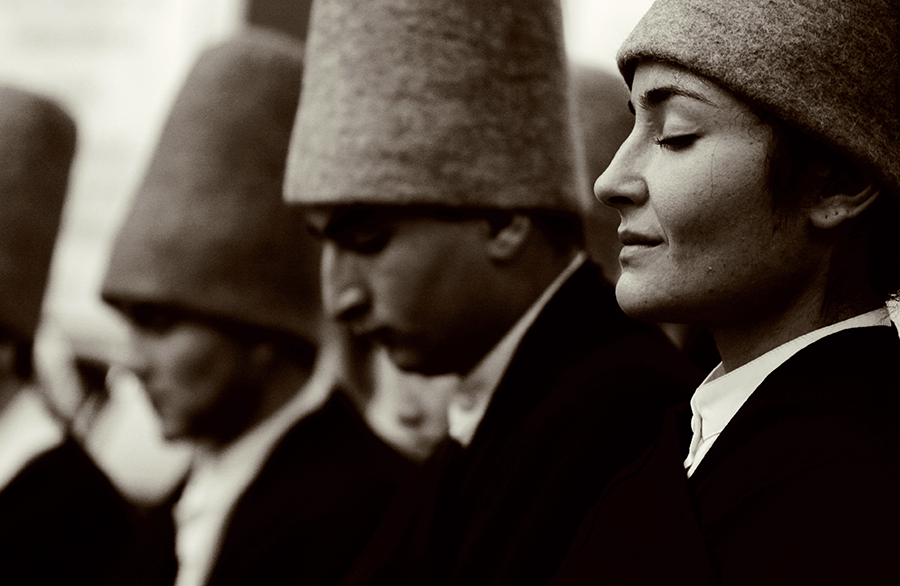
The Mevlevi Order or Mawlawiyya (Turkish: Mevlevilik or Mevleviyye; Persian: طریقت مولویه) is a Sufi order that originated in Konya and which was founded by the followers of Jalaluddin Muhammad Balkhi Rumi, a 13th-century Persian poet, Sufi mystic, and Islamic theologian. The Mevlevis are also known as the “whirling dervishes” due to their famous practice of whirling as a form of dhikr (remembrance of God). Dervish is a common term for an initiate of the Sufi path; whirling is part of the formal sema ceremony and the participants are properly known as semazens.
In 2008, UNESCO confirmed “The Mevlevi Sema Ceremony” as amongst the Masterpieces of the Oral and Intangible Heritage of Humanity.
Approximately 750 years old, the Mevlevi Order is a living tradition based on the teachings of Rumi, also known as Mevlana, who is perhaps Turkey’s most celebrated poet and in Iran, second only to Hafiz. He is also venerated as a divine mystic within Sufi Islam. Rumi’s friend and spiritual mentor, Shams of Tabriz, is also revered within the order and within Sufism more widely.
Rumi said, “As long as I have life, I am the slave of the Quran. I am dust at the door of Muhammad the Chosen”, and the Mevlevi path is based firmly on Islamic principles. Kabir Helminski, a Mevlevi shaikh, writes ‘It is a rigorous path of initiation and service continually adapting itself to changing circumstances and times…. Mevlevis have always been progressive and liberal in spirit while at the same time conserving the best of tradition.’
The Mevlevis insist that love is at the centre of Islam. Mevlevi shaikh Şefik Can writes, ‘Rumi tells us to take the love of God to the forefront, to abstain from being attached to the letter of the law rather than the spirit of it, to find the essence of the faith, and to raise our faith from the level of imitation to the level of realization.’
In addition to obligatory Islamic worship, some of the main spiritual practices within the Mevlevi Order are as follows:
Dhikr: invocation of the Divine Names which is believed to purify the heart
Sema (sama): the whirling ceremony
Study of the Quran and Rumi’s works (especially his poetic masterpiece the Mathnavi)
Spiritual conversation led by the shaikh (sohbet)
Meditation (known as muraqabah in Islam)
Adab (developing courtesy and mindfulness)
 Whirling Dervish Ceremony in Sultanahmet
790.00₺
|
 Hocapasha Culture Center Whirling Dervish Ceremony
1,240.00₺
|
 Whirling Dervish Ceremony Real Monastery in Fatih
1,350.00₺
|
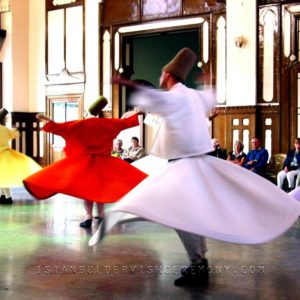 Whirling Dervish Ceremony in Sultanahmet Sirkeci Train Station
200.00₺
|
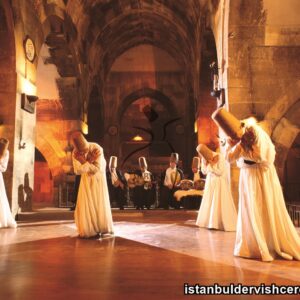 Whirling Dervish Ceremony in Saruhan Cappadocia
1,050.00₺
|
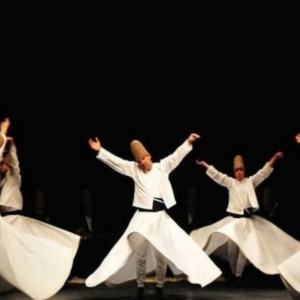 Galata Mevlevi House Dervish Ceremony
|
-
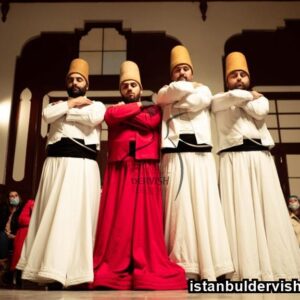 Tailor Made Whirling Dervish Dress Costume
Sema/Sama
The Sema with the greatest significance to the Mevlevi order is the annual celebration of Mevlana’s marriage to god (death), also called Seb-i Arus, meaning Nuptial Night or Night of Union. It is observed for one week, with the final night occurring on the anniversary of his death. Pilgrims from all over the world travel to Konya for the official celebration. The event is so popular that a ticketing system is in place for those who wish to attend.
Rumi mentions whirling in a number of his poems. In one ghazal in the Divani Shamsi Tabriz he says:
Those who turn in the direction of prayer,
whirl in both this world and the next.
Pay heed when a circle of friends whirl,
circling round and round, the Kaaba is the center.
If you wish a mine of sugar, it is there;
and if you wish a fingertip of sugar, it is gratis.
According to a popular story, Rumi was first inspired to whirl when he heard the hammering of the goldsmiths in Konya’s bazaar, however, Mevlevi historian Abdülbâki Gölpınarlı believed that Rumi must have learnt whirling from Shams of Tabriz. Şefik Can claimed that whirling was practiced among Sufis at least as early as Abu Sa’id Abu’l-Khayr (d. 1049). Though they have cultivated it to the highest degree, Mevlevis are not the only Sufis who practice whirling, and Kabir Helminski suggests primordial origins: ‘The practice of whirling may have its origins in the timeless shadows of Central Asian spirituality where shamans used it to induce altered states of consciousness.’
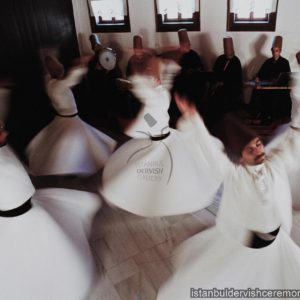
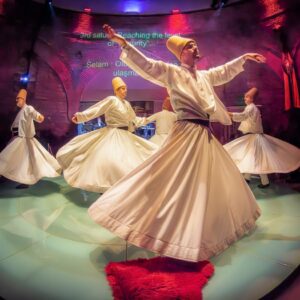
Sema (or sama) is traditionally practised in a semahane (ritual hall) according to a precisely prescribed symbolic ritual with the semazens whirling in a circle around their shaikh. Semazens whirl using their right foot to propel themselves in a counter-clockwise circle, whilst their left foot remains rooted to the floor acting as an axis about which the semazen turns. Both arms are extended and raised to the level of the head, with the right palm pointing upward (believed to be receiving Divine grace) and the left palm pointing downward (believed to channel that grace to the world). With each 360° turn, the semazen is inwardly chanting “Allah” – a form of dhikr.
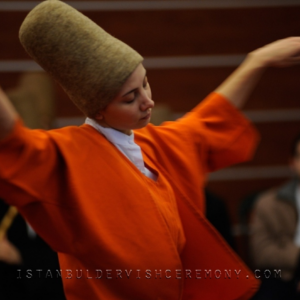
The semazens enter wearing a black cloak (hırka) symbolizing death and the grave, which they remove before whirling. On their heads they wear a tall, brown hat known as a sikke, which symbolizes the tombstone and the death of the ego (a version of the “Sikke” is also worn by the Bektashi). Once their cloaks are removed, their long white robes (tennûre) and white jackets (destegül – meaning ‘bouquet of roses’) become visible. Both are symbols of resurrection.
Structure of the ceremony
Naat-i Sharif – The naat marks the beginning of the ceremony in which a solo singer offers a eulogy to the Prophet Muhammad. It is concluded with a taksim (improvisation) on the reed flute (ney), which symbolises the Divine breath that gives life to everything.
Devr-i Veled – The Sultan Veled walk involves the semazens walking slowly and rhythmically to the peshrev music. After slapping the ground forcefully (representing the Divine act of creation when God said ‘Be!’ according to the Quran), they make a circuit in single file around the hall three times, bowing first to the semazen in front of them, and then to the semazen behind them as they begin each circuit. The bow is said to represent the acknowledgement of the Divine breath which has been breathed into all of us and is a salutation from soul to soul. The dervishes then remove their black cloaks.
The Four Salams – The Four Salams (Selams) form the main part of the ceremony and are distinct musical movements. According to Dr. Celalettin Celebi and Shaikh Kabir Helminski, ‘The first selam represents the human being’s birth to Truth through knowledge, and through his awareness and submission to God. The second selam represents the rapture of the human being while witnessing the splendour of creation and the omnipotence of God. The third selam is the transformation of rapture into love, the sacrifice of mind to love. It is annihilation of the self within the Loved One. It is complete submission. It is unity…. The fourth selam is the semazen’s coming to terms with his destiny. With the semazen’s whole self, with all his mind and heart, he is a servant of God, of God’s books and His prophets – of all Creation.’
Quranic recitation – The ceremony concludes with a recitation from the Quran, which normally includes the following verse: God is in the East and West. And wherever you turn, there is the face of God. (Quran 2:115)
History
The order was established after Rumi’s death in 1273 by his son Sultan Veled and Husameddin Chelebi (who inspired Rumi to write the Mathnavi). Like his father, Sultan Veled is celebrated for his poetry. Lyrics he wrote are often sung during the sema ceremony itself, and both he and Husameddin Chelebi are honoured within the order as accomplished Sufi mystics in their own right. It was they who had Rumi’s mausoleum built in Konya, which to this day is a place of pilgrimage for many Muslims (and non-Muslims). A number of Rumi’s successors, including both Sultan Veled and Husameddin Chelebi themselves, are also buried there. Their personal efforts to establish the order were continued by Sultan Veled’s son Ulu Arif Chelebi.
During the Ottoman period, the Mevlevi order spread into the Balkans, Syria, Lebanon, Egypt, and Palestine, especially in Jerusalem. The Bosnian writer Meša Selimović wrote the book The Dervish and Death about a Mevlevi dergah in Sarajevo. Eventually, there were as many as 114 Sufi lodges, the order becoming well established within the Ottoman Empire when Devlet Hatun, a descendant of Sultan Veled, married Bayezid I. Their son Mehmed I Çelebi became the next sultan, endowing the order, as did his successors, with many advantages. Many of the members of the order served in various official positions within the caliphate.
To this day, responsibility for overseeing the Mevlevi Order is passed down through the generations of Rumi’s male descendants. The head of the order is referred to as Çelebi (Chelebi) which means ‘man of God’ or ‘noble, courteous’ according to Mevlevi historian Abdülbâki Gölpınarlı. The current Çelebi is Faruk Hemdem Çelebi. He is also president of the International Mevlana Foundation (UluslararasI Mevlânâ Vakfi), a Turkish cultural and educational foundation managed by his sister and vice-president Esin Çelebi Bayru. Shaikhs, who have the authority to teach Mevlevi practices and philosophy, are appointed by the Çelebi.
Artistic heritage
Rumi’s Mathnavi and Diwan-e Shams-e Tabrizi are considered masterpieces of Persian literature, and throughout the centuries the Mevlevi Order has continued its long-standing association with the arts in Turkey. Apart from the works of Rumi and Sultan Veled, other famous literary works by Mevlevis include influential commentaries on Rumi’s Mathnavi by Ismāʿil Rusūhī Ankarawi (d. 1631) and Ismāʿil Ḥaqqı Burṣalı (d. 1724), the latter also being ‘a fine mystical poet’ in his own right. The most celebrated Mevlevi poet, after Rumi and Sultan Veled, is Shaykh Ghalib Dede (d. 1799), the author of Hüsn ü Aşk and ‘perhaps the last true master of Turkish classical poetry’ according to scholar Annemarie Schimmel. Both Ghālib Dede and Ankarawī are buried at the Galata Mevlevihanesi.
A significant number of the most celebrated Turkish musicians have been Mevlevis, and during the Ottoman era the Mevlevi Order produced a great deal of vocal and instrumental music. Mustafa Itri (1640–1712), an Ottoman-Turkish musician, composer, singer and poet, is regarded as the master of Turkish classical music. Ismail Dede (1778-1846) is also considered one of Turkey’s greatest classical composers and wrote the music for the ceremonial songs (ayins) played during the sema ceremony. Celebrated female musicians and composers include Dilhayat Khalifa (early 1700s) and Layla Saz (late 1800s – also buried at Galata Mevlevihanesi)
Women in the Mevlevi Order
Camille Helminski explains in her book, Women of Sufism, A Hidden Treasure, how Rumi had a number of noteworthy female students, and how in the early days of the order there were instances of female shaikhs and semazens, such as Destina Khatun (who was appointed shaykha of the Kara Hisar Mevlevi lodge). ‘In the early days of the Mevlevi order, women and men were known to pray, share sohbet (spiritual conversation), and whirl within each other’s company, though more often as the centuries unfolded, women held their own semas and men also whirled in zhikr separate from women. However, in the time of Mevlana [Rumi], spontaneous semas would occur including both men and women.’. In the same book, Camille Helminski presents a letter (dated from 1991) from Celaleddin Bakir Çelebi (who was the Çelebi heading the order at that time) which grants permission for men and women to once more whirl together in mixed Mevlevi ceremonies.
How can one participate?
You can make reservations from here ( online ), you can e-mail us or you can visit our ticket center in advanced and make your reservation in person. Here are our details ;
LOCATION of our Meeting Point in Sultanahmet :
https://goo.gl/maps/uXuyRmELZsx
Contact People : Mr. Alp – Mr. Nurdogan
( Phone : +90 544 220 10 22 / +90 212 527 68 59 )
Here is our address :
Google Maps : https://goo.gl/maps/uXuyRmELZsx
Istanbul Dervish Ceremony – Les Arts Turcs / Culture Center
Alemdar Mh. Incili Çavus St.
No: 19 Floor : 3 (Behind The Underground Cistern)
Sultanahmet 34400
Istanbul, Turkey
TO CONTINUE TO PART 2 CLICK THE LINK BELOW:
SAMA – Part 2 of 2 – The Pagan Influence on Society
spacer