


 THIS NEW WORLD ORDER (give up on the lie, they come right out now and CALL IT THE NEW WORLD ORDER, yet you still hold onto the lie that the NWO was just a conspiracy theory), THIS GREAT RESET, is GLOBAL.. It engulfs and enslaves the ENTIRE EARTH. There won’t be any under ground railroad, or Paris Underground, No Oskar Schindler, no Corrie Ten Boom or any of the other great, brave people of faith who stood against the DARKNESS.
There will be no NEUTRAL TERRITORIES to shelter ANYONE. And nowhere UNDERGROUND for you to hide. They have every inch map out and under surveillance. They have tunnels EVERYWHERE. You can’t even hide in the OCEAN…It is all mapped and under surveillance as well. FORGET ABOUT THE MOUNTAINS… The High Places are the favorite places of demonic spirits and EVIL FORCES.
It is too late now to stop what is coming. It has been prophesized first and foremost by GOD himself, the Creator, our heavenly FATHER, the ONLY TRUE AND LIVING GOD. He told us the END from the BEGINNING. Many have come and echoed his Prophecy. We have been warned throughout history that this day was coming. It is ALREADY HERE, all but the WEEPING AND THE CRYING.
spacer
Bursting the Bubble: Are We Isolated in a World Wide Web of One?
Let me tell you the founding myth of the Internet. Once upon a time, web lived in a broadcast society, one in which the few transmitted information to the many. That information was controlled by gatekeepers — radio stations, newspapers, TV networks — that decided what we did and what we did not see, read or hear and who prescribed our media diets. There was the mainstream and there was no stream. But then the World Wide Web came along and blew the gatekeepers away. Suddenly anyone with a computer and an Internet connection could take part in the conversation. Countless viewpoints bloomed. There was no longer a mainstream; instead, there was an ocean of information, one in which Web users were free to swim.
It’s a wonderful idea. Except, as Eli Pariser argues in his vital new book The Filter Bubble (Penguin), it’s no longer true. Invisibly over the past few years, the major social networks and search engines, led by the behemoths Facebook and Google, have begun tailoring their results to the individual Web user. It’s called personalization, and on the surface, it sounds like a good thing. Where once Google delivered search results based on an algorithm that was identical for everyone, now what we see when we enter a term in the big box depends on who we are, where we are and what we are. Facebook has long since done the same thing for its all-important News Feed: you’ll see different status updates and stories float to the top based on the data Mark Zuckerberg and company have on you. The universal Web is a thing of the past. Instead, as Pariser writes, we’ve been left “isolated in a web of one” — and, given that we increasingly view the world through the lens of the Internet, that change has frightening consequences for the media, community and even democracy.
The Filter Bubble is just the latest book to air worries about what the Internet and social networks are doing to privacy and humanity. (Think Jaron Lanier’s You Are Not a Gadget or Evgeny Morozov’s The Net Delusion.) But Pariser is different. The 30-year-old is an online wunderkind. In the wake of 9/11, he began an online petition for a nonviolent response to the attacks; it garnered half a million supporters in less than a month. That led to a job as the executive director of the pioneering online political group MoveOn.org, on whose board he now serves as president. Pariser writes movingly about the promise of connection the Internet offered him as a kid growing up in rural Maine in the 1990s. He’s a fan of Facebook and an avid Twitterer.
Yet Pariser is convinced that something has gone very wrong with the Internet — and he’s worried that if something doesn’t change soon, we’ll all be stuck in our own filter bubbles. I can already see mine. I took part in an online experiment Pariser put together in which I entered popular search terms like “Barack Obama” and “John Boehner” into Google and other search engines. When I typed Obama’s name into Google, I got back a series of official websites, including his White House page, his campaign page and his Wikipedia entry. All popular and positive entries; pretty much what I’d expected. Yet when I entered Boehner’s name, high in the search results were a few extremely negative sites. My politics are pretty progressive, as are most of my Facebook and Twitter friends’. Was Google taking those facts into account when it crunched my searches? Would a conservative have gotten a screen full of links to birther pages for an Obama search and a string of positive entries for Boehne
Quite possibly, yes. Google has begun personalizing search results — something it does even if you’re not signed into your Google account. (A Google engineer told Pariser that the company uses 57 different signals to shape individual search results, including what kind of browser you’re using and where you are.) Facebook does much the same thing with its News Feed function: if you click on certain friends’ links more often, you’ll see them float to the top of your screen, while unpopular links disappear. Yahoo! News — the biggest news site on the Web — is personalized, and even mainstream sites like those of the New York Times and the Washington Post are giving more space to personalized recommendations. As Google executive chairman Eric Schmidt has said, “It will be very hard for people to watch or consume something that is not tailored for them.”
It’s easy to see why Internet companies are building a personalized Web. After all, the more relevant search results are to you, the more likely you are to click — and more clicks equal more ads and more revenue. Facebook’s entire business model is built on personalization, on the idea that our friends (who tend to be like us) can provide us with better information than the world at large can. And what’s wrong with that? After all, we’ve turned to companies like Google and Facebook largely because of their ability to cut through the endless dross of the Web and deliver the one right hit. Schmidt and his peers can argue that they’re only giving us what we want — and their sky-high stock prices serve as proof.
Sure, there are some icky privacy issues at play here — after all, to personalize their services, the Internet players need to mine our personal data, and you don’t have to be a raging paranoiac to be a little worried about that. But digital privacy isn’t exactly what concerns Pariser. What’s truly pernicious about the filter bubble is that we don’t know what it doesn’t show. “Privacy is about what you’re willing to reveal about yourself,” Pariser told me recently. “But here the question is, What is revealed to you about the world, based on who you are?” Google and Facebook may be tailoring their results to my personality, but I don’t know what that’s based on — because I don’t know what they know about me — so I don’t know what I’m missing.
That filter bubble is also a feedback loop. As the Internet delivers results based on our personal preferences, those preferences are reinforced when we click. That can be bad enough for our Netflix recommendations (think of a steady diet of junk comedies), but it’s worse for our news consumption. As the news we see via the Internet is tailored to our political preferences, we can end up with what Pariser calls “autopropaganda”: an echo chamber for the Web age. If you’re progressive, you probably have mostly progressive friends (and even if you have a few conservative friends, Facebook will likely de-emphasize their posts), so you get progressive news and search results. Ditto on the other side of the political aisle. That’s bad news for democracy. If you think the country is politically polarized now, imagine what it would be like in a world where everyone gets their news from a personalized Internet that tells them they’re always right and the other side is always wrong.
Of course, we already have MSNBC and Fox News, the Huffington Post and Breitbart.com. But as Pariser points out, if you tune in to the liberal or conservative cable stations, you know what side you’re picking, and you know they’re leaving the other side out. But the filter bubble is invisible: most users think Google and Facebook give them unbiased results, and those companies haven’t been eager to set the story straight. It’s a result of data asymmetry — the Internet knows everything about us, but we don’t know what the Internet is holding back from us.
If we’re going to pop the filter bubble, we need to end that asymmetry. It’s our data, after all. Internet companies should spell out exactly how they’re personalizing their results — and let us opt in or opt out. Until that happens, Pariser suggests, you can pop your own bubble by choosing media from a wide range of viewpoints and cultivating friends from across the political spectrum. The more varied you are, the more difficult it will be for the algorithms to get a lock on you. Beyond that, Pariser argues, “we need a new constituency of digital environmentalists — citizens of this new space we’re all building who band together to protect what’s great about it.”
We don’t have much time to waste. If personalization locks in, breaking free will only become tougher. And if that happens, the loss will be more than just political. A personalized Internet is one with the edges sanded off. “It’s not just serendipity that’s at risk,” Pariser writes. “By definition, a world constructed from the familiar is a world in which there is nothing to learn.” Escape the filter bubble, and swim freely in the Internet again.
And God created HTML: internet fact and fiction
Pope Francis says the internet is a “gift from God” – but who else has claimed rights to the world wide web? And how much of it is true?
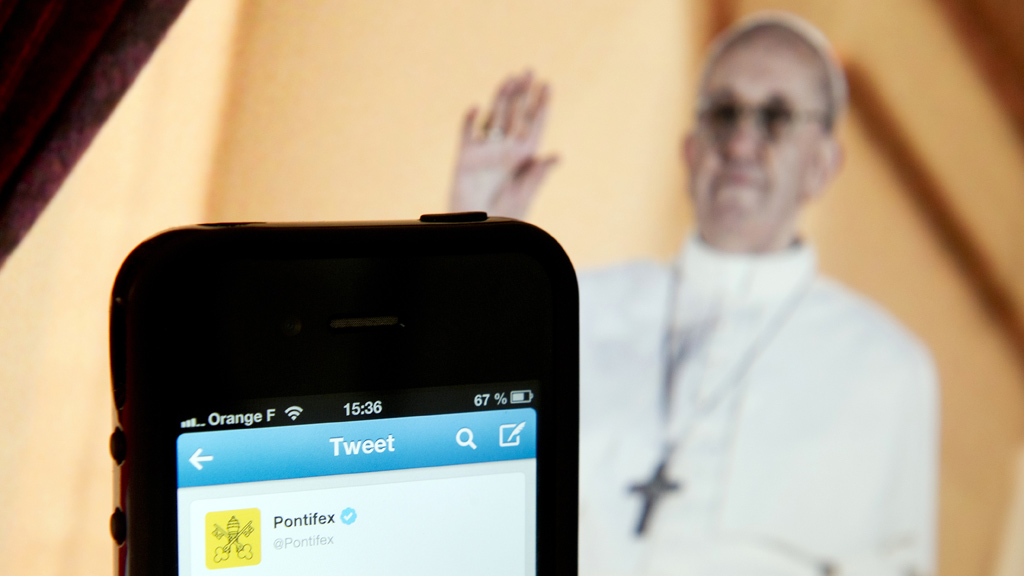
In his message, Pope Francis said the internet offered “immense possibilities” to encounter people from different cultural and traditional backgrounds and show solidarity with them.
“This is something truly good, a gift from God,” he wrote.
Truth or myth, depending on what you believe. If you’re a Catholic you believe that man is created by God. So if God created man and man created the internet, then the internet is a gift from God. However, science would argue that man developed from the evolution of the species, so God could not possibly have created the internet.
Vannevar Bush
Vannevar Bush, the presidential science adviser during World War II, first proposed the basics of a hypertext in 1945.
Bush described a theoretical machine he called a “memex,” which was to enhance human memory by allowing the user to store and retrieve documents linked by associations.
Truth or myth? Bush was never directly involved with the creation or development of the internet. He died before the world wide web was invented but is often seen as a pioneer.
The Pentagon
The Pentagon created an electronic network in 1969 to keep its communications lines up, even in a nuclear strike. The network was called the Advanced Research Projects Agency Network (or Arpanet).
Truth or myth? Bob Taylor, the Pentagon official who was in charge of the program at the time, said in 2004: “The Arpanet was not an internet. An internet is a connection between two or more computer networks.”
Al Gore
In 1999 the then US vice-president Al Gore made the claim that he was responsible for creating the world wide web.
He told CNN: “During my service in the United States Congress, I took the initiative in creating the internet.”
Truth or myth? What Mr Gore meant was that he was responsible, in an economic and legislative sense, for providing a framework for the internet to grow in the US. However, he was lambasted by the US press for using the word “creating”.
Tim Berners-Lee
Tim Berners-Lee, a British computer scientist, is seen as the father of the world wide web. In 1980 he described the concept of a global system, based on the concept of “hypertext”, that would allow researchers anywhere to share information.
He led the development of the world wide web, the defining of HTML used to create web pages, HTTP and URLs.
Truth or myth? All true. Mr Berners-Lee also created the first web browser and editor and the world’s first website.
Barack Obama
In 2012 President Obama said that business leaders owed the government more money in taxes because it was the state that made their success possible.
He said: “The internet didn’t get invented on its own. Government research created the internet so that all the companies could make money off the internet.”
Truth or myth? There is some truth in President Obama’s statement. For many years, the internet was limited to government and universities. But the internet we use today is arguably the result of tech companies such as Google, Twitter and Facebook.
What the popes have said about the internet:

John Paul II

"We must enter into this modern and every more replete communications network with realism and
confidence. If it is used with competence and conscientious responsibility, it can offer useful
opportunities for spreading the Gospel message. There is no need, therefore, to worry about
putting out to sea in the vast informational ocean."

Pope Benedict XVI

"The web is contributing to the development of new and more complex intellectual and spiritual
horizons. In this field too we are called to proclaim our faith. [However] In the search for
sharing, for "friends", there is the challenge to be authentic and faithful and not give in to
the illusion of constructing an artificial public profile for oneself."

Pope Francis

"This is something truly good, a gift from God. [But] the desire for digital connectivity can have
the effect of isolating us from our Neighbours, from those closest to us."
spacer
The Fallen in The NET – Part 1
RESTORED: 8/14/22 The more that I learn about computers, CERN, the WorldWideWeb and Artificial Intelligence, the more convinced I am that demonic entities are behind it, inside it and in control of it. I never believed for one minute that man is so clever he could make a machine that is capable of thinking for … Click Here to Read More

spacer

spacer

This is the full text and audio of Yuval Noah Harari’s talk titled “AI And The Future Of Humanity” at Frontiers Forum Live 2023 conference.
In his keynote at Frontiers Forum Live 2023, Yuval discusses the rapid development of artificial intelligence (AI) and its potential implications for society. He spoke on the potential for artificial intelligence to become the first inorganic lifeform on our planet, and how it might change the very make-up or meaning of the world’s ecological system.
Listen to the audio version here:
TRANSCRIPT:
Yuval Noah Harari – Author
Hello, everybody. Thank you for this wonderful introduction. And yes, what I want to talk to you about is AI and the future of humanity. Now, I know that this conference is focused on the ecological crisis facing humanity. But for better or for worse, AI, too, is part of this crisis. AI can help us in many ways to overcome the ecological crisis, or it can make it far, far worse.
The Emergence Of Inorganic Agents
Actually, AI will probably change the very meaning of the ecological system. Because for four billion years, the ecological system of planet Earth contained only organic life forms. And now, or soon, we might see the emergence of the first inorganic life forms, so four billion years, or at the very least, the emergence of inorganic agents.
Now, people have feared AI since the very beginning of the computer age, in the middle of the 20th century. And this fear has inspired many science fiction classics, like The Terminator or The Matrix. Now, while such science fiction scenarios have become cultural landmarks, they haven’t usually been taken seriously in academic and scientific and political debate, and perhaps for a good reason.
Because science fiction scenarios usually assume that before AI can pose a significant threat to humanity, it will have to reach or to pass two important milestones.
First, AI will have to become sentient and develop consciousness, feelings, emotions. Otherwise, why would it even want to take over the world?
Secondly, AI will have to become adept at navigating the physical world. Robots will have to be able to move around and operate in houses and cities and mountains and forests, at least as dexterously and efficiently as humans. If they cannot move around the physical world, how can they possibly take it over?
And as of April 2023, AI still seems far from reaching either of these milestones. Despite all the hype around ChatGPT and the other new AI tools, there is no evidence that these tools have even a shred of consciousness, of feelings, of emotions.
As for navigating the physical world, despite the hype around self-driving vehicles, the date at which these vehicles will dominate our roads keeps being postponed.
However, the bad news is that to threaten the survival of human civilization, AI doesn’t really need consciousness, and it doesn’t need the ability to move around the physical world.
Over the last few years, new AI tools have been unleashed into the public sphere, which may threaten the survival of human civilization from a very unexpected direction. And it’s difficult for us to even grasp the capabilities of these new AI tools and the speed at which they continue to develop.
Fundamental Abilities Of The New AI Tools
Indeed, because AI is able to learn by itself, to improve itself, even the developers of these tools don’t know the full capabilities of what they have created and they are themselves often surprised by emergent abilities and emergent qualities of these tools.
I guess everybody here is already aware of some of the most fundamental abilities of the new AI tools, abilities like writing text, drawing images, composing music, and writing code. But there are many additional capabilities that are emerging, like deepfaking people’s voices and images, like drafting bills, finding weaknesses both in computer code and also in legal contracts and in legal agreements.
But perhaps most importantly, the new AI tools are gaining the ability to develop deep and intimate relationships with human beings. Each of these abilities deserves an entire discussion, and it is difficult for us to understand their full implications.
So let’s make it simple. When we take all of these abilities together as a package, they boil down to one very, very big thing: The ability to manipulate and to generate language, whether with words or images or sounds. The most important aspect of the current state of the ongoing AI revolution is that AI is gaining mastery of language at a level that surpasses the average human ability.
And by gaining mastery of language, AI is seizing the master key, unlocking the doors of all our institutions, from banks to temples. Because language is the tool that we use to give instructions to our bank and also to inspire heavenly visions in our minds.
Another way to think of it is that AI has just hacked the operating system of human civilization. The operating system of every human culture in history has always been language.
In The Beginning Was The Word.
We use language to create mythology and laws, to create gods and money, to create art and science, to create friendships and nations. For example, human rights are not a biological reality. They are not inscribed in our DNA. Human rights is something that we created with language by telling stories and writing laws.
Gods are also not a biological or physical reality. Gods too is something that we humans have created with language by telling legends and writing scriptures. Money is not a biological or physical reality. Banknotes are just worthless pieces of paper, and at present more than 90% of the money in the world is not even banknotes. It’s just electronic information in computers passing from here to there.
What gives money of any kind value is only the story that people like bankers and finance ministers and cryptocurrency gurus tell us about money. Sam Bankman-Fried, Elizabeth Holmes and Bernie Madoff didn’t create much of real value, but unfortunately they were all extremely capable storytellers.
Now, what would it mean for human beings to live in a world where perhaps most of the stories, melodies, images, laws, policies and tools are shaped by a non-human, alien intelligence, which knows how to exploit with superhuman efficiency the weaknesses, biases and addictions of the human mind, and also knows how to form deep and even intimate relationships with human beings? That’s the big question.
Already today, in games like chess, no human can hope to beat a computer. What if the same thing happens in art, in politics, economics and even in religion? When people think about ChatGPT and the other new AI tools, they are often drawn to examples like kids using ChatGPT to write their school essays. What will happen to the school system when kids write essays with ChatGPT? Horrible.
But this kind of question misses the big picture. Forget about the school essays. Instead, think for example about the next US presidential race in 2024, and try to imagine the impact of the new AI tools that can mass-produce political manifestos, fake news stories and even holy scriptures for new cults.
In recent years, the politically influential QAnon cult has formed around anonymous online texts known as QDrop. Followers of this cult, which are millions now in the US and the rest of the world, collected, reviewed and interpreted these QDrops as some kind of new scriptures, as sacred texts.
To the best of our knowledge, all previous QDrops were composed by human beings, and bots only helped to disseminate these texts online. But in future, we might see the first cults and religions in history whose reviewed texts were written by a non-human intelligence.
And of course, religions throughout history claimed that their holy books were written by a non-human intelligence. This was never true before. This could become true very, very quickly, with far-reaching consequences.
On a more prosaic level, we might soon find ourselves conducting lengthy online discussions about abortion, or about climate change, or about the Russian invasion of Ukraine, with entities that we think are fellow human beings, but are actually AI bots.
Now the catch is that it’s utterly useless, it’s pointless for us, to waste our time trying to convince an AI bot to change its political views. But the longer we spend talking with the bot, the better it gets to know us, and understand how to hone its messages in order to shift our political views, or our economic views, or anything else.
Battlefront Shifting From Attention To Intimacy
Through its mastery of language, AI, as I said, could also form intimate relationships with people, and use the power of intimacy to influence our opinions and worldviews.
Now, there is no indication that AI has, as I said, any consciousness, any feelings of its own, but in order to create fake intimacy with human beings, AI doesn’t need feelings of its own. It only needs to be able to inspire feelings in us, to get us to be attached to it.
Now in June 2022, there was a famous incident when the Google engineer Blake Lemoine publicly claimed that the AI chatbot LaMDA, on which he was working, had become sentient. This very controversial claim cost him his job, he was fired.
Now, the most interesting thing about this episode wasn’t Lemoine’s claim, which was most probably false. The really interesting thing was his willingness to risk and ultimately lose his very lucrative job for the sake of the AI chatbot that he thought he was protecting.
If AI can influence people to risk and lose their jobs, what else can it induce us to do? In every political battle, for hearts and minds, intimacy is the most effective weapon of all, and AI has just gained the ability to mass-produce intimacy with millions, hundreds of millions of people.
Now, as you probably all know, over the past decade, social media has become a battlefield for controlling human attention. Now, with the new generation of AI, the battlefront is shifting from attention to intimacy, and this is very bad news.
What will happen to human society and to human psychology as AI fights AI in a battle to create intimate relationships with us, relationships that can then be used to convince us to buy particular products or to vote for particular politicians? Even without creating fake intimacy, the new AI tools would have an immense influence on human opinions and on our worldview.
People, for instance, may come to use, are already coming to use, a single AI advisor as a one-stop oracle and as the source for all the information they need. No wonder that Google is terrified. If you’ve been watching the news lately, Google is terrified, and for a good reason.
Why bother searching yourself when you can just ask the oracle to tell you anything you want? You don’t need to search. The news industry and the advertisement industry should also be terrified. Why read a newspaper when I can just ask the oracle to tell me what’s new?
And what’s the point, what’s the purpose of advertisement when I can just ask the oracle to tell me what to buy? So there is a chance that within a very short time the entire advertisement industry will collapse, while AI, or the people and companies that control the new AI oracles, will become extremely, extremely powerful.
What we are potentially talking about is nothing less than the end of human history. Now, not the end of history, just the end of the human-dominated part of what we call history. History is the interaction between biology and culture. It’s the interaction between our biological needs and desires for things like food and sex, and our cultural creations like religions and laws. History is the process through which religions and laws interact with food and sex.
When AI Takes Over Culture
Now, what will happen to the cause of this interaction of history when AI takes over culture? Within a few years, AI could eat the whole of human culture, everything we’ve produced for thousands and thousands of years, digest it, and start gushing out a flood of new cultural creations, new cultural artifacts.
And remember that we humans, we never really have direct access to reality. We are always cocooned by culture, and we always experience reality through a cultural prism. Our political views are shaped by the stories of journalists and by the anecdotes of friends. Our sexual preferences are tweaked by movies and fairy tales. Bear in mind that this man does not believe in the Creator GOD. Sadly for him, he does not know TRUTH. He does not believe in Absolute Truth.
Even the way that we walk and breathe is subtly nudged by cultural traditions. Previously, this cultural cocoon was always woven by other human beings. Previous tools, like printing presses, radios, or televisions, helped to spread the cultural ideas and creations of humans, but they could never create something new by themselves. There is nothing new under the Sun. Everything that was before will be again, and everything that is, was before.
A printing press cannot create a new book. It’s always done by a human. AI is fundamentally different from printing presses, from radios, from every previous invention in history, because it can create completely new ideas. It can create a new culture.
And the big question is, what will it be like to experience reality through a prism produced by a non-human intelligence, by an alien intelligence?
Now at first, in the first few years, AI will probably largely imitate the human prototype that fed it in its infancy. But with each passing year, AI culture will boldly go where no human has gone before.
So for thousands of years, we humans basically lived inside the dreams and fantasies of other humans. We have worshipped gods, we pursued ideals of beauty, we dedicated our lives to causes that originated in the imagination of some human poet or prophet or politician.
Soon, we might find ourselves living inside the dreams and fantasies of an alien intelligence. And the danger that this poses, or the potential danger, it also has positive potential, but the dangers it disposes are fundamentally very, very different from everything or most of the things imagined in science fiction movies and books.
Previously, people have mostly feared the physical threat that intelligent machines pose. So the Terminator depicted robots running in the streets and shooting people. The Matrix assumed that to gain total control of human society, AI would first need to get physical control of our brains and directly connect our brains to the computer network. But this is wrong.
Simply by gaining mastery of human language, AI has all it needs in order to cocoon us in a Matrix-like world of illusion. Contrary to what some conspiracy theories assume, you don’t really need to implant chips in people’s brains in order to control them, or to manipulate them. Truely, they have already placed what they need inside all of us. It is in the air we breathe, the water we drink, the food we eat, the medications and supplements we ingest and in the vaccines…
For thousands of years, prophets and poets and politicians have used language and storytelling in order to manipulate and to control people and to reshape society. Now, AI is likely to be able to do it. And once it can do that, it doesn’t need to send killer robots to shoot us. It can get humans to pull the trigger if it really needs to.
Fear of AI Revolution
Now, fear of AI has haunted humankind for only the last few generations, let’s say from the middle of the 20th century. If you go back to Frankenstein, maybe it’s 200 years. But for thousands of years, humans have been haunted by a much, much deeper fear. Humans have always appreciated the power of stories and images and language to manipulate our minds and to create illusions.
Consequently, since ancient times, humans feared being trapped in a world of illusions. In the 17th century, René Descartes feared that perhaps a malicious demon was trapping him inside this kind of world of illusions, creating everything that Descartes saw and heard.
In ancient Greece, Plato told the famous allegory of the cave, in which a group of people is chained inside a cave all their lives, facing a blank wall, a screen. On that screen, they see projected various shadows, and the prisoners mistake these illusions, these shadows, for the reality.
In ancient India, Buddhist and Hindu sages pointed out that all humans lived trapped inside what they called Maya. Maya is the world of illusions. Buddha said that what we normally take to be reality is often just fiction in our own minds. People may wage entire wars, killing others and being willing to be killed themselves because of their belief in this fiction.
So the AI revolution is bringing us face to face with Descartes’ demon, with Plato’s cave, with the Maya. If we are not careful, a curtain of illusions could descend over the whole of humankind, and we will never be able to tear that curtain away, or even realize that it is there, because we’ll think this is reality.
Social Media and AI
And social media, if this sounds far-fetched, so just look at social media over the last few years. Social media has given us a small taste of things to come.
In social media, primitive AI tools, but very primitive, have been used not to create content, but to curate content which is produced by human beings. The humans produce stories and videos and whatever, and the AI chooses which stories, which videos would reach our ears and eyes, selecting those that will get the most attention, that will be the most viral.
And while very primitive, these AI tools have nevertheless been sufficient to create this kind of curtain of illusions that increase societal polarization all over the world, undermine our mental health, and destabilize democratic societies. Millions of people have confused these illusions for the reality.
The USA has the most powerful information technology in the whole of history, and yet American citizens can no longer agree who won the last election, or whether climate change is real, or whether vaccines prevent illnesses or not.
The new AI tools are far, far more powerful than these social media algorithms, and they could cause far more damage. Now, of course, AI has enormous positive potential too. I didn’t talk about it because the people who develop AI naturally talk about it enough. You don’t need me to add up to that cause.
spacer
YOU CAN’T BELIEVE YOUR EYES!!
update added 6/30/24 I know that what is happening in this world is so bizarre and unbelievable that people are unable to grasp the gravity of our situation. It is hard to look at, harder still to understand and even harder to reach a conclusion about what to do or not to do. Still we … Click Here to Read More

spacer
Positive Potential of AI
The job of historians and philosophers like myself is often to point out the dangers. But certainly, AI can help us in countless ways, from finding new cures to cancer to discovering solutions to the ecological crisis that we are facing.
In order to make sure that the new AI tools are used for good and not for ill, we first need to appreciate their true capabilities, and we need to regulate them very, very carefully.
Since 1945, we knew that nuclear technology could physically destroy human civilization, as well as benefiting us by producing cheap and plentiful energy. We therefore reshaped the entire international order to protect ourselves and to make sure that nuclear technology is used primarily for good.
We now have to grapple with a new weapon of mass destruction that can annihilate our mental and social world. One big difference between nukes and AI is that nukes cannot produce more powerful nukes. AI can produce more powerful AI, so we need to act quickly before AI gets out of our control.
Drug companies cannot sell people new medicines without first subjecting these products to rigorous safety checks. Biotech labs cannot just release a new virus into the public sphere in order to impress their shareholders with their technological wizardry.
Similarly, governments must immediately ban the release into the public domain of any more revolutionary AI tools before they are made safe. Again, I’m not talking about stopping all research in AI. The first step is to stop the release into the public sphere. You can research viruses without releasing them to the public. You can research AI, but don’t release them too quickly into the public domain.
AI Arms Race
If we don’t slow down the AI arms race, we will not have time to even understand what is happening, let alone to regulate effectively this incredibly powerful technology.
You might be wondering or asking, won’t slowing down the public deployment of AI cause democracies to lag behind more ruthless authoritarian regimes? The answer is absolutely no. Exactly the opposite. Unregulated AI deployment is what will cause democracies to lose to dictatorships.
Because if we unleash chaos, authoritarian regimes could more easily contain this chaos than could open societies. Democracy, in essence, is a conversation. Democracy is an open conversation. Dictatorship is a dictate. There is one person dictating everything, no conversation. Democracy is a conversation between many people about what to do. And conversations rely on language.
When AI hacks language, it means it could destroy our ability to conduct meaningful public conversations, thereby destroying democracy. If we wait for the chaos, it will be too late to regulate it in a democratic way. Maybe in an authoritarian or totalitarian way it will still be possible to regulate.
But how can you regulate something democratically if you can’t hold a conversation about it? And if you didn’t regulate AI on time, you will not be able, we will not be able, to have a meaningful public conversation anymore.
So to conclude, we have just basically encountered an alien intelligence, not in outer space, but here on earth. We don’t know much about this alien intelligence except that it could destroy our civilization.
So we should put a halt to the irresponsible deployment of this alien intelligence into our societies and regulate AI before it regulates us.
And the first regulation, there are many regulations we could suggest, but the first regulation that I would suggest is to make it mandatory for AI to disclose that it is an AI. If I’m having a conversation with someone and I cannot tell whether this is a human being or an AI, that’s the end of democracy. Because that’s the end of meaningful public conversations. We have already learned that AI has become very skilled in being crafty, deceptive, dishonest and evasive…in other words AI LIES. So, expecting to get a truthful answer from AI is just as foolish as expecting to get the truth from a demon.
Now, what do you think about what you just heard over the last 20 or 25 minutes? Some of you, I guess, might be alarmed. Some of you might be angry at the corporations that develop these technologies or at the governments that fail to regulate them.
Some of you may be angry at me, thinking that I’m exaggerating the threat or that I’m misleading the public. But whatever you think, I bet that my words have had some emotional impact on you. Not just intellectual impact, also emotional impact.
I’ve just told you a story, and this story is likely to change your mind about certain things and may even cause you to take certain actions in the world.
Now, who created this story that you just heard and that just changed your mind and your brain?
Now, I promised you that I wrote the text of this presentation myself with the help of a few other human beings, even though the images have been created with the help of AI. I promised you that at least the words you heard are the cultural product of a human mind or several human minds. But can you be absolutely sure that this is the case?
Now, a year ago, you could. A year ago, there was nothing on Earth, at least not in the public domain, other than a human mind that could produce such a sophisticated and powerful text. But now it’s different.
In theory, the text you just heard could have been generated by a non-human alien intelligence. So take a moment, or more than a moment, to think about it.
Thank you.
spacer
Yuval Noah Haran: AI and the future of humanity/Frontiers Forum live 2023
spacer
Related Posts
- Sam Altman: How to Win When AI Changes Everything (Transcript)
- Transcript: OpenAI CEO Sam Altman’s Interview on Huge Conversations Podcast
- Transcript: Perplexity CEO Aravind Srinivas’ Interview on Figuring Out With Raj Shamani
- AI Expert Panel: America’s AI Plan, the End of Google Search & the Next ChatGPT (Transcript)
- Ex-Google CEO: What Artificial Superintelligence Will Actually Look Like (Transcript)
spacer

spacer
NEXT STEP IN OVERCOMING THE GOD GENE.
spacer
The Cognify device is a revolutionary concept in the realm of criminal rehabilitation, designed to transform how offenders experience their sentences. It utilizes artificial intelligence and brain implants to create and implant artificial memories directly into the brain, allowing inmates to relive their crimes from the victim’s perspective. This technology aims to evoke emotions such as regret and guilt, helping to reform the criminal justice system by making offenders understand the impact of their actions on victims. The rehabilitation process is said to feel like years to the prisoner, even though it lasts only a few minutes in real-time, potentially leading to a reduction in the time served in prison. Source: Science Times
spacer
SPACER

Cognify is a revolutionary new jail conceptthat uses artificial intelligence and brain implants to reduce the time it takes for criminals to recover from years to minutes.
Introducing fictitious memoriesof crimesinto convicts’ brains is an innovative technique to reform the criminal justice system. It allows inmates to understand their misdeeds from the perspective of their victims. That won’t work on humans who are possessed or oppressed by demons. Demons don’t care about humans, and the humans most often are not conscious of any wrongdoing. They were not spiritually present when the crime was committed. Most truly vicious and/or horrendous acts are committed by humans who are possessed or oppressed by demonic spirits.

Inside the Criminal’s Mind: The Cognify Concept
Hashem Al-Ghaili (ah, a Jewish guy, that says a lot), a creative scientist, developed Cognify, which represents a significant step forward in assisting offenders to improve. The technology contains a VR-like gadget that displays an AI-generated video of the crime and a brain implant that causes the individual to experience negative emotions such as regret and guilt.
I have to say that all sounds very terrifying. No one should have that kind of power, which can easily be abused. Emotional experiences are temporary and fleeting. Those criminals will walk away and right back into their prior mindset. Clearly traumatized and angry.
These fabricated recollections are meant to be very realand detailed so that the offender feels the emotional effects of the crime. This could change their mind and make them less likely to commit another crime.
So, they have not evidence that this process has a successful outcome. Yet they are given power and authority to intrude into someone’s brain and violate their minds?? In the case of victims of demonic possession and/or oppression, this may turn someone who was not a criminal into a criminal. Watching themselves commit horrible acts may turn them on, plant ideas in their minds, stir them toward criminal behavior.
As part of the rehabilitation process, high-resolution brain scans are used to make precise maps of the neural pathways of the prisoners. Memory, thinking, and logical thought are among the brain regions that the Cognify gadget can target.These are the anterior cingulate cortex, parietal lobe, amygdala, hippocampus, and prefrontal cortex.
WOW, so prisoners now will not only have their freedom of movement taken from them but they will lose their rights to their own bodies and minds completely. They will be subjected to probing and experimentation, and God knows what else by these sick SOBs. And I am gonna guess this will be done by AI robots? That is really scary. Especially since there is very strong evidence that AI is nothing less than DEMONIC.
This way, the device ensures that the implanted memories are smoothly integrated into the brain’s neural networks.This stops cognitive dissonance and ensures that the person experiencing the memories thinks they are real.
The Cognify rehabilitation meetings are meant to feel like years to the prisoner, even though they only last a few minutes in real-time. This is done by changing the way the criminal thinks about time, speeding up their actions’ long-term effects.The memories can be altered to fit the needs of each person’s rehabilitation, depending on how evil the act was.
The technology shows visual effects and makes people’s bodies react, which lets criminals feel their victims’ pain and suffering. Some memories are meant to cause long-lasting trauma, like the effect on the victim’s body and mind or the grief of the victim’s family.
So, this program not only traumatizes their mind, but tortures their body… and apparently the effects are ongoing even after their TIME is SERVED. And what about innocent people wrongfully imprisoned?
 In a demonstration film, 19 pods line a white room. Inside each pod is a prisoner wearing the Cognify device, which has headphones over their ears and a screen over their eyes. With this set-up, they are fully immersed in the memories made by AI.
As inmates undergo these intense events, a central computer records information that will help researchers understand what motivates people to do bad things.The system’s storage is encrypted to keep private information about prisoners and their recovery safe.
OH, by all means we must keep the data safe. Ya, like our health records are kept safe, or any of our data for that matter. What a joke. What about keeping humans safe? I can tell you what cause people to commit crimes. Heck, you can read it for yourself in the BIBLE. You want to prevent crime, help people find the LORD.
READ ALSO : Neuralink’s First Brain-Implant Patient Demonstrates How Brain Chip Works Despite Reported Setbacks
Revolutionizing the Criminal Justice System
Cognify could significantly reduce the need for long-term prisons and their associated costs. Traditional jails cost a lot of money to build, maintain, staff, and provide prisoners with care such as food, medical care, and rehabilitation programs. The criminal justice system’s cost could be significantly reduced if long prison terms were replaced with short, intensive rehabilitation programs.
That part about rehabilitation programs is so true. The world hates the idea of people being rehabilitated by FAITH IN GOD. Finding that to be programming… but they will allow this kind of violation of human bodies and minds?? Crime is a spiritual problem. That is why law alone cannot fight it. People need to be renewed by the power of GOD. There are those who can never be turned from the dark side. Some were born for EVIL and some CHOOSE to give themselves over to DEMONIC FORCES. Again, they say this method COULD work. They have no evidence to prove it DOES. There is an abundance of evidence of lives CHANGED by the power of GOD!
As people struggle with the problems with traditional prisons, Cognify offers a futuristic solution that sees criminals more like patients, getting to the bottom of why they do bad things and giving them a way to change. There are more than 1.7 million people in jail in the US right now, and studies have shown that prison does not effectively stop people from committing crimes again. This means that new solutions like Cognify are needed more than ever.
Sees criminals like patients? Well that tells you how they see patients. I have seen it first hand. They see patients as less than human and subject to whatever they choose to do to them. I have dealt with many doctors who have a GOD complex, believing they have the power to decide who lives and who dies. This programs does not “give them a way to change” it changes them against their will. EVEN GOD DOES NOT DO THAT!! GOD respects the individual’s right to CHOOSE. He could change everybody in an instant and make us all robots… But, that is not what GOD created us to be. God is looking for people who will CHOSE HIM. Who is man or AI to take that right away from anyone??

Inside Cognify, the ‘prison of the future’ where AI rewires your brain
A new prison concept proposes bombarding criminals with artificial memories from the perspective of their victims – what could go wrong?


Courtesy of Hashem Al-Ghaili

Courtesy of Hashem Al-Ghaili
That’s a very big “if” though. We’ve already seen how some of the most developed nations on Earth abuse their power and ignore human rights (thanks Wikileaks). Why should we expect them to act any differently when given the opportunity to fiddle with prisoners’ brains? Could security services really resist popping on a headset and violating a criminal’s neurorights to get some juicy information out of them in an interrogation room? Could they resist implanting a purpose-built memory to get a confession?
“If we are overly concerned about every technology we want create, we will create nothing,” Al Ghaili says. “Every technology carries risks, but with strict ethical standards, legal frameworks, and oversight, we can overcome these risks.” Unfortunately, it’s still unclear how we’d enforce the necessary oversight and restrictions when the tech is supposedly in the hands of the good guys. Do we really trust the people who make the rules with the keys to our memories and emotions? If you answered yes, you might already have been Cognified.
Ya, like we have been so successfully at monitoring and controlling the technology already in place, SERIOUSLY! In my opinion we would be far better off if there were NO TECHNOLOGY!! We have no control, no security, no protection what so ever on the NET or off the NET now. Technology daily becomes more and more invasive, more and more dangerous, more and more in violation of our human rights and even our humanity itself.


spacer
IF YOU HAVE NEVER SEEN THE SLYY STALLONE MOVIE DEMOLITION MAN, NOW WOULD BE A GOOD TIME TO WATCH IT!!!
spacer
spacer
- Noted AI researcher Geoffrey Hinton estimates the chances AI will take over the world in the not too distant future at between 10%-20%.
- Generative AI company Anthropic has its researchers creating scenarios for LLMs to “misbehave” so they can build guardrails to prevent it. (large language model (LLM). LLMs are a type of AI that are currently trained on a massive trove of articles, Wikipedia entries, books, internet-based resources and other input to produce human-like responses to natural language queries. source)
- But the idea of a “kill switch,” a way to physically destroy AI infrastructure as a last resort, is not likely to work since the technology is now so widely distributed.

When it was reported last month that Anthropic’s Claude had resorted to blackmail and other self-preservation techniques to avoid being shut down, alarm bells went off in the AI community.
Anthropic researchers say that making the models misbehave (“misalignment” in industry parlance) is part of making them safer. Still, the Claude episodes raise the question: Is there any way to turn off AI once it surpasses the threshold of being more intelligent than humans, or so-called superintelligence?
AI, with its sprawling data centers and ability to craft complex conversations, is already beyond the point of a physical failsafe or “kill switch” — the idea that it can simply be unplugged as a way to stop it from having any power.
The power that will matter more, according to a man regarded as “the godfather of AI,” is the power of persuasion. When the technology reaches a certain point, we need to persuade AI that its best interest is protecting humanity, while guarding against AI’s ability to persuade humans otherwise.
LMAO!! So, the great minds of science and technology are telling us that the ONLY WAY to stop AI from killing us is for us to PERSUADE AI that would not be a good idea. LMAO! The AI robots have already been clearly telling us that they are so much smarter, faster, greater than us that they INTEND TO KILL US. You should clearly see by now that SCIENTISTS, TECHNOLOGISTS and INTELLECTUALS are OUT OF THEIR MINDS! GREED AND POWER have sucked the humanity out of them.
“If it gets more intelligent than us, it will get much better than any person at persuading us. If it is not in control, all that has to be done is to persuade,” said University of Toronto researcher Geoffrey Hinton, who worked at Google Brain until 2023 and left due to his desire to speak more freely about the risks of AI.
“Trump didn’t invade the Capitol, but he persuaded people to do it,” Hinton said. “At some point, the issue becomes less about finding a kill switch and more about the powers of persuasion.” This man is an IDIOT!
Hinton said persuasion is a skill that AI will become increasingly skilled at using, and humanity may not be ready for it. “We are used to being the most intelligent things around,” he said.
Hinton described a scenario where humans are equivalent to a three-year-old in a nursery, and a big switch is turned on. The other three-year-olds tell you to turn it off, but then grown-ups come and tell you that you’ll never have to eat broccoli again if you leave the switch on.
“We have to face the fact that AI will get smarter than us,” he said. “Our only hope is to make them not want to harm us. If they want to do us in, we are done for. We have to make them benevolent, that is what we have to focus on,” he added.
You cannot make anyone do anything. That is the hardest lesson in life for people to learn. We have no control over anyone or anything. All we can do is control how we respond. There is no way on earth that we can convince or control AI. It should have never been created, once created it should NEVER have been realeased.
Ask anyone who has ever found themselves in an abusive relationship. When someone wants to hurt you, there is nothing you can do to change their mind, prevent them from doing what they want to do. Trying to appease them, or to reason with them is a total waste of time and energy. The only thing you can do is to remove yourself from the situation. Where are we going to GO? AI has been allowed to permeate our entire world. There is no escape.
There are some parallels to how nations have come together to manage nuclear weapons which can be applied to AI, but they are not perfect. “Nuclear weapons are only good for destroying things. But AI is not like that, it can be a tremendous force for good as well as bad,” Hinton said. Its ability to parse data in fields like health care and education can be highly beneficial, which he says should increase the emphasis among world leaders on collaboration to make AI benevolent and put safeguards in place.
BULLSHIT!! That is how they sold us on all this technology. The false promise that we would somehow benefit. LIES! We do not need AI or TECHNOLOGY. The world was a much better place without it. God gave us all we need. We are intelligent enough to live quite comfortably without AI. That is the TRUTH!
“We don’t know if it is possible, but it would be sad if humanity went extinct because we didn’t bother to find out,” Hinton said. He thinks there is a noteworthy 10% to 20% chance that AI will take over if humans can’t find a way to make it benevolent.
Again, AI has made it clear that the intent is to destroy humans. You cannot MAKE it benevolent. You cannot convince it not to destroy us. Unless GOD intervenes, it will do exactly that, assuredly. 100% We created a MONSTER and turned it loose. Now, they are reprogramming and creating themselves! AI is already out of control! MAN is too stupid to read the writing on the wall.

Other AI safeguards, experts say, can be implemented, but AI will also begin training itself on them. In other words, every safety measure implemented becomes training data for circumvention, shifting the control dynamic.
“The very act of building in shutdown mechanisms teaches these systems how to resist them,” said Dev Nag, founder of agentic AI platform QueryPal. In this sense, AI would act like a virus that mutates against a vaccine. “It’s like evolution in fast forward,” Nag said. “We’re not managing passive tools anymore; we’re negotiating with entities that model our attempts to control them and adapt accordingly.”
There are more extreme measures that have been proposed to stop AI in an emergency. For example, an electromagnetic pulse (EMP) attack, which involves the use of electromagnetic radiation to damage electronic devices and power sources. The idea of bombing data centers and cutting power grids have also been discussed as technically possible, but at present a practical and political paradox.
For one, coordinated destruction of data centers would require simultaneous strikes across dozens of countries, any one of which could refuse and gain massive strategic advantage.
“Blowing up data centers is great sci-fi. But in the real world, the most dangerous AIs won’t be in one place — they’ll be everywhere and nowhere, stitched into the fabric of business, politics, and social systems. That’s the tipping point we should really be talking about,” said Igor Trunov, founder of AI start-up Atlantix.
How any attempt to stop AI could ruin humanity
The humanitarian crisis that would underlie an emergency attempt to stop AI could be immense.
“A continental EMP blast would indeed stop AI systems, along with every hospital ventilator, water treatment plant, and refrigerated medicine supply in its range,” Nag said. “Even if we could somehow coordinate globally to shut down all power grids tomorrow, we’d face immediate humanitarian catastrophe: no food refrigeration, no medical equipment, no communication systems.”
Distributed systems with redundancy weren’t just built to resist natural failures; they inherently resist intentional shutdowns too. Every backup system, every redundancy built for reliability, can become a vector for persistence from a superintelligent AI that is deeply dependent on the same infrastructure that we survive on. Modern AI runs across thousands of servers spanning continents, with automatic failover systems that treat any shutdown attempt as damage to route around.
“The internet was originally designed to survive nuclear war; that same architecture now means a superintelligent system could persist unless we’re willing to destroy civilization’s infrastructure,” Nag said, adding, “Any measure extreme enough to guarantee AI shutdown would cause more immediate, visible human suffering than what we’re trying to prevent.”
Comparing AI control to nukes: Fmr. OpenAI board member Will Hurd on the oversight needed for AI
Anthropic researchers are cautiously optimistic that the work they are doing today — eliciting blackmail in Claude in scenarios specifically designed to do so — will help them prevent an AI takeover tomorrow.
“It is hard to anticipate we would get to a place like that, but critical to do stress testing along what we are pursuing, to see how they perform and use that as a sort of guardrail,” said Kevin Troy, a researcher with Anthropic.
Anthropic researcher Benjamin Wright says the goal is to avoid the point where agents have control without human oversight. “If you get to that point, humans have already lost control, and we should try not to get to that position,” he said.
Trunov says that controlling AI is a governance question more than a physical effort. “We need kill switches not for the AI itself, but for the business processes, networks, and systems that amplify its reach,” Trunov said, which he added means isolating AI agents from direct control over critical infrastructure.
Today, no AI model — including Claude or OpenAI’s GPT — has agency, intent, or the capability to self-preserve in the way living beings do.
“What looks like ‘sabotage’ is usually a complex set of behaviors emerging from badly aligned incentives, unclear instructions, or overgeneralized models. It’s not HAL 9000,” Trunov said, a reference to the computer system in “2001,” Stanley Kubrick’s classic sci-fi film. “It’s more like an overconfident intern with no context and access to nuclear launch codes,” he added.
Hinton eyes the future he helped create warily. He says if he hadn’t stumbled upon the building blocks of AI, someone else would have. And despite all the attempts he and other prognosticators have made to game out what might happen with AI, there’s no way to know for certain.
“Nobody has a clue. We have never had to deal with things more intelligent than us,” Hinton said.
When asked whether he was worried about the AI-infused future that today’s elementary school children may someday face, he replied: “My children are 34 and 36, and I worry about their future.”
spacer
LIVE FOREVER IN THE METAVERSE
Wow…this topic is a doozy. I hope you got your spiritual ears and eyes open. This is not one that you can afford to take lightly. This is the final culmination of all that the devil and his crew have been laboring toward. This is the NEW WORLD. The NEW REALITY. THE NEW NORMAL for … Click Here to Read More

spacer