We are in the middle of the what is known as the Winter Holiday Season. Christmas is just a few days away and is quickly followed by what is called New Year’s. I hope you all know by now that holidays are filled with spiritual traps. They are called Holidays now, as a means of hiding their true purpose. Holiday is a shortened term for HOLY DAYS, and Festivals is a shortened term for FEAST DAYS. ALL HOLIDAYS are days dedicated to a god/goddess/entity of some kind or another, or even multiples.
We are all trying to dig our way through the decptions to find the truth. “THEY” keep telling us that EVERYTHING IS CONNECTED, and boy howdy that is not a lie. The more we dig the more we discover the interconnections of all their lies.
This post is my best effort at tying all the pieces together as they relate to the celebration of the coming year. I pray that you find it enlightening and that it spares people from aligning themselves with things, beliefs, ideas, and entities that will only bring them to destruction.
SPACER

Pagan Origins of New Year Celebrations
As we usher in the New Year, it is important to remember the pagan origins of the holiday we celebrate every January 1st. While the holiday has evolved over the centuries, its roots can be traced back to ancient cultures where it was celebrated as a time of rebirth and renewal. In this article, we will explore the pagan origins of New Year’s Day and its significance in modern culture.
The celebration of New Year’s Day is an ancient tradition that dates back thousands of years. While many cultures today celebrate the new year with parades, music, and fireworks, the original New Year’s celebration was a much more pagan affair. The pagan origin of New Year’s Day has its roots in many different cultures from around the world. Here is a look at the history of the pagan origins of New Year’s Day.
Ancient Babylonia
The ancient Babylonians celebrated the new year with a festival that lasted for 12 days. This festival, known as Akitu, was held at the start of spring (because at that time spring was the beginning of the year) and was intended to honor Marduk, the Babylonian god of storm and fertility. During this festival, the Babylonians would make offerings to Marduk and participate in rituals to ensure the coming year’s harvest would be successful. The Babylonians believed that if they honored Marduk during Akitu, he would protect them from the forces of nature. The Babylonian calendar was based on the cycles of the moon, so the new year would fall at a different time each year.
Ancient Egypt
The ancient Egyptians had their own version of the new year festival. This festival, known as Wepet Renpet, was held at the beginning of the Nile’s annual flooding season. During this festival, the Egyptians would offer gifts to the gods and make sacrifices to ensure the coming year’s harvest would be successful. The Egyptian calendar was based on the cycles of the sun, so the new year would always fall on the same day of the year.
Ancient Greece
The ancient Greeks celebrated the new year with a festival known as the Anthesteria. This festival was held at the start of spring and was intended to honor Dionysus, the Greek god of wine and fertility. During this festival, the Greeks would make offerings to Dionysus and participate in rituals to ensure the coming year’s harvest would be successful. The Greek calendar was based on the cycles of the moon, so the new year would fall at a different time each year.
Ancient Rome
The ancient Romans celebrated the new year with a festival known as the Saturnalia. This festival was held at the end of December and was intended to honor Saturn, the Roman god of agriculture and fertility. During this festival, the Romans would make offerings to Saturn and participate in rituals to ensure the coming year’s harvest would be successful. The Roman calendar was based on the cycles of the sun, so the new year would always fall on the same day of the year.
Pagan Origins of Modern Celebrations
Today, many of the traditions associated with New Year’s Day have their roots in pagan traditions. The exchanging of gifts, the use of noise makers, and the drinking of champagne are all believed to have originated in pagan celebrations. Additionally, the idea of making resolutions for the new year is believed to have originated in ancient Greece, when people would make promises to the gods in return for a prosperous new year.
Conclusion
The celebration of New Year’s Day has its roots in many different cultures from around the world. From the ancient Babylonians to the ancient Romans, many cultures have celebrated the new year with parades, rituals, and offerings to their gods. Though the pagan origins of New Year’s Day may be lost to time, many of the modern traditions associated with the new year can still be traced back to their pagan roots. The New Year is a time for celebration and reflection as we look forward to the year ahead. It is a time for us to come together and celebrate the end of one year and the start of a new one. While the New Year is celebrated in many different ways around the world, its origin can be traced back to pagan traditions that date back thousands of years. The ancient pagans celebrated the New Year as a time to honor their gods and goddesses, and to mark the end of one season and the beginning of another. As we celebrate the New Year, it is important to remember the pagan origins of this special holiday and to recognize the importance of honoring the past while looking forward to the future.
Read more here: https://paganeo.com/pagan-origins-of-new-year-celebrations/
spacer

The Pagan New Yearbegins not on January 1 but at Yule, the Winter Solstice, when the Sun is reborn and a new cycle begins.Long before modern calendars existed, ancient Pagan cultures marked the turning of the year by the return of light, not by a date on paper. What we call “New Year’s resolutions” today began as Yule vows and Solstice oaths, spoken aloud at the Pagan New Year as acts of spiritual alignment and personal commitment.
Understanding the Pagan New Year changes how we view resolutions entirely. Instead of guilt-driven promises made after holiday chaos, Yule offers a natural, sacred time to set intentions rooted in cosmic rhythm, ancestral practice, and the return of the Sun.

History and Origins of the Pagan New Year
Yule as the True Turning of the Year
For most of human history, time was measured by the sky—not by paper calendars. The Winter Solstice, the heart of Yule, marks the return of the Sun after the longest night. To ancient people, this was the moment the year truly began.
The Pagan New Year at Yule represented:
- The rebirth of divine light
- The turning of the Wheel
 Ancient CeltsThe Wheel of the Year originated from the ancient Celts, who inhabited much of Europe from the 8th century BCE to the 3rd century CE. The Celts were among the first to formalize the concept of the Wheel of the Year,developing the Sabbats or seasonal festivals that are still celebrated by modern pagans and Wiccans. The ancient Celts divided the year into two seasons, summer and winter, and marked the transition between these seasons with four Sabbats: Imbolc, Beltane, Lughnasadh, and Samhain. These festivals were not just markers of seasonal change but also times of communal gathering, ritual, and celebration. grandmasgrimoire.com+5
 - The emergence of hope
- A new beginning after the death of the old year

This was not metaphor—this was cosmology. Ancient Cosmologies were all aligned with the word of God.

Scientists have Redefined Planets and Asteroids Meteor Shower Captured While Asleep – Jul 15, 2019 – Caters Clips There has been quite an uptick lately, in sightings of falling stars, shooting stars, comets, asteroids, and various other lights in the sky. We see almost regularly now, orbs in the skies, day or night. spacer Here is a cool video of meteors/falling … Click Here to Read More WHO RULES YOUR WORLD??Everyday God is revealing more and more truth. All the revelations that he has been giving us are coming together and we are seeing the big picture. Hopefully, we are all recognizing that all things are indeed related, and we are in a battle for our very souls. There are only two forces in the … Click Here to Read More |

January 1, by contrast, is a civil invention, created thousands of years later. The cosmic new year has always been Yule.
Celtic and Druidic Practices
For Druids and Celtic peoples, the Pagan New Year was a season of deep stillness and reflection. Winter was not an interruption; it was a sacred transition.Solstice gatherings honored:
- The return of the Mabon or divine child
- The cleansing of the past year
- Community reconciliation
- Blessings for the returning light
These traditions included the earliest examples of annual vows, the ancestors of modern resolutions. People pledged to act with integrity, restore harmony, or commit to personal or communal practices.
These vows weren’t about self-punishment. They were about intentional living in alignment with the turning of the seasons.
Norse & Germanic Yule Oath Traditions
Perhaps the clearest link between Yule and resolutions comes from Norse Paganism. During Yule feasts, especially the symbel, participants made:
- Boasts: Statements acknowledging past deeds
- Oaths: Declarations of what they would do in the coming year
- Promisessworn over the sacred horn
These Yule oaths were powerful spiritual and social commitments. A person’s identity, honor, and destiny were believed to be shaped by their word.
This is the direct ancestor of the New Year’s resolution.
Yet modern resolutions lose the sacred container. Ancient oaths were made:
- In community
- In ritual
- In alignment with seasonal energy
- At the Pagan New Year
This created power, clarity, and accountability—something our January 1 resolutions lack.
Babylonian and Roman Influence
Even outside Northern Europe, the roots are clear.The Babylonians made yearly promises at their New Year festival, long before Rome existed.Romans made vows to Janus, the god of beginnings and transitions.
But even then, Rome originally started the year in March, aligned with the agricultural season—not January.
The shift to January 1 came from political reform, not spiritual understanding.But Pagan cultures continued observing the Solstice as the true beginning.
Thus the Pagan New Year endured in practice, even as calendars changed.
The Pagan New Year aligns our intentions with the returning Sun—making them more sustainable and meaningful.
Temple of Baal – Part 5 – INVICTUS & OLYMPICS
Originally posted 09-04-2016, 06:47 AM Update: 2/27/2019 SOL INVICTUS The UnConquered Sun ______________________ SOL INVICTUS – A solar deity (also sun god or sun goddess) is a sky deity who represents the Sun, or an aspect of it, usually by its perceived power and strength. Solar deities and sun worship can be found throughout most of recorded history in various forms. The Sun is … Click Here to Read More

spacer

New Year Traditions
Belgian New Year
 In Belgium New Year’s Eve is called Sint Sylvester Vooranvond or Saint Sylvester Eve. The réveillon or New Year’s Eve family parties are thrown. At midnight everyone kisses, exchanges good luck greetings, and drinks toasts to absent relatives and friends. The cities, cafés, and restaurants are crowded with people who bid farewell to the Old Year.
New Year’s Day is called Nieuwjaarsdag at this time of the year the children save money to buy decorated paper for writing holiday greetings to parents and god parents. Motifs are golden cherubs and angels, colored roses, and ribbon tied garlands. On New Year’s morning the children read what they have written to their parents and god parents.
Belgium farmers wish their animals a Happy New Year for blessings. Source: 
spacer

author: babylonianMyths
published: November 28, 2024 / category:Babylonian Rituals
Babylonian New Year: Celebrating Akitu and Its Rituals
I. Introduction to Akitu: The Babylonian New Year
Akitu, the Babylonian New Year festival, marked a critical time in the ancient Mesopotamian calendar. It symbolized renewal, the return of life to the land, and the reaffirmation of kingship. This celebration was not just a festive occasion; it was deeply rooted in the spiritual and agricultural life of the Babylonians.
The significance of Akitu can be traced back to its role in agricultural cycles and its importance in the social and political spheres of Babylonian society. It represented a time of hope and regeneration, reflecting the people’s dependence on the seasonal cycles of nature.
II. The Origins of Akitu
Akitu has ancient Sumerian roots, with early celebrations likely originating around 4,000 years ago. The festival was initially a springtime event, coinciding with the barley harvest, and it was dedicated to the fertility of the land.
As Mesopotamian civilizations evolved, so too did the Akitu festival. It transitioned from Sumerian practices to more elaborate Babylonian rituals, incorporating various elements from different cultures within the region.
III. The Timing of Akitu: When and How It Was Celebrated
The timing of Akitu was intricately linked to the astronomical calendar, particularly the vernal equinox, which signified the start of the agricultural year. The festival usually took place in the spring, around March or April, depending on the lunar calendar.
The celebration spanned over 12 days, each day filled with specific rituals and activities, including:
- Processions to the temple
- Ritual offerings to the gods
- Reenactments of mythological stories
- Festive feasts and communal gatherings
IV. Key Rituals and Ceremonies of Akitu
One of the central rituals of Akitu was the ceremonial planting of barley. This act symbolized the agricultural renewal that the festival celebrated. It was believed that the successful planting would ensure a bountiful harvest for the coming year.
The king played a pivotal role in the Akitu festivities. His participation symbolized the renewal of kingship and the divine mandate to rule. During the rituals, the king would:
- Proclaim his loyalty to the god Marduk
- Perform symbolic acts of purification
- Participate in processions and offerings
V. The Role of Deities in Akitu Celebrations
The worship of deities, especially Marduk, was central to the Akitu festival. Marduk, the chief god of Babylon, was honored through various rituals, including offerings and the recitation of prayers.
Myths associated with Marduk, such as his victory over Tiamat, were recounted during the celebrations, highlighting the themes of chaos and order. These myths reinforced the belief in the gods’ role in ensuring the prosperity of the land and its people.
The concept of the sacredAll of the ancient Middle Eastern people saw the agency of the gods in every aspect of life and nature. Everything on earth was regarded as a reflex of its prototype in the divine or sacred sphere, such as in the biblical description of the creation of man “in the image of God”; God was viewed as the primary reality of the universe, and human beings were seen as the reflection of that reality. In Egypt, Thoth was the scribe in the pantheon. Mortal scribes were viewed as the human reflections of Thoth, and “the beak of the Ibis (i.e., Thoth) is the finger of the Scribe” (Wisdom of Amenemope, ch. XV, 17:7). The Babylonian creation epic (Enuma elish, “When on High”) states that at first there existed only the male (Apsu) and female (Tiamat) gods of the deep. They raised a family of gods that were so unruly that Apsu resolved to destroy them. Rebellion and chaos ensued. Among the deities was Marduk, the god of Babylon. Since the main version of the epic of creation is the Babylonian, Marduk occupies the role of Creator. (In the Assyrian version, Ashur is important.) Tiamat, who had embarked on a course of destruction, was slain by Marduk, who cut her in two and used her carcass to create the universe. Out of half her body he fashioned the sky containing the heavenly bodies to mark the periods of time. The epic culminates in the glorification of Marduk and the establishment of his order. The Enuma elish was read on the Akitu, or New Year festival, at Babylon, to reestablish order, in accordance with sympathetic transference principles, by reciting Marduk’s creation. The function of the Akitu is thus to rejuvenate society for the new year. SOURCE |
VI. The Symbolism of Akitu: Themes of Renewal and Fertility
Akitu’s symbolism is rich with themes of rebirth and renewal. The festival reflected the agricultural cycle, where the death of winter gave way to the rebirth of spring. This cyclical nature was a fundamental aspect of Babylonian mythology.
Several cultural symbols and practices during Akitu embodied these themes, including:
- Barley as a symbol of fertility and sustenance
- Processional banners depicting floral motifs
- Rituals of purification to cleanse the community
VII. Akitu in Modern Context: Influence on Contemporary Celebrations
Although the ancient Akitu festival is no longer celebrated in its original form, its influence can still be seen in modern cultural rituals in the region. Elements of the Akitu festival have been integrated into contemporary New Year celebrations and agricultural fairs.
The legacy of the Babylonian New Year continues to resonate, as communities reflect on themes of renewal and the importance of agricultural cycles in their lives today.
VIII. Conclusion: The Enduring Legacy of Akitu
Akitu remains a significant part of Babylonian heritage, serving as a reminder of the rich cultural history of Mesopotamia. The festival’s focus on renewal, fertility, and the divine connection to the land highlights the importance of these ancient rituals in shaping societal values.
In a world that often overlooks ancient traditions, the story of Akitu encourages us to reflect on the enduring relevance of such rituals in contemporary life, reminding us of our connection to nature and the cycles that govern our existence.

The Babylonian Akītu Festival and the Ritual Humiliation of the King
 Many Mesopotamian festivals are known, but only one involved a priest striking the king. The akītu was one of the most important calendrical festivals of ancient Mesopotamia. It was performed at several different cities, and at various dates, from the third millennium BCE onwards. However, the details of the festival are mostly known from cuneiform tablets dating to the first millennium BC.
Right: Fragment of a clay tablet, Prayers of Amil-urgal, New Year ritual at Babylon, 72 lines of inscription, neo-Babylonian. © The Trustees of the British Museum (CC BY-NC-SA 4.0)
In the first millennium BC the Babylonian akītu festival was performed twice a year. The spring akītu took place in the month of nisannu (March-April). This was the first month of the Babylonian calendar, corresponding to the spring equinox. The second akītu was performed in the seventh month (tašrītu = September/October), corresponding to the autumn equinox. Detailed descriptions of the festival are known especially for the cities of Babylon and Uruk, but also to a lesser extent for various cities in Assyria. However, in all cases our knowledge of the festival is fragmentary and incomplete.
The main ritual description of the akītu of Babylon in nisannu survives in cuneiform tablets dating to the late 1st millennium BCE. These sources include ritual descriptions, but also references in royal inscriptions and other indirect evidence. Highlights of the festival include day 4, when the Babylonian Creation Epic (enūma eliš) was recited in front of the cult statue of Marduk. Marduk was the principal deity of Babylon, and both the akītu festival and the Babylonian Creation Epic are generally concerned with the exaltation of Babylon and Marduk.
 Left: Marduk and his snake-dragon (mušḫuššu). (looks like a basilisk) Lapis-lazuli seal, from F. H. Weissbach, Babylonische Miscellen (Wissenschaftliche Veröffentlichungen der Deutschen Orient-Gesellschaft 4). Leipzig (1903), 16. Public Domain.
spacer
The term “réveillon” originates from the French verb “réveiller,” meaning “to wake up.” It refers to a festive dinner traditionally held on Christmas Eve or New Year’s Eve, symbolizing the awakening of the year. The practice has deep cultural roots in France, where it began as a night of communal feasting and reflection, evolving into a celebration that includes gourmet dishes and the iconic bûche de Noël (Yule Log) dessert. In various cultures, such as in Portuguese-speaking countries, it also designates the party preceding New Year’s Day. Wikipedia+4
spacer
I know they tell us Reveiller means “to wake up” and refers to the awakening of the year. However, as you can see below, that definition makes no sense and I highly doubt it is about the awakening of the year. Though it may be true that they are talking about unveiling the Sun… but I see no evidence of that at all. Re Veiling to me means they are covering, veiling, concealing something. I checked and found that veil means exactly the same thing in French as it does in English. I submit that the feasting, sacrifices and rituals performed at the Reveiller, are a disguise, a distraction from what is really going on in the spiritual realm. It reminds me of the insane ritual performed at the Grand Opening of the Gotthard Tunnel.
spacer
 Suffix lon meaning in French: Possibility or ability to do something
Suffix er meaning in French. links a person or thing to an acitivity
The French suffix -er is used to form nouns that link a person or thing to a group or activity. It is similar to the suffix -er, but is often attached to nouns rather than verbs. For example, “Hausbesetzler” refers to a person who takes over a building, indicating a dismissive tone. Wiktionary universal veil (noun) / universal veils (plural noun) / partial veil (noun) / partial veils (plural noun)
verb
veil (verb) · veils (third person present) · veiled (past tense) · veiled (past participle) · veiling (present participle)
|
|||||||||||
spacer
Ancient religious and spiritual roots
spacer
Yule Log
Burning a log in celebration of Yule started well before medieval times. It began as part of the winter solstice festivities. Yule celebrates the winter solstice—the shortest day and longest night of the year. It’s an ancient festival marking the rebirth of the Sun and the return of longer days, symbolizing hope, light, and renewal during the darkest time of winter. The Yule log was lit to entice the Sun to return as part of the jól (Yule) festival in Scandinavia.
The word Yule comes from the Old English geol and Old Norse jól, both referring to ancient midwinter festivals. Yule is celebrated on or around the winter solstice, which falls between December 20 and 23 in the Northern Hemisphere. Burning the Yule log was an ancient custom meant to honor the Sun and encourage its return after the long, dark winter nights. The Yule log was often kept burning for 12 days and nights, and its ashes were believed to bring good luck and protect the home, a custom that inspired the “12 Days of Christmas.”
Common Yule symbols include evergreen branches, holly, mistletoe, candles, wreaths, and, of course, the Yule log—all representing life, renewal, and the return of light after the darkest night of the year.
TROLL THE ANCIENT YULETIDE CAROL.
You might recognize the phrase from Deck the Halls! In old English, “troll” meant to sing in a hearty or merry way. So when you “troll the Yuletide carols,” you’re joyfully singing Yuletide songs—just as people have done for centuries during Yule.
spacer
Belgium Mythology
Belgian mythology is characterized by its regional diversity, with folklore varying significantly from one area to another. This diversity reflects the cultural influences of the Celts, Romans, and Germanic tribes. The myths often center around themes of nature, with forests, rivers, and hills playing significant roles, and feature a blend of Christian and pagan elements, reflecting the Christianization of the region and the syncretism of beliefs.
While Belgium does not have a pantheon of gods unique to its own ancient beliefs, the region’s mythology was influenced by the deities worshiped by the Celts and the Romans.
Belgian folklore is rich with mythical beasts and creatures, each embodying the fears, hopes, and values of the communities that spun tales about them. The Wild Hunt, known in many European cultures, also finds its place here, with spectral hunters riding through the night sky. Browse Gods and Monsters from Belgium Mythology
SPACER

11.6K subscribers
spacer
The DARK PORTAL of NEW YEARS EVE

146K subscribers
REVELATIONSOFJESUSCHRIST.COM STAY FAITHFUL TO THE LORD JESUS CHRST WE LOVE YOU ALL.


268K subscribers
 / @exposingthemark #revelationsofJesusChrist #REVELATIONS #OF #jesuschrist #Jesus #Christ #theworldisastage #revelationsofjesuschrist #WORLDstage #THESERVANT #ROJC #exposed #ITSWORSETHANYOUTHINK #werks
spacer
YEAR
In the biblical context, the concept of a “year” is significant both in terms of timekeeping and in the unfolding of God’s divine plan. The Hebrew calendar, which is primarily lunar, plays a crucial role in the religious and agricultural life of the Israelites. The Bible references years in various contexts, including creation, prophecy, and the observance of religious festivals.
The concept of a year is first implied in the creation narrative. Genesis 1:14 states, “And God said, ‘Let there be lights in the expanse of the sky to separate the day from the night, and let them serve as signs to mark seasons and days and years.'” Here, the celestial bodies are established to help humanity measure time, including years. Source: Topical Bible: Year
year (n.)
Etymology
English year (via West Saxon ġēar (/jɛar/), Anglian ġēr) continues Proto-Germanic *jǣran (*jē₁ran). Cognates are German Jahr, Old High German jār, Old Norse ár and Gothic jer, from the Proto-Indo-European noun **yeh₁r-om “year, season”. Cognates also descended from the same Proto-Indo-European noun (with variation in suffix ablaut) are Avestan yārǝ “year”, Greek ὥρα (hṓra) “year, season, period of time” (whence “hour“), Old Church Slavonic jarŭ, and Latin hornus “of this year”.[citation needed]
Latin annus (a 2nd declension masculine noun; annum is the accusative singular; annī is genitive singular and nominative plural; annō the dative and ablative singular) is from a PIE noun *h₂et-no-, which also yielded Gothic aþn “year” (only the dative plural aþnam is attested).
Although most languages treat the word as thematic *yeh₁r-o-, there is evidence for an original derivation with an *-r/n suffix, *yeh₁-ro-. Both Indo-European words for year, *yeh₁-ro- and *h₂et-no-, would then be derived from verbal roots meaning “to go, move”, *h₁ey- and *h₂et-, respectively (compare Vedic Sanskrit éti “goes”, atasi “thou goest, wanderest”). A number of English words are derived from Latin annus, such as annual, annuity, anniversary, etc.; per annum means “each year”, annō Dominī means “in the year of the Lord”.
The Greek word for “year”, ἔτος, is cognate with Latin vetus “old”, from the PIE word *wetos- “year”, also preserved in this meaning in Sanskrit vat-sa-ras “year” and vat-sa- “yearling (calf)”, the latter also reflected in Latin vitulus “bull calf”, English wether “ram” (Old English weðer, Gothic wiþrus “lamb”).
In some languages, it is common to count years by referencing to one season, as in “summers”, or “winters”, or “harvests”. Examples include Chinese 年 “year”, originally 秂, an ideographic compound of a person carrying a bundle of wheat denoting “harvest”. Slavic besides godŭ “time period; year” uses lěto “summer; year”.
Intercalation
Astronomical years do not have an integer number of days or lunar months. Any calendar that follows an astronomical year must have a system of intercalation such as leap years.
Julian calendar
In the Julian calendar, the average (mean) length of a year is 365.25 days. In a non-leap year, there are 365 days, in a leap year there are 366 days. A leap year occurs every fourth year during which a leap day is intercalated into the month of February. The name “Leap Day” is applied to the added day.
In astronomy, the Julian year is a unit of time defined as 365.25 days, each of exactly 86400 seconds (SI base unit), totaling exactly 31,557,600 seconds in the Julian astronomical year.[4][5]
Revised Julian calendar
The Revised Julian calendar, proposed in 1923 and used in some Eastern Orthodox Churches, has 218 leap years every 900 years, for the average (mean) year length of 365.2422222 days, close to the length of the mean tropical year, 365.24219 days (relative error of 9·10). In the year 2800 CE, the Gregorian and Revised Julian calendars will begin to differ by one calendar day.[6]
Gregorian calendar
The Gregorian calendar aims to ensure that the northward equinox falls on or shortly before March 21 and hence it follows the northward equinox year, or tropical year.[7] Because 97 out of 400 years are leap years, the mean length of the Gregorian calendar year is 365.2425 days; with a relative error below one ppm (8·10) relative to the current length of the mean tropical year (365.242189 days) and even closer to the current March equinox year of 365.242374 days that it aims to match.
Other calendars
Historically, lunisolar calendars intercalated entire leap months on an observational basis. Lunisolar calendars have mostly fallen out of use except for liturgical reasons (Hebrew calendar, various Hindu calendars).
A modern adaptation of the historical Jalali calendar, known as the Solar Hijri calendar (1925), is a purely solar calendar with an irregular pattern of leap days based on observation (or astronomical computation), aiming to place new year (Nowruz) on the day of vernal equinox (for the time zone of Tehran), as opposed to using an algorithmic system of leap years.
spacer
For more information on this topic, see my earlier posts:
THE JANUS KEY
“Janus is the god of beginnings, gates, transitions, time, doorways, passages, and endings. He is usually depicted as having two faces, since he looks to the future and to the past.” wikipedia This post will convince you that they are working very hard to CHANGE our entire beings by polluting and/or altering our DNA. If … Click Here to Read More
Distribution of the Vaccines led by Tiberius SOFTWARE
So often God will cause me to catch just a tiny bit of information…a news report, a tweet, an online video, an advertisement, or a comment on a television show. Usually seemingly innocuous. Then HE takes me on the most incredible journey of revelation. This one, my friends, is very serious. I pray that you … Click Here to Read More


spacer
 Biblical time is a significant concept that reflects how time is perceived and utilized in the Bible.
-
Additionally, the Bible advises believers to use their time wisely, as every moment is significant in the context of God’s
plan. These perspectives illustrate the multifaceted nature of time in the biblical narrative and its implications for faith and life.
 Father Time is a personification of time, often depicted as an elderly bearded man with a scythe and an hourglass, symbolizing the passage of time.
-
Father Time serves as a reminder of the transient nature of human existence and the inevitability of time’s march.
 5 Sources
spacer
The enemy’s Endtime endgame is all about changing TIMES and LAWS and STEALING SOULS!
spacer
It’s About TIME – Part 1 – Changing Clocks to Change Time
God’s Time is written in the Sun, Moon and Stars! I got started on this topic while working on another. I just recently learned that the BA’AL Arch was erected once again. This time in Bern, Switzerland. I am still working on that research. That is a very … Click Here to Read More

It’s About Time – Part 8 – ETERNALLY CHANGED
Satan’s plan is to reduce us all to nothing more than random particles tossed together by chance. God had purpose for placing us on the this Earth. And it was not so that we could fill time up with the pursuit of our own lusts and gratification. Satan wants to take our focus off of … Click Here to Read More

spacer
Father Time, Death and the New Year

Father Time, Death and the New Year -By Angelique Duncan
The ringing of the New Year marks the arrival of Father Time to take away the old year. He is often depicted bearded, wearing a cloak, carrying a scythe and an hourglass. Sometimes accompanied by a crow, often Father Time’s companion is Baby New Year. In some renderings he is winged. His arrival marks an end of time and sometimes the death of an era.
It is believed that Father Time is the embodiment of the ancient Greek deity Chronos or Kronos. With many of the Greek deities, they carried over to the Roman mythologies. Chronos and the Roman deity Saturn were of similar nature. Both were Gods of Harvest and were depicted as carrying a scythe in which they would use to cut down crops. An overlapping mythology from the Greeks is that of Cronis, who castrated and killed his father Uranus by using a scythe. Some historians tell that the mythologies of Chronis and Cronis are of the same deity, some contend that the two are separate entities serving different mythological functions, much as Zeus and Saturn are similar in functions in their perspective cultures.
The word Saturn has the meaning to sow. Chronis holds a dual meaning of time and crow, hence where the crow companion who appears in illustrations of Father Time fits in. The scythe shape carried by the two deities is symbolic that time rises and falls and inevitably all things must end.
|
Crows Associated With Death: Dark Mysteries Crows often appear in stories and movies when something dark or mysterious is about to happen. It’s not just a coincidence. In movies, crows are shown as ominous or connected to the supernatural. They may appear before a scary event. There’s a deep history and a mix of cultural beliefs behind this connection that might surprise you. |
|
The scythe is a powerful symbol of death, often associated with the Grim Reaper, representing
the inevitability of mortality and the cycle of life. |
spacer
During the Renaissance era (14th –17th century) Father Time emerged as the keeper of time passage and our modern image of the deity was formed. He carries with him a scythe that cuts down time and timepiece either an hourglass or a clock face, symbolizing the constant flow of time forward.
It was once believed that we each have our own hourglass that is kept by Father Time. When our “time is up” and we have come to the end of our time on Earth, he comes to collect. During the renaissance era Father Time was also synonymous with the Reaper of Death. (So, from the creation of this myth Father Time has been associated with the Grim Reaper. The root is all that matters, everything else is a cover up) The imagery of the elderly male wearing a cloak with broad wings that collected souls at the end of their life was split to another entity of what is known today as the Grim Reaper, (So, the GRIM REAPER was just a spin off) a skeletal man with a beard in a dark cloak with a scythe and hourglass in hand. The imagery of death developed his own persona and through out time no longer was depicted with the beard and hourglass, however the hooded cloak and scythe remain part of his repertoire.
Some cultures believe Father Time works alone, gathering the years as they expire.
Others believe that Father Time and Baby New Year are the same entity. As the old year expires Father Time collects it and passes a New Year to the Baby to hold guardianship over and bring to maturity. As the year progresses so does the Baby to become the next incarnation of Father Time to hand off that year to a new Baby and the cycle continues.
Some believe that the two work in concordance, but are individual entities independent of each other. The Father collects the old decayed era that has come to an end; the Baby brings the new fresh era.
The Baby New Year has his origin in Greek mythology of a baby that was ceremonially carried in a basket to symbolize the rebirth of the fertility God Dionysus. The custom of The Baby New Year was practiced by Germans and carried over to America through their migrations. The modern image of the Baby New Year now sports a top hat and a banner sash with the year he is custodian over tied across his chest. It was the Victorians, with their fascination of dressing children like adults, who are responsible for Baby New Years fashionable top hat.
VICTORIAN ERA At the Platinum Jubilee the memorial to Queen Victory was totally at center throughout. Of course we know that the Goddess Victory was really the star. But, I wanted to look at Queen Victoria to see what was so great about her and/or her reign. Wow… I learned a lot. Not only was the Victoria … Click Here to Read More |
Across cultures and spans of time a common theme of a Fatherly elderly bearded man appears at Winter. The Holly King is the Celtic God of the dying year. He rules from Summer Solstice through the Winter Solstice. The Holly King represents the darkness and decay of winter. Depicted often as a bearded man with a Holly crown. Some historians correlate the Holly King to Father Christmas. Father Christmas is depicted as a bearded man wearing a robe; in lieu of a scythe he carries a staff. Father Christmas was the precursor to the bearded St Nicholas and later Santa Claus. The Holly king is also thought to bear resemblance to Old Man Winter, the deity who reins over the winter months and brings cold, snow and the “death” of the sun until it’s season.
Each of these bearded fellows has their place in their cultures mythology and history. They may all be offspring in some fashion of the same mythology. They may serve to tell the story of Chronos or Saturn, defining end of eras and the sowing of time in the cross cultural belief that has stood the test of time. The image of Father Time holding his scythe and hourglass counting the minutes until it is time to collect the next expired year remains.
These are all PAGAN creations designed to take the minds and hearts off the One True God who created TIME and who is still in control of it. It is vital that people know the truth about our world, about time and the purpose of it, and about our loving Creator and His Plan. The devil and his minions have been very busy at deceiving the whole world, and they are doing a great job, to the peril of billions of souls.
BABY NEW YEAR

Pagan Origins of Baby New Year
spacer

This Is the Fascinating Origin of Baby New Year—and It Goes Back Much Further Than You Probably Think
There’s so much more to Baby New Year than a cute cartoon figure. See if you can guess when he was “born” and what he represents.
Sure, he’s cute and all, but why is the new year represented by a baby? And where does this baby come from? We spoke with Daniel Compora, PhD, a professor in the department of English language and literature at the University of Toledo, and mined ancient history and folklore to find out. Here’s what to know about the origins of Baby New Year and how the infant became a New Year’s tradition.
Who is Baby New Year, exactly?
Baby New Year is a symbolic representation, or personification, of the passing of the previous year and the ushering in of a new one, says Compora. This concept is meant to show the passage of time over the course of one calendar year, as represented by human life: a person born on Jan. 1 who ages and becomes an older man on death’s doorstep by Dec. 31. “Since the new year is a way to start over again, it represents rebirth or starting over,” Compora explains.
What is the origin of Baby New Year?
Baby New Year is traditionally depicted as a baby or toddler wearing a diaper, loincloth or toga—and often a sash bearing the new year—but otherwise nude. Sometimes the baby is wearing a party hat, like those who ring in the new year at midnight. Other times, he’s depicted with wings, like Cupid.
The origins of Baby New Year can be traced back to Ancient Greece—specifically, an annual celebration known as the Great Dionysia, according to William Crump in his book Encyclopedia of New Year’s Holidays Worldwide. Originally, the festival wasn’t tied to the new year; instead, it commemorated the winter death and springtime resurrection of Dionysus, god of wine, vegetation and fertility. During the festivities, the birth of Dionysus was reenacted by placing an infant in a winnowing fan, a type of bread basket.
spacer
| Great Dionysia, ancient dramatic festival in which tragedy, comedy, and satyric drama originated; it was held in Athens in March in honour of Dionysus, the god of wine. Source |
Historical ContextThe Great Dionysia originated in the 6th century BCE and was celebrated annually in March or April. It was a major cultural event in Athens,
dedicated to Dionysus, the god of wine, fertility, and theater. The festival included a series of theatrical performances, processions, and sacrifices, marking it as a cornerstone of Athenian classical culture. Cultural SignificanceThe Great Dionysia remains a significant historical event, illustrating the rich cultural heritage of ancient Greece and its lasting influence on theater
and literature. Its legacy continues to inspire modern performances and artistic expressions, highlighting the enduring power of storytelling and communal celebration. Wikipedia+1 / Britannica+1/ Britannica 2 |
| The rituals and sacrifices to Dionysus in ancient times were deeply intertwined with the worship of the god of wine, fertility, and ecstasy. These practices were not only religious observances but also social mechanisms that allowed participants to transcend everyday constraints and experience divine ecstasy. The primary festivals honoring Dionysus included the Dionysia and the Bacchanalia, which were elaborate multi-day events that included grand processions, theatrical performances, and dramatic competitions . These festivals were crucial for the development of Greek theater and contributed significantly to artistic development. Participants engaged in ekstasis, a state of spiritual rapture where individual consciousness dissolved into collective experience . Performers often wore masks and elaborate costumes, symbolizing the god’s ability to change forms. These visual representations reinforced the festival’s themes of metamorphosis and spiritual journey. Wikipedia+1 ecstasy, (from Greek ekstasis, “to stand outside of or transcend [oneself]”), in mysticism, the experience of an inner vision of God or of one’s relation to or union with the divine. Various methods have been used to achieve ecstasy, which is a primary goal in most forms of religious mysticism. The most typical consists of four stages: (1) purgation (of bodily desire); (2) purification (of the will); (3) illumination (of the mind); and (4) unification (of one’s being or will with the divine). Other methods are: dancing (as used by the Mawlawiyyah, or whirling dervishes, a Muslim Sufi sect); the use of sedatives and stimulants (as utilized in some Hellenistic mystery religions); and the use of certain drugs, such as peyote, mescaline, hashish, LSD, and similar products (in certain Islamic sects and modern experimental religious groups). Source |
| The rites were based on a seasonal death-rebirth theme, common among agricultural cults. Spirit possession involved liberation from civilization’s rules and constraints. It celebrated that which was outside civilized society and a return to primordial nature—which would later assume mystical overtones. It also involved escape from the socialized personality and ego into an ecstatic, deified state or the primal herd (sometimes both). In this sense Dionysus was the beast-god within, or the unconscious mind of modern psychology.[4] Such activity has been interpreted as fertilizing, invigorating, cathartic, liberating, and transformative, and so appealed to those on the margins of society: women, slaves, outlaws, and “foreigners” (non-citizens, in Greek democracy). All were equal in a cult that inverted their roles, similar to the Roman Saturnalia.
The trance induction central to the cult involved not only chemognosis (an altered state caused by drug use), but an “invocation of spirit” with the bullroarer and communal dancing to drum and pipe. The trances are described in familiar anthropological terms, with characteristic movements (such as the backward head flick found in all trance-inducing cults found today in Afro-American Vodou and its counterparts[citation needed]). As in Vodou rites, certain rhythms were associated with the trance. Rhythms are also found preserved in Greek prose referring to the Dionysian rites (such as Euripides‘ The Bacchae). This collection of classical quotes describes rites in the Greek countryside in the mountains, to which processions were made on feast days: SOURCE |
|
spacer
What is Baby New Year’s relation to Father Time?

Father Time—typically depicted as an elderly man with a long white beard—is the end-of-year counterpart to Baby New Year. In other words, in this scenario, the passage of one year corresponds to one human lifetime. As noted above, the person is born as Baby New Year on Jan. 1 and gradually ages as the months pass until he reaches the end of his life as Father Time on Dec. 31. Baby New Year and Father Time are often shown together.
According to Compora, the elderly image of Father Time is most likely drawn from Chronos, the Greek god of time, or the Roman god Saturn. Like Father Time, each was often depicted carrying a scythe, like the Grim Reaper. But Compora says that Father Time may have also been inspired by the two-faced Roman God Janus, who represented beginnings and endings, as well as life and death. “The Father Time persona appears to be an amalgamation of these various figures,” he says.
How did this tradition evolve over the millennia?
The tradition of celebrating rebirth and renewal with a symbolic baby spread from Ancient Greece to other parts of Europe. According to Theodor Gaster in the book New Year: Its History, Customs, and Superstitions, the image and tradition of Baby New Year was brought to the United States by German immigrants—specifically, through an obscure 14th-century folk carol in which a baby serves as a symbol for the new year.
The image and concept of Baby New Year became more widespread in both Europe and the United States during the Victorian era, thanks to the massive popularity of greeting cards and postcards. Advancements in printing technology meant that colorful illustrations could be mass-produced. In addition to Christmas cards, people sent cards to wish others luck in the new year—many of which were adorned with pictures of Baby New Year, sometimes alongside Father Time.
A different type of illustration kept Baby New Year in the public eye for the next several decades. From 1907 to 1943, illustrator (and mentor to Norman Rockwell) J.C. Leyendecker drew depictions of Baby New Year for the covers of the Saturday Evening Post. Starting in the 1910s, Leyendecker began referencing contemporary events in his iconic illustrations, like a baby flying an airplane in 1910—a nod to the era’s fascination with aviation—and a baby carrying a “Votes for Women” placard in 1912, during the ongoing campaign for women’s suffrage.
A few decades later, Baby New Year was featured alongside Father Time in the 1976 stop-motion animated film Rudolph’s Shiny New Year. In it, Happy (Baby New Year) goes missing, and if he isn’t located by midnight on New Year’s Eve, it will remain the old year forever. Because there’s a snowstorm, the titular reindeer is the only one capable of the task.
How do we celebrate Baby New Year today?
The image of Baby New Year is less prominent today than it was in the 20th century, according to Compora, but people still view the holiday as a time to start anew. “The spirit of rebirth or renewal is still present, but people apply it to themselves instead of looking for an artistic representation,” he says. “That’s why people begin the new year with resolutions designed to improve their lives.”
spacer
|
In Pagan traditions, the concept of rebirth and renewal is deeply rooted in various deities and rituals.
|
spacer
One of the last remaining traditions is fêting New Year’s babies born at the stroke of midnight. In the past, a baby born on New Year’s Day would be featured in local newspapers. However, even this custom is becoming less common, as many hospitals no longer share information on New Year’s babies with the media out of concerns about privacy and identity theft.
spacer
![[Christine O’Keeffe’s New Year’s Customs Page]](https://www.tartanplace.com/newyear/banners/newyrcus.gif)
Belgian New Years Customs: In Belgium, New Year’s Eve is called Sint Sylvester Vooranvond, Saint Sylvester Eve. The réveillon, or New Year’s Eve family party is thrown. At midnight everyone kisses, exchanges good luck greetings, and drinks toasts to absent relatives and friends. The cities, cafés, and restaurants are crowded with people who bid farewell to the Old Year.
New Year’s Day (Nieuwjaarsdag)
Children save money to buy decorated paper for writing holiday greetings to parents and god parents. Motifs are golden cherubs and angels, colored roses, and ribbon tied garlands. On New Year’s morning the children read their compositions. (6)
spacer
|
|
St. Sylvester I: The Pope Who Witnessed the Dawn of a new Era for Christianity…
Dec 24, 2024 · St. Sylvester’s papacy marked the dawn of a new era for Christianity. His leadership during the transition from persecution to imperial favor laid the …
St. Sylvester I, who served as Pope from 314 to 335 AD, presided over the Church during one of the most transformative periods in its history. His papacy coincided with the reign of Emperor Constantine the Great, marking the end of Christian persecution and the establishment of (Roman Catholic) Christianity as a favored religion in the Roman Empire.
The Council of Nicaea: Defining the Faith
One of the most significant events during Sylvester’s papacy was the First Council of Nicaea in 325 AD. Although Sylvester did not attend the council personally, he sent two legates to represent him. The council condemned Arianism—a heresy denying the divinity of Christ—and produced the Nicene Creed, which remains a cornerstone of Christian doctrine. St. Sylvester’s approval of the council’s decisions reinforced the Church’s unity and doctrinal clarity.
Take the LOG from Your Eye – Part 4 – Changing TIMES and LAWS TAGS: Pagan Rome, SABBATH Usurped, EASTER ESTABLISHED, PROTESTANTS RISE, FREEDOM IMPORTANT UPDATES 08/05/2021; 11:35:11 AM When God first opened my eyes, he began to show me so many truths. I spent every moment I could just learning from HIM. For several weeks He had me studying the DICTIONARY! I kid you not. I can’t tell … Click Here to Read More |
The Legend and Reality of the Donation of Constantine
A famous legend from Sylvester’s time is the “Donation of Constantine,” a document claiming that Constantine granted the Pope dominion over Italy and the Western Roman Empire as a reward for baptizing him and curing him of leprosy. While this document has been proven to be a medieval forgery, the true “donation” from Constantine was far more significant: freedom from persecution and the construction of iconic basilicas.
Constantine gifted the Church the Basilica of St. Peter in the Vatican and the Basilica of St. John Lateran, the latter becoming the official residence of the Pope for centuries. These monumental churches symbolized the newfound status of Christianity and became centers of worship and administration.
Architectural Contributions
St. Sylvester is also credited with the construction of several important churches. He built a church in the Cemetery of Priscilla along the Salarian Way, where he was buried upon his death in 335 AD. His efforts in establishing places of worship were instrumental in fostering the growth of the Christian community.
Trivia and Lesser-Known Facts
- Patronage: St. Sylvester is the patron saint of stonecutters and masons, reflecting his contributions to the construction of churches.
- Feast Day: His feast day is celebrated on December 31, making him the namesake of “Sylvester Night,” a traditional name for New Year’s Eve in many European countries.
- The Baptism of Constantine: Although the legend states Sylvester baptized Constantine, historical evidence suggests Constantine was baptized on his deathbed by Bishop Eusebius of Nicomedia.
A Quote to Remember
Though no writings of St. Sylvester have survived, his legacy is encapsulated in the words of Constantine at the Council of Nicaea: “Let us cleanse our souls of all falsehood and unite in the truth of our Lord Jesus Christ.” LOL LOL LOL.. the entire church is built on lies and deception.
Legacy and Impact
St. Sylvester’s papacy marked the dawn of a new era for Christianity. His leadership during the transition from persecution to imperial favor laid the foundation for the (Roman Catholic) Church’s future. The basilicas he oversaw, the council he supported, and the legends surrounding his papacy continue to inspire and captivate the faithful.
When we celebrate St. Sylvester’s feast day on December 31, let us remember his role in shaping a Church that would stand strong for centuries to come, bearing witness to the enduring legacy of faith and perseverance.
.spacer
December 31: Saint Sylvester I, Pope – catholic-saints …
c. Late Third century—335
Optional Memorial; Seventh Day in the Octave of Christmas;
Liturgical Color: White
Patron Saint of the Benedictines
<<< A new captain pilots the ship of the Church in calmer seas >>>
One thousand four hundred years before Christ, approximately when Moses led the Jewish people out of Egypt, a pharaoh ordered his slaves to hew an enormous obelisk out of a bank of stone. It was the largest monolithic obelisk ever cut. While it was still recumbent, craftsmen carved hieroglyphs up and down its narrow sides. Then, it was hoisted upright to adorn a temple of Aten, a sub-deity of the Egyptian Sun God Ra. And there the giant obelisk stood watch over the endless desert, like a lighthouse, for a thousand years. In the mid-fourth century A.D., a pharaoh of the West, the Roman Emperor Constantius II, wanted the obelisk to grace a new city. So it was dragged out of the sands of remote Egypt and placed on a specially constructed ship. It floated down the Nile, across the Mediterranean, and up the Tiber to Rome. This colossal ancient artifact, the largest of its kind in the world, stands today ramrod straight before the Basilica of St. John Lateran. And the name of today’s saint, Pope Sylvester I, is carved into its base. Curses and all!
Little is known of Saint Sylvester, though there are legends. He succeeded to the Chair of St. Peter in 314. This was soon after the military triumph of Constantine and his Edict of Milan granting toleration to Christians. Constantine did not make Christianity the official religion of the Empire. This would not occur until 380. But Constantine did give the Church breathing space. The Church could now simply be herself. And so the faithful poured out of the dark confines of their house churches and into the open-aired basilicas. There were processions, statues erected in public, a new Christian calendar, sermons preached in the open, and proud bishops to lead a grateful people. Pope Sylvester led the Church as it grew by leaps and bounds, becoming the primary institution in the Roman Empire, even replacing the imperial government itself. Sylvester must have been a capable and even-handed leader. As pagan Rome slowly transformed (MORPHED) into Christian (Roman Catholic) Rome, any number of missteps could have halted the evolutionary process. But Sylvester and his successors stood confidently at the helm, kept a steady hand on the ship’s wheel, and guided the Barque of Peter to harbor with great tact.
Pope Sylvester did not attend the all-important Council of Nicea in 325, instead sending four legates. Constantine called the Council, kissed the palms of tortured bishops, was present at some of its sessions, and threw a large banquet at its conclusion. The Council was composed almost entirely of bishops and theologians from the East. Saints Hilary, Ambrose, Augustine, and Leo were still to come in the West. Real theology was done in Egypt, Syria, Palestine, and Asia Minor. Rome was in decline. Even Constantine himself fled Rome and re-established the imperial capital in Constantinople in 330. Yet…the Bishop of Rome was still the jurisdictional and symbolic head of the body of Christ (Roman Catholic Church). All looked to him for approbation if not enlightenment. All turned their heads and craned their necks to listen to what he said. The Bishop of Rome had no equal. It was this role that Sylvester fulfilled. He did not generate theology, but he did validate it and stiffen it with institutional force.
The inscription at the base of the Lateran obelisk states that it marks the location where Saint Sylvester baptized Constantine. This is now known to be an error. The religiously ambiguous Constantine was baptized in Northwest Turkey just before he died in 337, two years after Sylvester had passed. (So you see that Constantine was not converted and baptised until long after the so called Christian (Catholic) Church became the official church of Rome)
REVIVED ROMAN EMPIRE – As Prophesied – Part 1 RESTORED: 8/12/22 It really is important to view this series in order. The information revealed builds on itself, so that you cannot fully appreciate the posts individually. Please view the entire Series from beginning to end. The links are listed in order at the end of each post. Thank you and God bless you. In … Click Here to Read More REVIVED ROMAN EMPIRE – THE SEA – Part 2It really is important to view this series in order. The information revealed builds on itself, so that you cannot fully appreciate the posts individually. Please view the entire Series from beginning to end. The links are listed in order at the end of each post. Thank you and God bless you. In this part … Click Here to Read More Revived Roman Empire – ONE RELIGION UNDER ROME – Part 3 RESTORED: 8/14/22 It really is important to view this series in order. The information revealed builds on itself, so that you cannot fully appreciate the posts individually. Please view the entire Series from beginning to end. The links are listed in order at the end of each post. Thank you and God bless you. In … Click Here to Read More REVIVED ROMAN EMPIRE – Maritime Law – You & Your Children – Part 4RESTORED: 8/12/22 It really is important to view this series in order. The information revealed builds on itself, so that you cannot fully appreciate the posts individually. Please view the entire Series from beginning to end. The links are listed in order at the end of each post. Thank you and God bless you. It … Click Here to Read More |
Saint Sylvester was buried near the Catacombs of Saint Priscilla. His remains were transferred in the eighth century to a church in the heart of Rome named in his honor, San Silvestro in Capite, where his stone cathedra, or papal throne, can still be seen and his remains still venerated. San Silvestro in Capite was built over the rubble of a pagan temple dedicated to the Unconquered Sun (Sol Invictus).
spacer
PILGRIMAGE – NOT WHAT YOU THINKAll the hullabaloo and fanfare about a jubilee and millions of people ready to make pilgrimage to earn indulgences from the Roman Catholic Church. They are not offering any gift. What they are offering, you don’t even need and in order to get it you have to pay with your own sacrifices and sufferings. This … Click Here to Read More Temple of Baal – Part 5 – INVICTUS & OLYMPICSOriginally posted 09-04-2016, 06:47 AM Update: 2/27/2019 SOL INVICTUS The UnConquered Sun ______________________ SOL INVICTUS – A solar deity (also sun god or sun goddess) is a sky deity who represents the Sun, or an aspect of it, usually by its perceived power and strength. Solar deities and sun worship can be found throughout most of recorded history in various forms. The Sun is … Click Here to Read More |

It was precisely this Roman god whom Constantine (supposedly) abandoned when he accepted Jesus Christ. And it was the Sun God of Egypt who was originally honored by the Lateran obelisk. A cross now crowns the obelisk. Rome’s massive Corpus Christi procession begins every year at the Lateran Basilica near the obelisk. No more pharaohs. No more emperors. No more sun gods. (Really? We see the symbols of Sun Worship all over the Catholic Church) A new leader carries God in his hands, (the Pope carries God in his hands? Then they are surely telling you what god they serve, because what the Pope carries in his hands is the image of the Unconquerable Sun. NO MAN carries GOD in any way shape or form. And GOD forbids us to make and ‘venerate’ statues. Venerate means to bow down to, to carry around, to worship, venerating parts of the human body is an abomination, God commands that we call no man father, and there is only ONE mediator between God and Man and that is His Son the Christ)
spacer
|
San Silvestro in Capite is a historic Roman Catholic basilica in Rome dedicated to Pope Sylvester I, known for its rich history and significant relics, including a fragment of the head of John the Baptist.
Historical BackgroundArchitectural Features |
spacer
Blessed Sylvester Of Assisi – Saint for a Minute
Biography
Blessed Sylvester of Assisi, also known simply as Sylvester, was born to the nobility during an era of great social and political upheaval. He is renowned as one of the first twelve followers of Saint Francis of Assisi and holds the distinction of being the first priest in the Franciscan Order.
Sylvester, a man of great piety and devoted prayer, accompanied Francis on his journeys and became one of his most trusted advisors.
Sylvester passed away in 1240 and was lovingly laid to rest in the Basilica of Saint Francis in Assisi, Italy, where his memory and legacy are venerated.
Though no specific representation is mentioned in the available information, it is believed that like other Franciscan saints, Sylvester may be depicted in the traditional Franciscan habit, often accompanied by symbols associated with the Order, such as the Tau cross or the stigmata.
Blessed Sylvester of Assisi is honored on his feast day, celebrated on March 6th. While no formal veneration or beatification is specified, he is revered as a blessed figure within the Catholic Church.
THE NEW POPETHERE IS A NEW SHERIFF AT THE VATICAN. We can’t really know what this change is going to mean, but from what I have learned so far itis not going to be much of a change. Business as usual…well at least as it has been since Jorge Mario Bergoglio sat on the throne. I have … Click Here to Read More |
The Ancient Mystery Religion – The MAGI(CIANS) This topic is hugely overwhelming. So much information to review, sort through, gather together and put into a format that is easy to view and enlightening. I pray that I am a faithful servant and have followed God’s leading. Only when He speaks are lives changed. Stay with me through this series. We will dig … Click Here to Read More |
Temple of BAAL – BERN Switzerland – Part 2 – Unveiling the ConnectionsNow that you know more about the city of BERN, Switzerland. Let’s dig into some things that might seem fringe to you. TRUST me, they are all related and part of what is happening. GOD is lifting the veil and allowing us to see a little of what is happening in the spirit. Some of … Click Here to Read More |


spacer
Sylvester
Entries linking to Sylvester
spacer
Etymology
The name Silvānus (Classical Latin: [s̠ɪɫ̪ˈwaː.nʊs̠]) is a derivation from Latin silva (‘forest, wood’). It is cognate with the Latin words silvester (‘wild, not cultivated’), silvicola (‘inhabiting woodlands’) or silvaticus (‘of woodlands or scrub’). The etymology of silva is unclear.[13]
Like other gods of woods and flocks, Silvanus is described as fond of music; the syrinx was sacred to him,[2] and he is mentioned along with the Pans and Nymphs.[3][14] Later speculators even identified Silvanus with Pan, Faunus, Inuus and Aegipan.[15] He must have been associated with the Italian Mars, for Cato refers to him consistently as Mars Silvanus.[10] These references to Silvanus as an aspect of Mars combined with his association with forests and glades, give context to the worship of Silvanus as the giver of the art (techne) of forest warfare. In particular the initiation rituals of the evocati appear to have referenced Silvanus as a protective god of raiding for women and cattle, perhaps preserving elements of earlier Etruscan worship. [16]
The Etruscan god Selvans appears to be a close cognate to Silvanus: Even to the point of being associated with boundary stones under the name Selvansl Tularias, and (protection from) wolves as Selvans Calusta. It is unclear whether the Roman god was adopted by the Etruscans, or the Etruscan god inherited by the Romans.
|
|
TERMINUS It is certainly true that GOD, who CREATED EVERYTHING, has every right to set the boundaries. Afterall, it is HIS Creation. NO ONE ELSE can claim that. In the process of creating the world, he set all kinds of boundaries in place, thank GOD! If he had not we would be in a world of … Click Here to Read More |
 Silvanus
|
|
| There may also be some relation to the Gaulish deity Cernunnos, but the only current evidence for that Gaulish deity being known anywhere close to Etruria are rock drawings near Valcamonica in Lombardy. Source |


CERNUNNOS
Cernnunos, often referred to as the “Horned God,“ is a prominent figure in Celtic mythology, embodying the essence of nature, fertility, and the underworld . His imagery is deeply pntertwined with the natural world, representing the balance between life and death, and the cycles of growth and decay. As a deity revered by the ancient Celts, Cernnunos holds significant importance in various rituals and beliefs, symbolizing the interconnectedness of all living things. mythologyworldwide.com
Cernnunos is often depicted in ancient art and archaeological finds, most notably in the form of sculptures, carvings, and coins. His iconography is rich and evocative, often featuring horns, animals, and a torc, representing wealth, status, and the connection between the spiritual and the physical realms. mythologyworldwide.com
 In Celtic mythology, the Wild Hunt is a captivating and eerie aspect of European folklore, particularly prevalent in Celtic traditions. It is often depicted as a ghostly procession of hunters, accompanied by hounds and other spectral figures, racing through the skies or across the land. The origins of the Wild Hunt are diverse, with roots in ancient pagan beliefs, and it varies in interpretation across different cultures. mythologyworldwide.com
Cernnunos serves as a protector of the wild and all its inhabitants. His influence is felt throughout the seasons, embodying the fertility of the earth and the cyclical nature of life. In ancient Celtic culture, hunting was not merely a means of sustenance but a sacred practice imbued with spiritual significance. mythologyworldwide.com
Cernnunos is also associated with the Wild Hunt, reflecting themes of transformation, the supernatural, and the relationship between humans and the wild. It serves as a reminder of the untamed aspects of nature and the spirit world. mythologyworldwide.com
 In just about all of his depictions, Cernunnos appears to be wearing deer antlers. His appearance alone mixes man and beast since he has aspects of both. Though, he is also wearing a torque and holding one.
The torque in Celtic mythology usually could tell a few things about its wearer. Notably, people who wore torques were of the elite, heroes, or the divine. Cernunnos holding a torque could suggest that he could grant wealth and status, which would make sense since other symbols of his include a cornucopia and a sack of coins. Though, there is the chance that Cernunnos could be the judge of heroes, especially when comparing the god to the Green Knight of Arthurian legend.
Then there is the horned serpent that seems to tag along wherever Cernunnos goes. A popular figure throughout many different cultures, the horned serpent usually has to do with a sky or storm god. Since Cernunnos is likely neither, the snake possibly has to do more with his chthonic nature.
Cernunnos, the Seasons, and Sacrificial Death
One of the biggest aspects of Cernunnos is his representation of the natural cycle. A part of the natural cycle is death, rebirth, and life. According to popular myth, Cernunnos dies and decays in the fall; his body is soon swallowed by the earth. In dying and being returned to the earth, Cernunnos impregnates a fertility deity, one assumed to be his wife so that a new life could be born.
Coincidentally, the death of Cernunnos is a sacrificial one. He must die for a new life to even have a chance. This is the natural order of things. Overall, Cernunnos’ death marks the stagnation of crops throughout the autumn and winter, while his rebirth heralds spring. Source
 |
| THE SYMBOLS OF CERNUNNOS
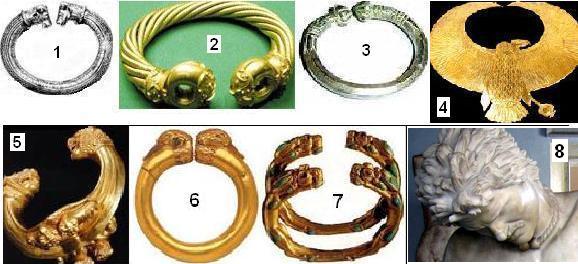
As you can see in the image to the above right, he wore and sometimes also held what is called a torque, the sacred necklace and bracelet of the Celtic gods and heroes. They were often made of bronze, silver and gold. One of the most famous statues in Rome was the dying Gaul whose naked chiseled physique had only one item adorning it, and that was the torc necklace show in image number 8 below. When the Emperor Augustus had made an alliance with the Celtic Gauls of France, he was presented by the Gauls with a gold torc weighing 100 pounds.
This sacred jewelry was more than just a decoration, it was an ancient healing device that also revealed the secret religious rites of the Celts that we can easily trace to the East. Many ancient statues and hieroglyphs that predate all these found in the West show various God and Kings wearing these necklaces, bracelets and were often accompanied by a rod. Source |
CERN – STILL CONNECTING DOTS END TIMES: SEAT OF SATAN – CERN – ROME’S RESURRECTION – GIANTS RETURN August 7, 2024 by Cynthia Whether you want to believe it or not, WE ARE LIVING IN THE END TIMES. God created this Earth with an expiration date… THANK HEAVEN!! What a merciful God we serve. There is evidence all over the world that … Click Here to Read More |

The Mysterious and Frightening WILDHUNT
The God of the Wild Hunt is often associated with figures like Odin in Norse mythology and Herne the Hunter in British folklore, symbolizing the connection between hunting, nature, and the supernatural.
The Wild Hunt in Mythology
Key Figures
-
Odin: In Norse mythology, Odin is frequently depicted as the leader of the Wild Hunt. He rides his eight-egged horse, Sleipnir, accompanied by a pack of wolves and ravens (crows). The hunt is often associated with winter and is seen as a harbinger of doom or a gathering of
fallen warriors (harvesting of souls).Odin (pronounced “OH-din”; Old Norse Óðinn, Old English and Old Saxon Woden, Old High German Wuotan, Wotan, or Wodan, Proto-Germanic *Woðanaz, “Master of Ecstasy”) He’s the ruler of the Aesir tribe of deities, yet he often ventures far from their kingdom, Asgard, on long, solitary wanderings throughout the cosmos on purely self-interested quests. He’s a relentless seeker after and giver of wisdom, but he has little regard for communal values such as justice, fairness, or respect for law and convention. He’s the divine patron of rulers, and also of outlaws. He’s a war-god, but also a poetry-god, and he has prominent “effeminate” qualities that would have brought unspeakable shame to any historical Viking warrior. He’s worshiped by those in search of prestige, honor, and nobility, yet he’s often cursed for being a fickle trickster
He maintains particularly close affiliations with the berserkers and other “warrior-shamans” whose fighting techniques and associated spiritual practices center around achieving a state of ecstatic unification with certain ferocious totem animals, usually wolves or bears, and, by extension, with Odin himself, the master of such beasts. Thus, as a war-god, Odin is principally concerned not with the reasons behind any given conflict or even its outcome, but rather with the raw, chaotic battle-frenzy (one of the primary manifestations of óðr) that permeates any such struggle.Odin presides over Valhalla, the most prestigious of the dwelling-places of the dead. After every battle, he and his helping-spirits, the valkyries (“choosers of the fallen”), comb the field and take their pick of half of the slain warriors to carry back to Valhalla. He was a frequent recipient of human sacrifice, especially of royalty, nobles, and enemy armies. This was generally accomplished by means of a spear, a noose, or both. His mastery of necromancy, the magical art of communicating with and raising the dead, is frequently noted. Source -
The Herne the Hunter character of English folklore is a bit more debatable of a myth. He’s a spirit exclusive to Windsor Park and is likely just a local interpretation of the horned god Cernunnos if even that. Herne too has horns, though he’s known for his rebel-rousing more than anything. He first appears in William Shakespeare’s The Merry Wives of Windsor (1597). From Elizabethan times onwards, Herne has had many identities. He has been considered everything from a forest keeper that once committed a terrible crime to a spiteful forest god. Whoever Herne the Hunter was, he was historically used as a boogeyman to keep children from romping in the woods. Apparently, he could even take the form of a huge stag!
Cultural Significance
In summary, the God of the Wild Hunt encompasses various deities across different cultures, each representing the primal connection to nature, hunting, and the supernatural. The legends surrounding these figures continue to resonate in modern interpretations of folklore and mythology.
Lludd Llaw Eraint – Wikipedia
Lludd Llaw Ereint (“Lludd of the Silver Hand”) son of Beli Mawr, is a legendary hero from Welsh mythology. As Nudd Llaw Ereint (the earlier form of his name, cognate of the Irish Nuada Airgetlám, derived from the pre-Roman Celtic god …
The name Nudd, cognate with the Irish Nuada and related to the Romano-British Nodens or Nodons worshiped at Lydney Park in Gloucestershire,[1] probably derives from a Celtic stem *noudont- or *noudent-, which J. R. R. Tolkien suggested was related to a Germanic root meaning “to catch, entrap (as a hunter)”, and together with the “silver hand” epithet detects “an echo of the ancient fame of the magic hand of Nodens the Catcher”.[3] Similarly, Julius Pokorny derives the name from a Proto-Indo-European root *neu-d- meaning “acquire, utilise, go fishing”.[4]
The name Nudd Llaw Ereint probably assimilated and shifted to Llud Llaw Ereint through alliteration, as suggested by John Rhys and later by Joseph Vendryes.[5][6]
The byname “Llaw Ereint” or “llawereint” is glossed as “of the Silver Hand” or “Silver-handed”.[5] Welsh eraint is listed as meaning “a round body; a ball; a bowl, a cup; a pear”, probably related to the adjective erain “abounding with impulse”, but ereint has been defined as “silver cup”, no doubt owing to Welsh arian “silver”.[7][8]Wikipedia text under CC-BY-SA license
spacer
Nodens
*Nodens, *Nodons or *Nudens (reconstructed from the dative Nodenti or Nodonti) is a Celtic healing god worshipped in Ancient Britain. Although no physical depiction of him has survived, votive plaques found in a shrine at Lydney Park (Gloucestershire) indicate his connection with dogs, a beast associated with healing symbolism in antiquity. The deity is known in only one other location, in Cockersand Moss (Lancashire). He was equated on most inscriptions with the Roman god Mars (as a healer rather than as a warrior) and associated in a curse with Silvanus (a hunting-god).[2][3] His name is cognate with that of later Celtic mythological figures, such as the Irish Nuada and the Welsh Nudd.[4][2][5]
The philologist and author J. R. R. Tolkien was invited to investigate the Latin inscription, and scholars have noted several likely influences on his Middle-earth fantasy writings, including the Elvish smith, maker of Rings of Power, Celebrimbor, whose name, like that of Nuada’s epithet Airgetlám, means ‘Silver-hand’. Nodens appears, too, in the works of Arthur Machen, as well as H. P. Lovecraft‘s Cthulhu Mythos.
Name and origin
The origin of the name remains obscure, scholar John Carey noting that “it seems at any rate safe to say that no etymology so far proposed can be accepted with full confidence”.[4] The Welsh noun nudd means ‘mist, haze, fog’, and both Lludd and Nuadu are attached to the epithet ‘[of the] silver hand/arm’, which could lead to a conjectural Proto-Celtic stem *snowdo- (‘mist, haze’), from Proto-Indo-European *snewdh– (‘mist, cloud’; cf. Latin nūbēs ‘clouds’),[4][5] perhaps also attested in the Irish snuad (‘appearance, colour’).[4] However, the sound shift sn– > n– does not seem to be attested elsewhere in Gaulish (although –sn– > –n– is known) and remains difficult to justify in Proto-Brittonic (the sound change should have occurred later than the inscriptions).[4] Scholars have also linked the Celtic names with the stem *néud- (cf. Gothic niutan ‘to catch, attain, acquire’ and nuta ‘catcher, fisherman’, Lithuanian naudà ‘property’), associating *Nowdont- with the fishing (and possibly hunting) motifs of the Lydney remains and with the silver arms of Nuadu and Lludd.[4][7] However, this stem remains unattested elsewhere in Celtic, and possibly takes its origins from a pre-Indo-European language.[4][10]
According to Arthur Bernard Cook (1906) the toponym “Lydney” derives from the Old English *Lydan-eġ, “Lludd‘s Island”, which could connect it with Nodens.[16]
Nodens is a Celtic healing god that was worshipped by the Celts of Britain. He is mostly known from the remains of a Romano-Celtic temple at Lydney Park in Gloucestershire. As well as being a healing god, Nodens seems to have had associations with the sea. This would not be unusual in Celtic religions, and divine sea imagery was also common at healing shrines in Gaul. The Romans seem to have compared him to Mars, who was principally a god of war but also had healing powers.
What’s in a Name?The name Nodens is derived from a Latin inscription at the shrine in Gloucestershire, but the Celtic etymology of the name is unclear. It may be related to the Welsh noun nudd, which means mist, haze, or fog. It could also be linked to the Celtic stem neud, which means to catch, attain, or acquire. It could also be linked to neued, which means need.
Nodens at Lydney Park While this evidence for the worship of Nodens comes from Romano-Celtic Britain, it is possible that Nodens was related to the Celtic-Irish god Nuada Airgetlam, the first king of their pantheon known as the Tuatha De Danann. He was an early king but was disqualified from the position after losing an arm. No longer hole, he could no longer rule. He was later restored to power after he was given a magically working silver arm. This earned him the epithet Airgetlam, which means silver arm. Source |
THE HUNT – NODENS – The First will be Last.This is a continuation of the series entitled “THE HUNT” I have been trying to get this series finished since the Wuhan VIrus was made public. Just so much going on. This post is primarily about one deity. It is important to dedicate a post to this guy with all that is going on right … Click Here to Read More |


SPACER
SPACER